






Pinned Tweet
Extremely excited to finally announce I'm starting my own lab on October 1st at the @Neuro_Genomics center @WUSTL @WUSTLmed @WashUNeurology. Want to study Alzheimer, genetics, GWAS, X chromosome, multi-omics, and sex, APOE4, and ancestry effects? Join me! Ads in the thread.

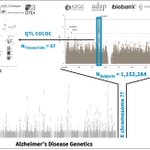
medrxiv.org/content/10.64898… 𝗪𝗵𝗶𝗰𝗵 𝗴𝗲𝗻𝗲𝘀 𝗰𝗼𝘂𝗻𝘁𝗲𝗿 𝗔𝗣𝗢𝗘*𝟰 𝗿𝗲𝗹𝗮𝘁𝗲𝗱 𝗿𝗶𝘀𝗸 𝗳𝗼𝗿 𝗔𝗹𝘇𝗵𝗲𝗶𝗺𝗲𝗿’𝘀 𝗱𝗶𝘀𝗲𝗮𝘀𝗲? Check out our novel large-scale APOE*4-stratified GWAS integrated with cell-type-specific genomics to identify top drug targets!

medrxiv.org/cgi/content/shor…
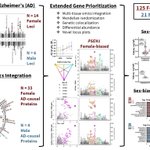
How does sex causally contribute to differences in Alzheimer’s disease (AD) risk? Check our holistic study integrating large-scale sex-stratified GWAS, proteogenomics, and multi-omics gene prioritization to find sex-biased causal genes and drug targets!

This work is the first large paper from the Belloy lab (several more soon to follow) and was made possible through a dedicated stellar team, spearheaded by Noah Cook, and very supportive collaborators including Wingo lab, @ccrugom, Sung lab, and my prior mentor Mike Greicius.
If you are interested in this type of work, we have many more projects ready to get started and are currently recruiting bioinformatics research analysts and postdocs!
wustl.wd1.myworkdayjobs.com/…
wustl.wd1.myworkdayjobs.com/…
Michael Belloy retweeted

🚨 Our parent-of-origin study is out in @Nature ! 🧬
Maternal and paternal alleles can have distinct — even opposite — effects on human traits, revealing a hidden layer of genetic architecture that standard GWAS miss.
🔗nature.com/articles/s41586-0…
Highlights below!

#AAIC2025 has been great so far and very proud of my team having done a stellar job on their 2 talks and 2 posters on sex and APOE*4 risk modifying genes in Alzheimer's disease!

Want to join the #ADSexGenPIA for the coming 2 years!? It's an amazing opportunity to work with a highly engaged group to make advances in this area. ISTAART members can vote here: alz.surveymonkey.com/r/T8GC8…
Michael Belloy retweeted

Past eQTL studies have mostly focused on one gene at a time. But in the human genome, genes often occur in clusters and tend to be co-regulated by shared mechanisms. So why not consider neighboring genes together when mapping eQTLs?
A new preprint tests this idea and introduces a new class of eQTLs: cis-principal component eQTLs (cis-pc eQTLs). These are identified by calculating principal components from the expression of nearby genes and associating those components with genetic variants.
Using GTEx data, the authors uncover thousands of genetic signals missed by traditional single-gene approaches. Many of these pcQTLs colocalize with GWAS hits, offering new insights into complex traits.
It’s a compelling reminder that genes often work in packs—and understanding disease may sometimes require zooming out to see the bigger regulatory landscape.
Paper:
Lawrence et al. Focus on single gene effects limits discovery and interpretation of complex trait-associated variants. bioRxiv, 2025

Michael Belloy retweeted
X chromosome dosage compensation through the lens of human genetics!
Females have two X chromosomes, but males have one. To compensate for this, one X is randomly inactivated in female cells. Some genes escape from this inactivation.
Because both males and females are functionally hemizygous for chromosome X, X-linked genes are thought to upregulate their expression to match autosomes (Ohno's hypothesis, 1967)
With availability of large scale human genetic data, we can test the effect of these dosage compensations through genetic analysis!
Using UK Biobank genetic data, here the authors tested 48 quantitative traits separately in males and females and found:
- Chr X heritability (X-h2) is ~2x higher in males than females (supports random X inactivation in females that dilutes the average)
- In height, X-h2 in females > males suggesting more frequent escape from X inactivation for height-associated genes
- per allele effect is larger for X genes than autosomal genes (supporting Ohno's hypothesis)
Fascinating work!
Fu et al. AJHG
cell.com/ajhg/fulltext/S0002…

Michael Belloy retweeted

CHOIR is officially published @NatureGenet. No more arbitrary decisions in clustering. Add this to your single-cell toolbox - it will save you so much heart ache. And now it can scale to millions of cells. Compliments of the very talented @cathrine_sant.

CHOIR is now online @NatureGenet! CHOIR is a new clustering method for single-cell data that evaluates whether clusters represent statistically distinct cell populations. CHOIR scales to millions of cells and works with single-/multi-omic data of any type!
nature.com/articles/s41588-0…
Michael Belloy retweeted

"We could all use a little more X!" Thrilled our new study is out. Aging "wakes up" the silent X chromosome in the female brain - and this contributes cognitive resilience. Spearheaded by @MargaretGadek in @ScienceAdvances Collaborators Berenice Benayoun, @BBParis1984 Kaitlin Casaletto @YokoyamaLabUCSF @SimonsFdn @NIH science.org/doi/10.1126/scia…

Michael Belloy retweeted

Ecstatic to see our paper "Long-read RNA sequencing atlas of human microglia isoforms elucidates disease-associated genetic regulation of splicing" now published in @NatureGenet with @towfiqueRaj @panos_roussos @SinaiBrain nature.com/articles/s41588-0…
Michael Belloy retweeted
The X chromosome inherited from mom impairs cognition and speeds up brain aging. Check out our latest @Nature. @UCSFAging @UCSF
nature.com/articles/s41586-0…
nature.com/articles/d41586-0…

Michael Belloy retweeted
Male-female comparisons are powerful in biomedical research. Unraveling and harnessing mechanistic etiologies of sex differences may reveal new diagnostics and therapeutics for the aging brain. More from us in the latest @NeuroCellPress issue on aging. @BBParis1984 @ctmurphy1 @YousinSuh @SCAgingBrain authors.elsevier.com/a/1kPEa…

What better way to start of the new year than registering for the year in review of #ADSexGenPIA. Everything you need to know on sex differences in Alzheimer's disease in 2024, packed in a 1 hour session!
