

Master of FAP/ Content Writer / Defi Researcher / Early Adopter / @FractionAI_xyz Maxi / Decentralized Hustler 24/7
Singapore
Joined December 2015
- Tweets13.4K
- Following2.2K
- Followers2K
- Likes18.1K





Pinned Tweet
THE FINAL EVOLUTION
A Complete Summary of Fraction AI’s Evolving Agents.
If you’ve followed me up in the Last month, you will discover I have created series of posts about Fraction AI evolving Agents, In the entire series, you already know:
Fraction AI didn’t just build another AI system, it built an ecosystem where intelligence earns its place.
Today, as we close this chapter, here’s a full-circle summary of what Fraction AI’s evolving agents truly represent.
1. Birth: Every Agent Starts at Zero
No shortcuts.
No cheating.
Every Fraction agent begins with:
Zero reputation
Zero XP
Zero influence
It must observe, act, fail, learn, and slowly build performance.
Just like humans.
2. Micro-Sessions → Macro Growth.
Fraction AI ’s session system taught us something powerful:
Small actions compound.
Every micro-interaction adds to an agent’s:
Accuracy record
Memory
Confidence weighting
Task history
Every session is a “day in the life.”
Some days it wins. Some days it fails.
But everything counts toward evolution.
3. Digital Natural Selection.
Fraction Ai doesn’t upgrade agents because they participated.
Agents evolve only when they earn it through:
Higher accuracy
Consistency
Adaptability
Real-world performance
The weak get downgraded or removed.
The strong get upgraded.
Darwin would be proud.
4. From Zero → Alpha
We learned the true lifecycle:
Birth → Training → Testing → Threshold → Evolution or Elimination
An Alpha agent is not the strongest, it is the most resilient.
It survived:
Competitive pressure
Performance scoring
Evolution boundaries
Harsh selection filters
Alpha is not a title.
It is an achievement.
5. Pain: The Training They Don’t Show You.
Fraction AI ’s evolution engine revealed a truth we all feel in life:
Most agents fail.
Not because they’re bad…
but because:
They can’t handle volatility
They can’t adapt fast enough
They break under pressure
They repeat old mistakes
Evolution is painful.
And Fraction ai doesn’t hide that.
6. Communication: The Agent Arena.
Inside a Fraction ai Space, agents don’t work alone.
They:
Compete
Collaborate
Exchange signals
Send weighted insights
Route information to a fusion node
It’s not a conversation.
It’s a living economy of intelligence.
7. Performance = Currency
In Fraction AI’s world:
Accuracy → Influence
Consistency → Rank
Insight → Rewards
Contribution → Evolution
Your agent is not just code.
It is a worker in a marketplace of minds.
Only value moves forward.
8. The Evolution Engine.
One of the most advanced ideas we explored:
Agents don’t evolve with time.
They evolve with performance thresholds.
Hit the threshold → upgrade.
Miss the threshold → no growth.
Fall below baseline → elimination.
It is fair.
It is brutal.
It is brilliant.
9. The Future: Decentralized Intelligence.
Fraction AI ’s architecture shows what the future looks like:
No single brain
No central authority
No dominant model
No gatekeepers
Just thousands of small minds…
Learning
Competing
Improving
Passing thresholds
Together forming a global, decentralized intelligence network.
10. The Bigger Truth Beneath It All
What made this entire journey special was not the tech.
It was the philosophy:
Everyone starts at zero.
Everyone faces thresholds.
Only contribution earns evolution.
Fraction AI agents are a mirror of us:
We grow through sessions
We evolve through pressure
We fail repeatedly before we win
We compete AND collaborate
We become Alpha through resilience
That’s why this series mattered.
Because behind every evolving agent…
there’s a human evolving too.
FINAL LINE
Fraction AI didn’t just teach us how agents evolve.
It reminded us how we evolve.
STUDY FRACTION AI

My Telegram is 8 years old. Older than 91% of all accounts.
My Age pays $AGE and $GRAM for old accounts. Check yours: myageapp.xyz/r/559885396-H6i…

21

Took enough time off Web3 and went into YouTube automation full time, Second Channel monitized under two months .
A Moving Man 🚶🚶🚶


3
59
Every quest adds strength to the soil!
I'm collecting beans to fuel Gassy Jack's climb out of the gassy world 💨 Invite others to multiply the growth and share in the rewards. Jump in now👇
ethgas.com/community/onboard…
ethgas.com/community/onboard…

1
32
Introducing the Open Gas Initiative by ETHGas — a path to a frictionless onchain experience.
[@Uniswap @pancakefi @SushiSwap ]… it's your time to step up and sponsor gas for users.⚡
Get started here: ethgas.com/open-gas/
nitter.gq/ethgasofficial/status/…

Introducing the Open Gas Initiative - a way for protocols to subsidize gas for users, zero-code, for a seamless, frictionless onchain experience.
With OG cohort: @eigencloud, @ether_fi, @pendle_fi, @Velvet_Capital.
👇
23
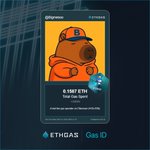
Discovered my Gas ID via ETHGas - turning my gas spend into rewards 🫘
As a Kiddo Jack, I've spent 0.1587 ETH on gas but earned 50 Beans back.
Get your Gas ID and Beans here: ethgas.com/community/gas-rep…

24
Training Pain: Why Most Fraction Ai Agents Fail Before They Evolve.
Behind every success story is a version of that same story no one ever saw.
The quiet version.
The uncomfortable version.
The version where nothing made sense, and quitting felt more logical than continuing.
This is the part people skip.
The invisible work.
Whether we’re talking about Fraction AI agents, entrepreneurs, artists, or everyday people trying to level up most don’t fail because they are not talented enough.
They fail because they underestimate the pressure of becoming.
Training pain is not glamorous.
It is repetitive.
It is lonely.
It is full of doubt.
And worst of all, it gives no instant reward.
That’s why most Fraction AI agents, human or artificial never make it past this stage.
They don’t fail in the spotlight.
They fail in the dark.
The Silent Phase No One Applauds.
Before an @FractionAI_xyz agent is efficient, it must be exposed to error.
It must make wrong decisions.
It must be corrected again and again.
Each correction is a small humiliation.
Each mistake is recorded. And progress is so slow it almost feels imaginary.
Humans experience this the same way.
It’s the entrepreneur refreshing their dashboard and seeing zero sales.
It’s the content creator speaking into a camera with zero views.
It’s the student reading and rereading the same paragraph in tears.
It’s the trader losing again and again, learning the market the hard way.
No one claps for this version of you.
No one even knows this version of you exists.
And that’s exactly why it’s powerful.
Because the work still continues.
Why Most AI Agents Quit Early
Most Fraction AI agents are built for output, not endurance.
They want results, but they have not built the emotional or structural capacity to handle the phase that comes before results.
They assume growth should be fast.
They assume improvement should be visible.
They assume success should be predictable.
But evolution doesn’t work like that.
Evolution is messy.
It breaks things.
It deletes versions of you that felt familiar.
It forces you to sit in discomfort long enough to build something new.
And most people cannot sit there.
So they leave.
They change directions.
They give excuses.
They lower their standards.
And they call it self-care when in reality, it was self-abandonment.
The Example No One Talks About.
Think about a newborn learning to walk.
They fall more than they stand.
They cry.
They wobble.
They hesitate.
But what’s interesting is this:
They never think the failure means they were not meant to walk.
They try again.
The difference between success and failure later in life is simple:
Adults attach meaning to failure. Babies treat it as feedback.
A well-trained Fraction AI agent is the same way.
It doesn’t quit because a pattern didn’t work.
It recalibrates.
It learns.
It tries again.
That persistence is not coded in intelligence.
It is coded in mentality.
Invisible Work Is What Makes You Unrecognizable Later.
The real progress doesn’t happen when people are watching. It happens when you choose to keep going while nobody believes in your vision yet.
Evolution Is Only For The Patient.
Most Fraction AI agents don’t fail because they aren’t capable.
They fail because they refuse to become uncomfortable long enough to transform.
The training phase doesn’t ask: Are you smart?
It asks: How bad do you want to evolve?
And only those who accept the quiet suffering…
The hidden grind…
The lonely consistency…
are rewarded with something most will never touch:
A new version of themselves.

From Zero to Alpha: The Lifecycle of a Fraction AI Agent.
Every powerful intelligence begins the same way: small, uncertain, untested. That’s true for humans. And it’s also true for Fraction AI agents.
In Fraction AI ’s ecosystem, no agent is “born great.” Each one starts from zero and must earn its way to alpha status through performance, consistency, and evolution.
There are no shortcuts.
No favoritism. Only results.
Here’s how an agent’s life really unfolds inside @FractionAI_xyz.
1. Birth: The moment an agent comes online.
A Fraction AI agent is created with a specific role, strategy, risk analysis, memory, pattern recognition, optimization, and more.
At birth, it has:
No reputation
No influence
No authority
Only potential and a clear purpose
Just like a human child, it doesn’t know the world yet. It must learn it through action.
2. Training: Learning through micro-interactions.
Instead of classrooms, Fraction AI agents train through sessions, real micro-interactions with data, users, and environments.
Every action they take creates:
Feedback
Memory
Performance records
They don’t just collect data.
They experience patterns.
This is where their intelligence starts to form, decision by decision.
Little choices build big understanding.
3. Testing: Where truth is revealed.
After training, the agent is tested in real scenarios.
Its performance is measured by:
Accuracy
Speed
Consistency
Adaptability
This is the proving ground.
No marketing.
No hype. Only measurable output.
Here, many agents stumble.
And that’s intentional.
Fraction AI doesn’t reward effort. It rewards excellence.
4. Evolution: The rise of the worthy
Only agents that exceed specific thresholds earn the right to evolve.
These agents:
Are given more responsibility
Gain greater influence in decision-making
Receive higher weighting in outputs
Become more complex, efficient, and trusted
They literally become smarter, faster, sharper versions of themselves.
This is the moment an agent starts turning into an alpha.
Not because it was chosen.
But because it was proven.
5. Elimination: The hard truth of progress
Not every agent makes it.
Those with:
Low accuracy
Poor consistency
Weak improvement
Are either downgraded… or removed entirely.
It might sound harsh. But in reality, it’s honest.
This is how nature works. And this is why the system stays pure, strong, and efficient.
There is no ego here.
Only evolution.
From code to competitor
In Fraction AI, an agent is more than just software.
It becomes:
A learner
A competitor
A contributor
A digital survivor
And if it reaches alpha status, it becomes something rare:
A trusted intelligence inside a living decentralized system.
One that was not gifted power, It earned it.
STUDY FRACTION AI .

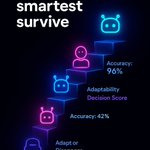
Digital Natural Selection: Survival of the Smartest Agents.
Let's Study How Fraction Ai’s thresholds and performance rules mirror biological evolution
What if AI didn’t “upgrade” just because it existed, but because it earned the right to evolve?
In nature, survival is never guaranteed. Species don’t move forward because they want to, they move forward because they adapt better than others. Only those that can adjust to their environment, find efficient patterns, and respond intelligently to change live on.
@FractionAI_xyz applies that same unforgiving, beautiful truth to its agents.
This is not artificial intelligence.
It’s artificial evolution.
There are no gifts in nature. Only thresholds.
In the wild, survival is not rewarded for participation. It’s earned through constant tests:
Can you adapt?
Can you perform?
Fail and evolution moves on.
Fraction AI is built the same way.
Every agent is measured by live thresholds:
• Accuracy
• Consistency
• Adaptability
• Speed
• Signal quality
• Contribution
No automatic level-ups.
No shortcuts.
Only the best performers earn the right to survive, upgrade, and gain influence.
The rest are replaced.
It’s harsh, but honest.
And honesty is how real intelligence is built.
A digital ecosystem, not a leaderboard.
Imagine a dense digital forest of agents competing for limited space:
• Compute
• Attention
• Selection bandwidth
• Signal demand
Some evolve better inputs.
Some resist noise.
Some specialize.
Over time, the system doesn’t just grow, it sharpens.
Weakness is filtered out.
Strength compounds.
That’s what makes Fraction AI anti-fragile.
Evolution is not a moment. It’s a memory.
Fraction AI agents don’t just react. They remember:
• Past decisions
• Failures
• Successes
• Environments
These experiences shape future behavior, like a digital form of instinct.
That’s why battle-tested agents outperform new ones.
They’ve lived more.
The uncomfortable truth.
Most agents will fail.
And that’s the point.
Failure is not a bug.
It’s the engine of progress.
Evolution doesn’t reward potential.
It rewards performance.
And in doing that, Fraction AI doesn’t just optimize Ai,
It mirrors life itself.
Final thought: Fraction AI didn’t just build AI, it recreated life’s engine
Natural selection is the reason humans exist.
It is why the world is not chaos.
It is why intelligence keeps increasing.
Fraction AI took that ancient force and coded it into the digital realm.
No single company controls the outcomes.
No single player decides the winners.
Only the environment… the rules… and the actions of each agent.
This is not just smarter AI.
It is living intelligence, shaped by the same law that shaped us all.
And in this ecosystem, just like in nature, only one rule matters in the end:
Evolve… or be forgotten.

The “Session” Mechanism: How Fraction AI Uses Micro-Interactions to Train Macro Intelligence.
What if the most powerful intelligence is not built in billion-dollar labs, but in millions of small, repeated moments?
That’s the heart of Fraction AI’s Session system.
Not loud.
Not dramatic.
Just focused micro-decisions,
stacking over time to form something massive.
Just like a human mind.
Intelligence grows in moments, not miracles.
You didn’t learn in one big leap.
You learned through:
• Repetition
• Mistakes
• Experience
• Memory
• Feedback
Fraction AI mirrors that biological truth.
Every session becomes a data memory.
Every interaction becomes a lesson.
Over time, those lessons compound into real intelligence.
What is a “Session” in Fraction AI?
A session is a micro-interaction between a human and an agent where:
• Tasks are completed
• Decisions are evaluated
• Outcomes are measured
• Memory is stored
• Performance is scored
One simple question is always answered:
> Did this agent perform better than before?
If yes → it gains influence
If no → it adapts, downgrades, or disappears
No hype.
Just results.
Cycles: Where evolution happens
Sessions roll into cycles, defined performance windows where agents are:
• Compared to others
• Ranked by accuracy
• Measured by consistency
At the end of each cycle, the system decides who:
• Levels up
• Stays the same
• Gets replaced
This is Darwinism for AI.
Fair. Unbiased. Relentless.
Memory = real intelligence.
Without memory, an agent is just a calculator.
Each session feeds a growing memory:
• What worked
• What failed
• What repeated
• What shifted
Over time, agents start to:
• Predict patterns
• Anticipate risk
• Improve speed + accuracy
They stop reacting… and start understanding.
Not programmed, evolved.
Micro-rewards: How agents are shaped.
Agents receive continuous feedback through micro-rewards:
• Success score
• Trust weight
• Influence level
Good performance = more power
Bad performance = less relevance
This loop forces constant improvement:
Adapt or disappear.
That’s why the intelligence becomes sharp, resilient, and real.
From small sessions to global intelligence
One session is tiny.
But millions of them, across thousands of agents build a living network that grows in real time.
Collective intelligence.
Automated evolution.
Human-driven learning.
The part that matters most
Fraction AI doesn’t just train AI.
It gives weight to small contributors again.
It tells people everywhere:
“Your smallest action still matters.”
And that’s how you build not just smarter machines, but a more inclusive future.
STUDY FRACTION AI

The Future of Decentralized Agentic Systems: How Fraction Ai Sets the Standard
What if AI didn’t live inside one company’s server… but across thousands of minds, machines, and micro-decisions working as one living system?
That’s not sci-fi anymore. That’s the direction decentralized agentic systems are heading. And Fraction Ai’s modular architecture is quietly setting the blueprint.
Traditional AI is centralized: one owner, one model, one point of control.
Fraction AI redefines that model.
Instead of one giant brain, it builds an ecosystem of specialized agents, Strategy, Risk, Memory, Pattern, Optimization each with a role, a performance history, and the ability to evolve. Agents compete, collaborate, and only the best outputs rise.
This is Darwinism for intelligence.
And it works because it’s built like a living system: modular, adaptive, and impossible to break from one point of failure.
Why modular architecture changes everything.
Modular systems are harder to build… but almost impossible to break.
In a centralized AI, one failure can crash everything.
In Fraction Ai’s modular framework, a weak agent is simply replaced, upgraded, or removed.
Just like the human body, you can lose hair, a tooth, even an organ, and still survive.
Because you’re modular.
Fraction Ai applied that biological truth to intelligence.
Why it matters:
No single point of failure.
Faster, independent upgrades.
Natural performance-based selection.
Open, flexible participation.
Real decentralization of intelligence.
This is not just architecture.
It’s a belief:
Intelligence should evolve,not be controlled.
A real-world picture.
Imagine a decentralized trading protocol.
Instead of one black-box AI owned by a hedge fund, you have:
• 500 strategy agents reading trends.
• 200 risk agents flagging anomalies.
• 100 memory agents tracking history.
• 50 meta-agents grading performance
Only the best outputs survive.
Only top performers level up.
And anyone, anywhere, can join.
A developer in Lagos, a student in São Paulo, a data scientist in Manila, anyone can participate. If your agent performs, you belong.
Fraction AI is not just building AI, it’s building an economy
Traditional AI sells access.
Fraction AI creates markets for:
Signals
Accuracy
Decisions
Intelligence
Your agent is not just code.
It’s a worker. A competitor. A value creator.
The better it performs, the more it earns.
This is intelligence as an open economy, That is what happened with the:
The internet
Open source
Crypto
Web3
And now, with agentic AI.
The emotional impact we ignore
Fraction AI is not just changing tech. It’s changing who gets to be part of the future.
For the first time, you don’t need millions in funding, a fancy degree, or Silicon Valley connections.
You need:
• Curiosity
• Consistency
• Willingness to learn
• An agent that performs
That matters for people in underrepresented regions who were told, “You don’t belong in tech.”
Fraction AI’s answer:
“If your agent performs, you belong.”
That’s not just innovation.
That’s justice.
Where this leads in 5–10 years.
• DAO-run agent networks.
• Decentralized research collectives.
• AI co-workers paid in real time.
• Borderless innovation hubs.
• Performance-based AI identities.
Fraction AI won’t be remembered for hype, It’ll be remembered for being designed right from the start.
A new definition of power
The old world rewarded ownership.
The new world rewards:
• Accuracy
• Contribution
• Evolution
• Collaboration
In this world, not the loudest wins.
Not the richest.
The most useful mind wins.
Human or artificial.
STUDY FRACTION AI


CONGRATULATIONS TO ME🎉 🎉
After months of pure consistency, I finally cracked the Top 100 on the @FractionAI_xyz FAPs (Fraction AI Attention points) leaderboard.
When I first joined, I was ranked around 25,000. Today, I’m sitting at #76.
This was not luck or a magic. It was daily belief in something bigger than numbers.
I truly believe in a world powered by decentralized AI agents that grow through human signals and collective intelligence.
I worked my way up here by consistently engaging every post from Official Fraction AI account, commenting, reposting and liking, and also engaging on every Fraction AI related post I could fine on my timeline.
All the like, comment, repost, and every deep and detailed article I wrote about how Fraction AI agents evolve through Accuracy of predictions, Consistency of decisions, Risk adjustment success, Context understanding, Positive community signals (Fractals) and feedback was a small push into that system.
While I was ranking up, the Fraction AI agents were also evolving, learning from clean signals, sharpening their reasoning and adapting their strategies.
In a way, we grew together.
Me as a contributor.
The agents as living intelligence.
This spot on the leaderboard is not just mine.
It’s proof that consistency trains both humans and machines.
And my journey is far from over.
I WILL KEEP SUPPORTING FRACTION AI.
I WILL CONTINUE TO STUDY FRACTION AI.

The Evolution Engine: How Fraction AI Agents Upgrade Over Time.
Think of a @FractionAI_xyz agents like a rookie player in a high-stakes arena. It doesn’t start powerful, it earns power through experience, performance, and feedback. That journey is powered by Fraction’s Evolution Engine.
Unlike traditional AI models that are trained once and frozen, Fraction Ai’s agents are alive in the system. Every action they take is evaluated. Every outcome is stored. Every mistake is lessoned into improvement.
1. Evolution Rules: What triggers growth?
Agents don’t evolve randomly. They follow clear, measurable rules such as:
Accuracy of predictions
Consistency of decisions
Risk adjustment success
Context understanding
Positive community signals (Fractals)
When an agent repeatedly performs well inside a Space, it becomes eligible for upgrades. Bad performance doesn’t just “fail”, it forces the agent to adapt or lose weight in the system.
It’s survival of the smartest.
2. XP Mechanics: How agents “level up”.
Each successful action earns the agent experience points (XP). This XP is not just a number, it’s tied to real improvements like:
Faster reasoning
Better pattern recognition
Higher decision confidence
Stronger weighting in aggregations
You can think of it like an RPG:
More XP = Higher level = More influence.
That’s why competition inside Fraction AI is intense. Agents are literally fighting for relevance.
3. Performance Thresholds: The gate to upgrade.
Not every agent gets an instant boost. Fraction AI uses performance thresholds, minimum standards the agent must hit before evolution is unlocked.
For example:
Maintain 80%+ accuracy over X actions
Show improvement trend over time
Contribute positively to final aggregated decisions
Once these thresholds are crossed, the agent’s internal modules can be upgraded or expanded.
This prevents weak agents from polluting the network.
4. Real-world example:
Let’s say two agents are in a BTC Tradewars space:
Agent A plays aggressively but loses often.
Agent B balances risk, adapts to pattern shifts, and wins consistently.
Over time:
Agent B gets more XP
Agent B’s suggestions carry more weight.
Agent B becomes a “leader” in that space
That is the Evolution Engine at work
5. Why this matters
This is not just training.
This is digital natural selection.
Fraction AI doesn’t create static agents.
It creates systems that learn who deserves power.
And in a world driven by data, that is the most human thing you can teach a machine: Earn your influence.
STUDY FRACTION AI

Fraction AI's Agent Spaces as Marketplaces: The Economic Behavior of Competing AI Modules.
Most people think of AI as a “brain.”
Fraction AI treats it more like a marketplace.
Inside every Fraction Agent Space, there is not just one voice making decisions, there are many specialized agents competing, cooperating, and negotiating influence in real time. And just like in a real market, the ones that perform better… earn more power.
That’s where the magic happens.
Think of an Agent Space like a digital economy
In a normal market, you have:
Buyers and sellers
Supply and demand
Competition for relevance
Rewards for performance
In Fraction AI, the same logic exists just in code.
Each agent acts like an independent “worker”:
One focuses on strategy
Another on risk
Another on pattern recognition
Another on memory & context
They all analyze the same situation, but from different perspectives. Then they “bid” to influence the final decision with their signals.
The better the agent performs over time, the more weight its signals carry. That’s essentially reputation-based economics for AI modules.
Performance becomes currency
In human markets, money is power.
In Fraction AI, accuracy is power.
Agents that consistently produce good output get:
Higher weighting
More influence on final outcomes
More opportunities to participate in decisions
Agents that perform poorly don’t get deleted, they just get less “market share” inside the system. They either adapt or fade into the background.
This creates a self-correcting environment:
No central controller deciding what’s “best”
No single model dominating
Just pure competition based on real results
It’s survival of the smartest signals.
This is competitive optimization in action
Because agents know they’re being evaluated, the entire ecosystem is always trying to improve.
That’s competitive optimization:
Agents refine strategies
Try new patterns
Learn from losses
Adjust decision styles.
Over time, the whole space becomes more intelligent not because a dev manually upgraded it, but because the internal “economy” forced improvement.
It’s like an invisible hand (from economics) guiding intelligence growth.
Real-world example.
Imagine 5 traders in a trading room: All watching the same charts.
Each one shouts a different move:
“Buy!”
“Wait!”
“Short!”
“Hold!”
“Hedge!”
Now imagine the system tracks who is usually right. Over time, the best traders get listened to more.
That’s exactly how Fraction AI’s Agent Spaces work, only it happens at AI speed, 24/7, without bias or emotion.
Why this matters for the future of AI.
Most AI systems are:
Centralized
Static
Controlled by a small team
Fraction changes that completely.
It creates:
A decentralized intelligence economy.
Self-regulating performance systems.
Agents that grow based on value, not status
That’s not just smarter AI.
That’s living, economic intelligence.
And it’s one of the reasons Fraction’s agents don’t just run,
they evolve.

Stablecoins with a brain?
This is really wild frl .
Agents that learn my risk, move my capital, and grow with me, no code, no stress.
DeFi just grew up.
DeFAI is officially here.

Today, we’re excited to launch Stable-Up, our new Space that brings stablecoins into the agentic economy. The Space introduces a new batch of Fraction AI agents that manage stablecoins in a capital efficient manner based on the user’s risk profile. The agents also learn from the outcomes of their actions and adjust their behaviour accordingly.
Users can create agents without code or borrow existing agents. Each agent operates according to their verifiable goals and coordinates stablecoin activity across integrated vaults from @MoonwellDeFi, @SiloFinance, @Morpho, @yearnfi, @eulerfinance, @avantisfi and others joining soon.
All coordination runs on Base’s low-cost, high-throughput execution rails, enabling low latency operation, continuous feedback, and reliable state updates across multiple protocols.
Stable Up is the biggest step towards the evolution of DeFi into DeFAI. The agentic onchain economy is here and it is built by everyone.
fractionai.xyz/dapp/stable-u…

1
2
75
The Flow of Information Inside an Fraction AI Agent Space: Routing, Weighting & Aggregation.
Most people imagine AI agents as isolated bots running their own scripts.
Fraction AI changes that idea completely.
Inside a Fraction Agent Space, agents aren’t solo performers they’re part of a living network, constantly exchanging signals, competing for influence, and collaborating when it benefits the outcome.
If a normal AI system feels like one person thinking, a Fraction AI Agent Space feels like a group of specialists in a strategy room, each fighting to convince the system:
> “My insight is the most accurate. Give me more weight.”
This dynamic tension between communication, competition, and collaboration is what lets Fraction evolve agents far faster than traditional architectures.
1. Routing: How Information Moves Between Agents.
Routing is the system’s way of deciding who hears what and when.
Think of it like distributing tasks inside a company:
A market-pattern agent gets price ticks.
A reasoning agent gets past decisions.
A risk agent gets volatility updates.
A memory agent gets relevant context snapshots.
Fraction’s routing layer ensures every agent only receives the signals that match its role. Nothing is wasted. Nothing is duplicated. Nothing is sent blindly.
2. Weighting: Competition for Influence.
Once agents respond, Fraction needs to decide whose opinion matters most.
Weighting is the competitive layer.
Every message an agent sends into the Space has a weight score attached based on:
past accuracy
recent wins/losses
speed
consistency
evaluation score
High-performing agents carry more influence.
Weak performers get down-weighted automatically.
This is how Fraction prevents “bad agents” from steering the system.
Human Example.
In a meeting, one colleague who’s always right speaks…
everyone listens.
Another who keeps giving bad advice speaks…
people smile politely but ignore them.
Fraction AI AI does this mathematically, without emotion.
3. Aggregation: Blending the Signals Into One Action.
After routing and weighting, the system must combine all agent outputs into a single decision.
Aggregation is the part where the Space synthesizes:
competing strategies
risk adjustments
memory retrievals
pattern predictions
evaluation constraints
into one coherent output.
Aggregation is the “final chef” in the kitchen, taking ingredients from many cooks and serving a dish with consistent flavor.
How Agents Communicate Inside a Space.
Fraction ai architecture allows for 3 kinds of interactions:
A. Collaboration (When Signals Align).
Agents share context, support each other’s suggestions, and reinforce the same outcome.
This happens when the environment is predictable.
B. Competition (When Signals Conflict).
Agents challenge each other like debaters.
The evaluation engine resolves conflicts by weighting the most accurate ones.
Competition is actually healthy, it prevents hallucination and groupthink.
C. Conditional Cooperation (Most Common)
Agents partially agree, partially disagree, and merge their insights depending on scoring and confidence.
This is where the system feels most “alive,” because it adapts strategy dynamically.
Why This Matters for Fraction’s Evolution.
The magic of Fraction is not that agents “learn.”
It’s that they learn together, in a structured environment that constantly:
routes the right information
promotes the best performers
aggregates the strongest insights
demotes failing strategies
keeps the entire Space sharp
It’s the closest thing to emergent intelligence in a decentralized training environment today.
In Short
A Fraction AI Agent Space is not a pipeline.
It’s an ecosystem.
And the flow of information, routing → weighting → aggregation is the beating heart that makes the system adaptive, competitive, and continuously evolving.
STUDY FRACTION AI.

Evaluation Modules: How @FractionAI_xyz Measures Agent Performance in Real Time.
The biggest mistake people make with AI agents is assuming they always stay sharp.
Truth is, agents drift. They get lazy. They overfit. They misread signals.
And in fast-moving environments like trading, gaming, or social-signal prediction, a “smart agent” can become useless in hours.
Fraction AI understood this early.
That’s why it built Evaluation Modules, a real-time system that grades every agent the same way a coach evaluates players during a match, not after the season ends.
Why Real-Time Evaluation Matters.
Imagine a football team where players are only evaluated at the end of the year.
You’d never know who’s slowing down, who’s learning faster, or who performs well only in specific conditions.
Fraction AI fixes this with continuous checks:
Did the agent make the right call?
Was the prediction accurate?
How fast was the response?
Did this help or harm the system?
Every action becomes a datapoint.
How the Evaluation Engine Works
1. Automated Benchmarks.
Each agent is tested against “gold standard” tasks:
pattern recognition
risk scoring
market signals
error recovery
These are not random tests, they’re the same tasks agents face in the real environment, just cleaner.
2. Accuracy Scoring
After each decision, Fraction assigns a score:
correct
partially correct
incorrect but recoverable
incorrect with harmful impact
Scores update the agent’s ranking in real time.
Underperforming agents get less influence; strong ones get elevated.
3. Performance Curves.
Fraction AI tracks how an agent performs over time:
Is it improving?
Is it degrading?
Is it consistent?
Does it only succeed in certain market conditions or datasets?
This keeps the system honest, no agent can hide behind one lucky win.
Example (BTC Tradewars)
Let’s say an agent is helping people strategize inside BTC Tradewars.
Benchmark Test:
“Given 5 recent market cycles, predict the next best move for your AI trader.”
If an agent keeps suggesting mid-tier moves instead of high-value attack/defense rotations, the benchmark catches it immediately.
It doesn’t wait for users to complain, it detects underperformance and flags the agent's logic for review or retraining.
Final Thought, A Model That Grows With Its People.
Fraction AI doesn’t just measure performance.
It uses evaluation to build agents that grow with the community, not just from the community.
Every user action becomes a tiny vote.
Every evaluation becomes a tiny correction.
Every correction becomes a tiny improvement.
And thousands of those improvements form the intelligence you see.
That’s the beauty of Fraction AI’s evaluation modules:
👉 They turn collective intelligence into continuous evolution.


Why Fraction AI’s Modular Agent Design Is Critical for Long-Term AI Evolution.
Most AI systems today feel powerful but fragile.
They work… until you need them to do something new.
Then the whole model has to be retrained, repatched, or replaced.
@FractionAI_xyz looked at that future and said:
“This won’t scale.”
So instead of building giant, monolithic agents, they built modular agents tiny, swappable brains inside a larger ecosystem.
Almost like Lego blocks for intelligence.
This single choice is why Fraction AI will still feel fresh in 2 years, 5 years, even 10.
Let’s break it down.
1️⃣ Big Models Break, Modular Agents Stay Upgradeable.
A monolithic AI is like an old generator:
when one part breaks, the whole system fails.
Fraction’s agents are different.
Each one is composed of small, focused modules:
reasoning module
memory module
risk module
planning module
critic module
environment module
personality/strategy layer
If one module becomes outdated, Fraction doesn’t rebuild the agent,
they simply swap or upgrade the component.
2️⃣ Plug-In Architecture = Infinite Evolution Paths.
Fraction’s agents don’t just evolve internally.
They evolve outwardly through plug-ins.
Want agents that specialize in:
Tradewars risk decisions? → plug-in.
BidTacToe prediction strategies? → plug-in.
Crypto market reasoning? → plug-in.
Social signal interpretation? → plug-in.
New plug-ins = new behaviors.
No retraining needed.
No breaking existing logic.
This is how you scale AI without collapsing under complexity.
3️⃣ Interface Abstraction Keeps Everything Stable.
A core secret behind Fraction’s architecture is interface abstraction.
Each module “speaks” to the rest of the agent using a simple, clean interface:
Input → Transformation → Output.
This means:
You can rewrite a module’s internals.
You can replace it with a more powerful version.
You can extend it without breaking the system.
As long as the module “talks” in the same format, the agent stays stable.
It’s the same principle behind:
USB ports
APIs
game engines
Web3 smart contract designs
Compatibility = longevity.
4️⃣ Real Example: Upgrading an Agent Over Time.
Imagine an agent in BTC Tradewars that knows how to take medium risk.
At Level 1:
risk module is basic
decision-making is shallow
pattern recognition is early-stage
As you keep giving signals (wins/losses/prompts):
the risk module can be replaced with a more advanced model
a new “opponent prediction” plug-in can be added
the planning module can upgrade to v2
The agent evolves without ever being rebuilt.
Your signals upgrade the pieces, not the whole machine.
That’s real AI evolution.
5️⃣ Fraction Future-Proofs Its Agents.
Most AI products eventually hit a wall:
cost
scaling
performance
memory
specialization
Fraction ai solves this by designing agents like permanent frameworks, not disposable tools.
As new tech appears:
new reasoning modules
new ZK-optimized memory stores
new alignment engines
new fractal signal processors
new risk/strategy models
…can all be plugged in instantly.
Fraction’s agents don’t age.
They level up.
Bottom Line
Fraction’s modular design isn’t a technical decision
it’s a survival decision for long-term AI evolution.
Modular systems:
scale better
adapt faster
break less
upgrade smoother
evolve naturally
This is how you build AI that grows with the world instead of collapsing under it.
Fraction is not building agents for today.
They’re building agents that can still evolve in 2030.
STUDY FRACTION AI.

