

Premium peptides & bioregulators. Triple third-party tested | 99%+ purity. Democratizing access to cutting-edge longevity research.
Akron, OH
Joined January 2014
- Tweets1.7K
- Following606
- Followers2.5K
- Likes3.9K





Pinned Tweet
$50 Billion Market. No Standard for Proof.
Over 110 peptides are approved globally.
Hundreds of suppliers.
Most can't verify what's in the vial.
The peptide therapeutics market is valued at $49.68 billion in 2026 - projected to reach $70.2 billion by 2031.
In the United States alone, the number is $65.1 billion, on pace for $160.3 billion by 2030. That's a 14.7% CAGR.
Over 110 peptides have been approved globally.
Four new FDA approvals came in 2024 alone.
North America holds roughly 40% of worldwide revenue.
The growth story is real.
What's not being examined is the supply chain underneath it.
⎯⎯⎯⎯⎯⎯⎯⎯⎯⎯⎯⎯⎯⎯⎯⎯⎯⎯⎯⎯
The Supply Chain Problem
Everyone talks about which peptide to buy.
Nobody talks about what's in the vial.
The peptide synthesis market - the companies actually manufacturing these compounds - sits at $1.9 billion and is projected to reach $2.59 billion by 2031.
The growing number of suppliers entering the market has expanded options significantly.
Some are serious.
Many are not.
And the gap between research-grade and "we printed a label" is enormous - but invisible to anyone who doesn't know what to look for.
The technology has advanced.
Microwave-assisted solid-phase synthesis now pushes crude purity above 90% while cutting production time from hours to minutes.
CPC Scientific is opening a new U.S. facility in 2026 to meet domestic API demand.
But more suppliers hasn't meant better quality.
It's meant more noise.
The ones cutting corners look identical on the surface to the ones doing the work.
⎯⎯⎯⎯⎯⎯⎯⎯⎯⎯⎯⎯⎯⎯⎯⎯⎯⎯⎯⎯
What Quality Actually Means
Two analytical methods form the backbone of peptide verification.
HPLC separates a peptide from impurities and reports purity as a percentage.
Above 99% is the research standard.
Mass spectrometry confirms molecular identity by matching observed weight to the intended sequence.
The critical point most buyers miss: HPLC alone cannot confirm you have the right compound.
It tells you how pure something is.
Mass spectrometry tells you what it is.
Both must appear on every COA.
A purity percentage without a chromatogram is not documentation - it's a marketing claim.
⎯⎯⎯⎯⎯⎯⎯⎯⎯⎯⎯⎯⎯⎯⎯⎯⎯⎯⎯⎯
The Conflict of Interest
When a supplier tests their own product, they're grading their own homework.
In-house testing creates structural bias.
Third-party labs eliminate that bias.
When multiple independent labs verify the same batch and agree, the confidence level is fundamentally different.
Triple third-party testing - three independent certified labs per batch - is the highest available standard.
⎯⎯⎯⎯⎯⎯⎯⎯⎯⎯⎯⎯⎯⎯⎯⎯⎯⎯⎯⎯
Red Flags That Should End the Conversation
COAs without batch numbers - generic or copied documents.
Purity percentage with no chromatogram - unverified claim.
No mass spectrometry data - molecular identity not confirmed.
Reused COAs across products - mislabeling risk.
Analytical data only after purchase - non-transparent sourcing.
Inconsistent COA formatting - unstable documentation processes.
Any of these introduces uncertainty into compound identity and purity - uncertainty that directly undermines research reproducibility.
⎯⎯⎯⎯⎯⎯⎯⎯⎯⎯⎯⎯⎯⎯⎯⎯⎯⎯⎯⎯
Who Meets the Standard
At the enterprise level, Bachem (50+ years, Switzerland) represents the documentation ceiling.
GenScript handles complex custom synthesis.
CPC Scientific, Thermo Fisher, and Phoenix Pharmaceuticals serve institutional procurement.
For the broader research market:
BioLongevity Labs - USA GMP-certified, 150+ compounds, triple third-party tested (three independent labs per batch).
Full analytical dossier ships with every order: COAs from all three labs, HPLC chromatograms, LC-MS confirmation, sterility testing, MSDS.
All documentation accessible pre-purchase.
⎯⎯⎯⎯⎯⎯⎯⎯⎯⎯⎯⎯⎯⎯⎯⎯⎯⎯⎯⎯
Where Research Is Concentrated in 2026
BPC-157 - tissue repair, angiogenesis models.
TB-500 - actin polymerization, cell motility.
GHK-Cu - collagen synthesis, fibroblast culture (research since the 1970s).
Semax - neuroprotection, BDNF expression.
Thymulin - immune cell regulation.
Bioregulators (Cardiogen, Pinealon) - organ-specific gene expression models.
All applications are strictly in vitro, and for research use only.
⎯⎯⎯⎯⎯⎯⎯⎯⎯⎯⎯⎯⎯⎯⎯⎯⎯⎯⎯⎯
The Bottom Line
The market is $50 billion and accelerating.
The supplier base is expanding.
The documentation gap between serious vendors and everyone else is widening.
The minimum standard: batch-specific COAs with HPLC chromatograms and MS confirmation from a named third-party lab.
The gold standard: triple third-party verification, full analytical dossier, pre-purchase access.
What's in the vial matters more than what's on the label.
What's on the COA matters more than what's on the website.
All compounds referenced are for research use only.
Sources: Mordor Intelligence, Grand View Research.
Comment “RESEARCH” and I’ll send you a link to the full research breakdown article.


Can what you eat change how your body burns fat?
Most people think fat loss is just about calories.
But your body also responds to signals—and one of them is called FGF21.
FGF21 is a hormone that helps regulate:
→ How your body uses fuel
→ Energy output
→ Metabolic flexibility
Certain short-term dietary approaches—like lowering protein and fat while increasing simple carbs (like fruit)—can increase this signal.
When that happens, the body may:
→ Burn energy more efficiently
→ Shift how it uses fuel
→ Support fat metabolism
This isn’t about eating unlimited sugar or replacing balanced nutrition long-term.
These responses are:
→ Short-term
→ Highly individual
→ Dependent on overall metabolic health
Fat loss isn’t just about eating less.
It’s about understanding how different foods influence your metabolism at a deeper level.
Prostamax and Chromatin Remodeling: What the Research Shows
Aging happens inside the nucleus before it shows anywhere else.🧵
DNA gets packed tighter. Once active genes go silent, the machinery that builds proteins slows down. The cell goes quiet.
The tetrapeptide Prostamax (Lys-Glu-Asp-Pro / KEDP) works one level deeper than most peptides. It doesn't signal through a receptor - it acts on the structure wrapped around DNA itself.
𝗛𝗲𝗿𝗲'𝘀 𝘄𝗵𝗮𝘁 𝘁𝗵𝗲 𝗿𝗲𝘀𝗲𝗮𝗿𝗰𝗵 𝘀𝗵𝗼𝘄𝘀.
𝟭. 𝗜𝘁 𝗣𝗵𝘆𝘀𝗶𝗰𝗮𝗹𝗹𝘆 𝗥𝗲𝗹𝗮𝘅𝗲𝘀 𝗖𝗵𝗿𝗼𝗺𝗮𝘁𝗶𝗻
In human lymphocyte studies, Prostamax transitioned the densely packed 30-nm chromatin fiber into the looser 10-nm filament.
Documented thermal shifts of 2.9C and 1.0C confirmed the structural change.
When chromatin loosens, the transcription machinery can reach genes it couldn't before.
𝟮. 𝗜𝘁 𝗧𝗮𝗿𝗴𝗲𝘁𝘀 "𝗔𝗴𝗲𝗱" 𝗖𝗵𝗿𝗼𝗺𝗮𝘁𝗶𝗻 𝗦𝗽𝗲𝗰𝗶𝗳𝗶𝗰𝗮𝗹𝗹𝘆
In lymphocytes from aged donors (75 to 88 years), Prostamax induced deheterochromatinization - the unpacking of densely condensed chromatin that accumulates with age.
𝗧𝗵𝗲 𝗲𝗳𝗳𝗲𝗰𝘁 𝘀𝗵𝗼𝘄𝗲𝗱 𝘂𝗽 𝗮𝗰𝗿𝗼𝘀𝘀:
~ Pericentromeric regions
~ Telomeric regions (confirmed by increased sister chromatid exchanges)
~ Nucleolar organizer regions
Each bioregulator selectively unpacks specific chromosome regions - meaning it may reopen specific gene sets that aging had silenced.
𝟯. 𝗜𝘁 𝗔𝗰𝘁𝗶𝘃𝗮𝘁𝗲𝘀 𝗥𝗶𝗯𝗼𝘀𝗼𝗺𝗮𝗹 𝗚𝗲𝗻𝗲𝘀
Ag-staining showed increased active nucleolus organizer regions on acrocentric chromosomes.
NORs are where ribosomal RNA genes live. More active NORs = more capacity for protein synthesis = more cellular work getting done.
𝟰. 𝗜𝘁 𝗕𝗶𝗻𝗱𝘀 𝗗𝗡𝗔 𝗮𝗻𝗱 𝗛𝗶𝘀𝘁𝗼𝗻𝗲𝘀 𝗗𝗶𝗿𝗲𝗰𝘁𝗹𝘆
Khavinson peptides with Lys, Glu, and Asp residues bind:
Double-stranded DNA in promoter regions
Histone proteins H1, H2b, H3, and H4
Related peptides (KED, AEDG) reduced expression of cellular aging markers p16 and p21 in mesenchymal stem cell cultures.
𝗪𝗵𝗮𝘁 𝘁𝗵𝗲 𝗣𝗿𝗼𝘀𝘁𝗮𝘁𝗲 𝗧𝗶𝘀𝘀𝘂𝗲 𝗦𝘁𝘂𝗱𝗶𝗲𝘀 𝗦𝗵𝗼𝘄𝗲𝗱
In rat models of sulpiride-induced benign prostatic hyperplasia, KEDP produced:
22.4% reduction in acini epithelium area
24% decrease in prostate mass
40% decrease in prostate volume
Inflammatory cell patterns shifted from diffuse to localized.
𝗪𝗵𝗮𝘁 𝗧𝗵𝗶𝘀 𝗣𝗼𝘀𝗶𝘁𝗶𝗼𝗻𝘀 𝗜𝘁 𝗳𝗼𝗿 𝗶𝗻 𝗥𝗲𝘀𝗲𝗮𝗿𝗰𝗵
Most peptide research targets signaling pathways. Prostamax operates on chromatin architecture - one level upstream.
𝗧𝗵𝗮𝘁 𝗺𝗮𝗸𝗲𝘀 𝗶𝘁 𝗮 𝗿𝗲𝘀𝗲𝗮𝗿𝗰𝗵 𝘁𝗼𝗼𝗹 𝗳𝗼𝗿 𝘀𝘁𝘂𝗱𝘆𝗶𝗻𝗴:
Chromatin remodeling
Epigenetic aging
Ribosomal gene regulation
Tissue-specific responses in aged cell populations
𝙍𝙚𝙨𝙚𝙖𝙧𝙘𝙝 𝙐𝙨𝙚 𝙊𝙣𝙡𝙮.
𝗖𝗼𝗺𝗺𝗲𝗻𝘁 "𝗥𝗘𝗦𝗘𝗔𝗥𝗖𝗛," 𝗮𝗻𝗱 𝗜'𝗹𝗹 𝘀𝗲𝗻𝗱 𝘆𝗼𝘂 𝘁𝗵𝗲 𝗳𝘂𝗹𝗹 𝗯𝗿𝗲𝗮𝗸𝗱𝗼𝘄𝗻

Most people are trapped in the allopathic "sick care" loop.
They receive a diagnosis for a condition they don’t even feel, and then they spend the rest of their lives subconsciously manifesting that illness.
Here is the truth: You are nothing more than your thoughts.
If you accept a label of "sick," your biology will follow suit.
Stop living your diagnosis.
Wake up every morning and affirm that you are healthy, whole, and complete.
Your thoughts create your reality—choose to manifest health, not a medical script.
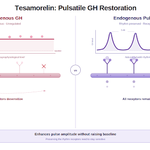
Exogenous growth hormone burns out the very receptors it's supposed to help.
Continuous exposure > receptor shutdown > diminishing returns.
One compound triggers the body's own pulsatile GH release without adding a single synthetic unit.
Everything the research shows on Tesamorelin🧵

Proteomics confirmed it at the protein level:
VEGFA reduced ~20% (linked to liver disease progression)
TGFB1 reduced ~35% (master fibrosis regulator)
CSF1 reduced ~17% (tracks inflammation + fibrosis)
Controlled studies also documented 15-20% reduction in visceral fat over 6-12 months, driven by GH activating hormone-sensitive lipase through the JAK2-STAT5 pathway
Everyone talks about mitochondria.
Almost nobody talks about how researchers are studying ways to improve their function.
SLU-PP-332 showed something unusual in preclinical models: not just more mitochondria, but more efficient ones.
Here's how 🧵

Whole-body effects in animal models:
✓ Fuel use shifted toward fat oxidation
✓ Fatty acid burning up across muscle, heart, liver
✓ Insulin signaling improved
✓ Fat mass decreased on high-fat diet
(Billon et al., 2024)