

Artist and Storyteller, posting Folklore, Fantasy Art, Poetry, Literature, and Mythology.
Joined July 2025
- Tweets9K
- Following1.2K
- Followers13.7K
- Likes35.3K


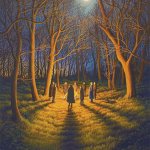




“Warlocks and witches in a dance;
Nae cotillion brent-new frae France,
But hornpipes, jigs, strathspeys, and reels
Put life and mettle in their heels.
A winnock bunker in the east,
There sat Auld Nick in shape o' beast…”
Tam o' Shanter is a legendary Scots poem written by Robert Burns. It focuses on the main character, Tam, as he travels home from the market after a night of drinking. On the way, it begins to rain and storm, and he has a supernatural encounter riding past the local church.
🎨Tam o' Shanter by John Joseph Barker, (1866)

3/4
They called the month when the winter season began Ƿintirfylliþ, a word composed of "winter" and "full moon", because winter began on the first full moon of that month.
🎨Sarah Vivian


Winterfylleth is the Old English name for the month of October. The early Anglo-Saxons based their year on the lunar calendar, when a month was marked by the phases of the moon (hence the name monath from the word mona, meaning moon).
🎨C. Hyde


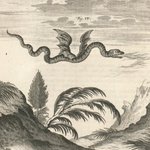
Talking about dragons… While there are different types of mythical reptiles, with their classification depending on their anatomical traits.
Let’s make things clear for a moment, first of all, they are ALL dragons.
Let’s not be petty about technical names, (honestly) most have evolved from ancient mythology and folklore, through contemporary literature and gaming lore, and classifications have changed somewhat.
Don’t let people ‘be know it alls’ telling you Habaneros or Padrón aren't peppers.
In European dragon classification, the specific limb-and-wing taxonomy was first formally recorded in the 16th and 17th centuries across regulated British and continental heraldic manuals, later codified in natural history compendiums like Edward Topsell's 1608 book The History of Serpents.
Large reptiles and land dragons, that roam the earth today, are still called Dragons in many cultures, across many centuries.
It’s about species, subspecies and hybrids. But, a pepper is still a pepper.
Teapot of the Day!
✨🫖✨
Chinese Thin-Walled Jade Teapot with Curling Branches (中华缠枝纹薄胎玉壶), carved in 2011 by master jade artist Yu Ting (俞挺) from Suzhou, China.


It’s always a good time for tea ☕️ 🫖✨
“Five O'Clock Tea” (or Lover of Tea), 1905, by illustrator Peter Newell published as a magazine cover for the Sunday Magazine of the Sunday Record-Herald.

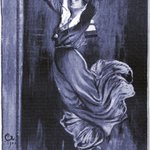
In 1897, critic and anthropologist Andrew Lang compared ghost-seeing to dreaming, arguing that apparitions and their actions were products of the mind rather than physical events.
“We do not see people naked, as a rule, in our dreams; and hallucinations, being waking dreams, conform to the same rule. If a ghost opens a door or lifts a curtain in our sight, that, too, is only part of the illusion. The door did not open; the curtain was not lifted … It was produced in the same way as when a hypnotised patient is told that ‘his hand is burned’, his fancy then begets real blisters.”
Lang suggested that ghosts’ clothing belonged to the fabric of dreams. This reflects the sanitised, chaste image of spirits prevalent in the nineteenth century, while his assumption that people rarely dream of nakedness reveals the moral attitudes underpinning his argument.
🎨 The Lady Ghost (1876) by Adelaide Claxton.

This story follows a young prince named Boots (the youngest of seven brothers). His six older brothers set out to find brides, but on their journey back, they encounter a cruel, magical giant who turns the brothers and their new brides into stone.
Boots sets off to rescue his family. Along the way, he encounters a starving wolf and shares his food with it. In gratitude, the wolf becomes his magical companion and trusty steed.
The wolf carries Boots through mountains and wilderness until, as shown here, they reach a hidden mountain lake. In the center of the lake is an island with a church.
This location holds the secret to defeating the giant. The giant cannot be killed by conventional weapons because he keeps his heart hidden outside his body. The giant reveals the hyper-specific riddle of his mortality to a captive princess:
"Far, far away in a lake lies an island; on that island stands a church; in that church is a well; in that well swims a duck; in that duck there is an egg, and in that egg there lies my heart..."
With the help of the wolf and other grateful animals (like a raven and a salmon), Boots crosses the lake, retrieves the egg from the duck, and squeezes it to destroy the giant, breaking the curse and saving his brothers.
George W. Hood, for the 1922 book The Norwegian Fairy Book.

This August 1909 newspaper clipping documents the real-life case of Annie McIntyre, an elderly Donegal woman applying for an old-age pension.
Under the Old-Age Pensions Act of 1908, applicants needed to prove they were at least 70 years old. Because mandatory civil birth registration in Ireland did not begin until 1864, official records were non-existent.
The Limavady pension committee accepted her vivid, historically benchmarked memory of being targeted by fairies on Hallowe'en Night in 1839 as valid proof of age and granted her the pension.


