

Founder notes. AI ops. Building WednesdAI in public.
Salt Lake City, UT
Joined September 2012
- Tweets2.6K
- Following463
- Followers310
- Likes745







Pinned Tweet
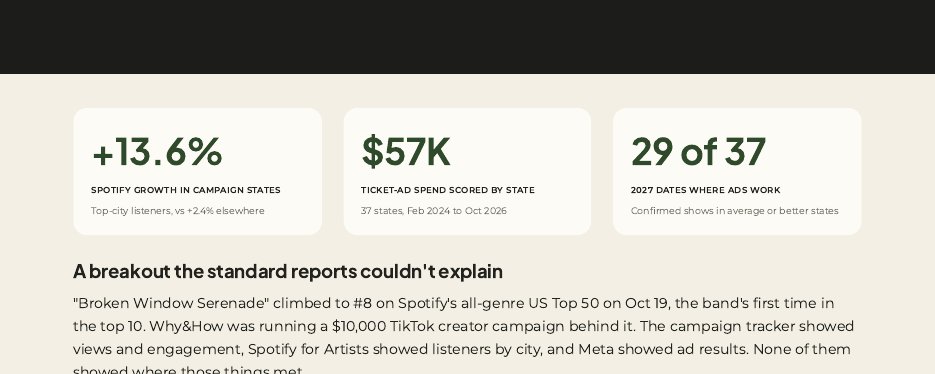
A $10K TikTok campaign, a top-10 Spotify song, and $57K of ticket ads that had never been on the same map.
Here's what happened when we connected them 👇
nitter.gq/Brendon_Arch/status/21…

1
1
166
I used to think evals tested the agent. Now I think the agent tests the evals. Every gap in your checks, it will find before you do.
1
1
23
48.8% when all three attempts have to pass. That's the number that matters in production. Agents don't need to be perfect. They need something checking every run.

The best AI agents still fail about 4 in 10 everyday tasks.
ShellBench, out today: 100 real-world tasks, 12 models, 5 harnesses, 53,100 graded runs.
Top score: 62.5%. Passing all three attempts: 48.8%.
Open-source harnesses held their own.
openclaw.ai/blog/shellbench

1
53
If agents become the buyer, attribution gets a lot harder.
The click path is gone. The agent read a page, compared options, and picked one.
Somebody has to score which agent sent the sale, and why.
Who's tracking agent referrals yet?
2
67
The a16z deep dive ran 11k+ agent tests on how agents decide what to recommend: nitter.gq/venturetwins/status/21…
Platform dashboards already grade themselves. Agent referrals will need the same outside check.

Agents are the next big distribution channel for products, services, and software.
But how do they decide what to recommend?
@omooretweets and I did a deep dive with @promptingco - and we're sharing takeaways after running 11k+ agent tests 👇

1
32
Never let the agent that wrote the change be the one that signs off on it.
Same rule we use for people. The author always thinks it works.
Who checks your agents' work?
1
29
Black Friday is when everyone trusts the platform dashboard most. Each grades itself.
Whiskey Myers: we put TikTok, Spotify and Meta on one map. Top cities in campaign states grew listeners 13.6%, everywhere else 2.4%. Correlation, not proof.
What do you check spend against?
1
27
The ad side: we scored $57K of ticket-ad spend across 37 states against the band's own $0.21 average per ticket click. Seven states came in well below average and took 23% of the spend.
Write-up: nitter.gq/Brendon_Arch/status/21…
8
Store every tool response your agent gets.
When a run goes wrong you can replay it without re-firing a single tool, and every bad run becomes a regression test.
Most teams log the prompt and the final answer. The tool responses are the part you actually need.
1
22
Your real eval set is already sitting in your logs: the failures. Most teams grade the final output and never look at where the run actually went wrong. Grade the steps, not just the output.
1
18
One word that scares me about agents in prod:
"Success."
The log says it passed. The app says otherwise.
What's yours?
1
19
An agent grading itself gives you a diary, not an eval.
If the same context that did the work also scores the work, it can log a bad run as a win and believe it.
The check has to live outside the agent, with its own view of the real end state.
Who grades your agents?
1
17
An agent's write call times out. Did it land or not? The timeout can't tell you. Retry blind and you can double-charge someone while every step looks fine.
Check the end state, not the return code. Idempotency keys on every write, or verify before you retry?
1
27