






We want an extra 20 years. Just don’t ask us to change what we’re doing tonight.
That’s the awkward part of the longevity conversation. A new pill gets our attention. An earlier bedtime feels like a sacrifice.
I’m excited about the breakthroughs ahead. But how much of the demand for an “easy button” is really a request to keep our habits and lose the consequences?
The AI world calls it recursive self-improvement. In business, I’ve always thought the real test of a leader was whether the team kept getting better without needing more of the leader.
Great people make the people around them better. A mistake changes how the team works. A win raises expectations. Over time, the whole company becomes harder to compete with.
But that takes a culture where people can challenge the boss, own a bad decision and keep working through a problem when the easy answers run out. Grit matters. So does knowing when persistence has turned into stubbornness.
Now put increasingly capable AI in the hands of a team like that.
I’d spend less time worrying about which company has the best AI tools and more time worrying about which company is learning fastest.
wsj.com/tech/ai/ai-anthropic…

AI can make drug discovery cheaper, but a promising drug candidate can still become a very expensive failure.
As AI gives us more candidates, knowing which ones deserve years of clinical work and serious capital becomes even more valuable. Those are consequential calls, and a longer pipeline doesn’t make them any easier.
I’d like to see the same ambition we’re bringing to discovery applied to shortening clinical development and regulatory review. Saving time at the beginning should push us to tackle the years that follow.
I’m encouraged by how quickly the science is advancing. But the patient waiting for treatment needs that science to become an approved medicine they can actually use.
It is coming, although @elonmusk and I may have different things in mind.
I’m excited about what science could do for how we age. That’s even more reason to take sleep, diet and exercise seriously today. Myself included. We should be giving ourselves the best chance to be around and benefit from the breakthroughs ahead.
I’d like to give the science a little less repair work when it gets here.😂

For me, business offers much of what people look for in a hobby. It’s a team sport with smart people, tough competition and always something to figure out.
Add the chance to discover new medicines and watch talented people grow, and it’s hard to find a hobby that holds my attention quite the same way.

You can only talk about your potential for so long before people start wondering why you haven’t delivered.
Before blaming the team, I’d look at myself. Are good people waiting on me to make a decision? Sometimes the most useful thing a leader can do is stop holding everyone up.

I’d be careful declaring there’s “no gold.” What if we can intervene in the biology of aging before disease takes hold? That’s worth putting capital behind and testing rigorously in humans. Keeping people healthy and independent at 85 is plenty ambitious. But I wouldn’t assume that’s the limit of what the science could deliver.

"The longevity industry is a goldrush without gold."
and other strong words about 2 delusions @TheLancet
thelancet.com/journals/lance…

I agree that clinical trials and regulatory review will remain the long pole in the tent. AI should help make that work more efficient over time, but we still have to prove a medicine is safe and effective.
The bigger question for me is whether AI can improve the odds of success. Finding novel targets is part of that. Helping us choose which ones to pursue, design better trials and catch problems earlier could be just as valuable.
Having spent years developing drugs, I’d put a lot of value on knowing sooner that we’re pursuing the wrong idea. Those years cost money, and they cost patients time.
If AI can help us make better bets and get more of them across the finish line, that’s plenty to be excited about.

The AI hype in biotech is just silly now. So your agent took only 12 hours to design a new drug? Great! Now, you still have to spend 5 years running trials and proving it works in humans without killing anyone. If AI does drug design like it does my stock reseach, there are going to be a lot of dead test subjects.
As a CEO, it’s hard to leave something alone when you know you could fix it. You have an opinion and want to jump in. I get it.
But just because you can improve something doesn’t mean it deserves your time. You can spend all week fixing little things and never get to the two or three that really matter.
You have to be willing to let some things stay imperfect.
I keep thinking about what this could mean for a doctor who doesn’t have access to the latest equipment.
If a simple photo could help them make a better treatment decision, that’s a big deal.
There’s still plenty to prove. But making good medical care less dependent on where you live or which hospital you can get to is a reason to be excited about AI.
There's a lot in a face photograph about health that AI can detect, as seen in this foundation model of >40 million face images, including outcomes from cancer, biological age, influence of lifestyle factors, and survival @LancetDigitalH
thelancet.com/journals/landi…

Monday morning, I ask myself a question: what am I going to be annoyed with myself for not getting done by Friday?
There’s usually something that comes to mind right away. Often it’s a conversation I’ve been putting off, or a decision I could make today if I’d stop finding reasons to wait.
I try to give that some time before the calendar takes over.
Some weeks I do better than others. But I know how frustrating it is to get to Friday, wonder where the week went, and still have that same thing hanging over me.
Brent Saunders retweeted

@Trevs_Dev brought an unreleased version of Atlas Fields Studio to life with the Apple Vision Pro.
Explore and view predicted electric (E) and magnetic (H) near-fields in Atlas Fields Studio yourself at fields-studio.arenaphysica.c…! More coming soon.
After nearly 20 years as a CEO, I can usually come up with an answer quickly. The question is whether I’ve stopped listening too soon.
Experience helps you recognize patterns. It can also make you see the same pattern everywhere.
Someone starts explaining a problem and halfway through, you’re already solving the version you dealt with five years ago. Except the customer has changed. The team is different. Or your old solution is now part of the problem.
That’s why curiosity matters, especially when you think you know what you’re doing.
Ask the next question. Talk to someone closer to the work. Find out why a smart person disagrees with you. And when you ask for an explanation, give people time to finish it.
I’m still working on that last one.
With AI making answers easier to get, I think the willingness to question our own answers becomes even more valuable.
A useful question to take into your next meeting: “What am I missing?”
Then let someone tell you.
A decision may deserve two weeks of thought. That doesn’t mean it should spend two weeks waiting for someone to think about it.
I tell people, “Look at your watch, not the calendar.” If we can move something forward today, why is the first meeting two weeks away?
If the facts are reasonably clear and we can easily change course, make the call. We’ll learn something by doing.
When the stakes are high and the consequences are hard to undo, take the time to gather evidence and think it through. Ask the uncomfortable questions. Those decisions deserve the work.
But waiting for an opening on everyone’s calendar doesn’t count as analysis.
You can be thoughtful about the decision and impatient about getting started.
Brent Saunders retweeted

(4/4) We're grateful to principal investigator Zoe Draelos, MD, our co-authors Rahul Mehta, PhD, Manisha Jha, @DrDorisDay, and Manpreet Randhawa, PhD, the entire Rapalogix team, and every participant who made this study possible.
Full press release: prnewswire.com/news-releases…

Will pharma keep spending billions on TV ads if your AI agent starts asking harder questions about the medicine being advertised?
Imagine seeing a drug commercial and asking your AI, “Is that a good option for me?”
With your permission, it could review your medical history, compare the evidence, check your insurance coverage and find financial assistance. You could then discuss those answers with your doctor and decide together.
That takes “ask your doctor about…” to a whole new level.
It could also change how pharma competes.
Too many patients leave an appointment with a prescription, only to find out at the pharmacy that they can’t afford it. Then come the calls and paperwork. Some patients just give up.
What if we could work through those issues before they leave the doctor’s office?
Is the medicine covered? Does it need prior authorization? Is there an appropriate alternative with a lower copay? Could a company’s savings program or patient assistance help? And what happens when that assistance runs out?
For the doctor, I’d want a short, useful comparison of the options, the evidence and what the patient would likely pay. The doctor still makes the clinical recommendation, taking the patient’s preferences and circumstances into account.
Then the agent could help with paperwork, pharmacy coordination and follow-up. If the patient never fills the prescription, the care team should know while there’s still an opportunity to help.
Of course, this depends on reliable access to medical records and insurance information, verified costs and clinical oversight. There’s real work to do to make it happen.
But I think pharma should be thinking about the implications now.
TV ads could still help people recognize symptoms and seek care. Getting a medicine into the conversation would still matter. But the questions that follow could get a lot tougher.
How strong is the evidence? How does it compare with the alternatives? Who benefits most? Can this patient afford to keep taking it?
Published clinical data, credible real-world evidence and accurate coverage information could become much more important in choosing a treatment. The agent would also need to recognize weak evidence and be honest when the comparison a patient needs hasn’t been studied.
We should ask some tough questions about the agent, too. Who pays for it? What influences its recommendations? Patients deserve to know when insurance rules or commercial relationships shape the options they see.
Having spent my career in biopharma, I find this fascinating. We’ve spent a lot of money encouraging patients to ask about our medicines. Soon, they may arrive with an AI agent that has already done the homework.
That would make me think hard about where the next dollar goes. How much of our advertising budget could do more for patients if we put it toward better evidence and helping them get, afford and stay on treatment?
Brent Saunders retweeted
We're excited to announce our collaboration with @microsoft to bring Heaviside and AI-powered electromagnetic design to the RF, photonics, and semiconductor ecosystem on Microsoft Discovery.
Every electromagnetic design problem reduces to the same question: how will this design actually behave once built? Heaviside was built to solve the verification problem, predicting the full 3D electromagnetic field response in milliseconds and within a decibel of commercial accuracy.
We are thrilled to be collaborating with the incredible team at Microsoft Discovery. Learn more here: arenaphysica.com/articles/he….
Brent Saunders retweeted

very cool anti aging news
like I said before, we will all be looking good soon (regardles of your age)
here's a small hint of what's coming (skin related)
you may be 40-80, but your skin will look like you're in your 20s. This is coming, very likely before other organs rejuvenation.
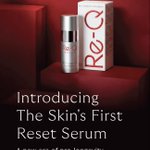
A skin serum targeting an aging pathway just delivered promising results in humans.
Researchers tested RLX-201 in a randomized, double blind study involving 47 women with sun damaged facial skin. Participants applied either the active serum or the same base formula without RLX-201 twice daily for 12 weeks.
Here’s what the researchers reported for the active serum compared with participants’ starting scores:
- 21% improvement in firmness and cheek wrinkles
- 40% improvement in skin texture
- 39% improvement in radiance
- 14% improvement in sagging, elasticity around the eyes and skin tone
Some benefits appeared within 2 weeks, and no adverse events were reported during the trial.
The interesting part is the biology: RLX-201 targets mTORC1, a pathway involved in cellular growth, maintenance and aging.
In separate lab grown human skin experiments, it reduced a marker of that pathway’s activity by roughly 92%, that measurement wasn’t taken from the trial participants.
Very encouraging step toward treatments that target skin aging biology.
🤖 Made with AI

Brent Saunders retweeted

Dry eye can affect patients in many different ways. At our Global Dry Eye Summit in Italy, eye care professionals explored the evolving science and management of dry eye disease and shared perspectives to help advance patient care. #DryEye #EyeHealth
Brent Saunders retweeted
More moments. More milestones. More of the people and places we love.
On #WorldSightDay, we celebrate sight – and everyone working to protect it.
#SeeBetterLiveBetter
