

Genome mining for unwinding iron binding. #BioInorganic #Chemistry, #Bioinformatics, #Biosynthesis Student run, opinions our own. IG: butlerlabucsb
Santa Barbara, CA
Joined April 2018
- Tweets254
- Following123
- Followers348
- Likes316





Butler Lab @ UCSB retweeted

Grab ‘n go: siderophore-binding proteins provide pathogens a quick fix to satisfy their hunger for iron!
Read #FirstRxns bit.ly/2UjsDKR by @ADGallo56 & Katherine Franz @FranzLabDuke on the research by the Wencewicz Lab
@WashUChem bit.ly/3df202b

Butler Lab @ UCSB retweeted

Bragging about huge numbers of hours worked each week misses two important truths:
-time at work doesn’t necessarily equal productivity
-there is no prize for suffering the most
Butler Lab @ UCSB retweeted

.@UCSB_chemistry’s graduate students recently discovered a technique to decipher siderophore's 3D structure. A better understanding this compound potentially means thwarting bacterial growth and treating certain illnesses. Findings appear in @PNASNews. ow.ly/ukWz50wGRxz
"Mentoring: Reflections and Suggestions" -- Don't miss this editorial by Harry Gray, pioneer of #bioinorganic chemistry. Alison is a proud member of Gray Nation!
We're lucky to have Rich in our department!

Working with just his hand and a very hot flame, #UCSB's in-house glassblower Richard Bock shares his expertise on this niche profession. ow.ly/Iq2p50wtMyE
Cool! Drosophila melanogaster has a nonribosomal peptide synthetase!
pnas.org/node/850115.full
#UCSB colleagues, sign ups are open for the 2019 Out List! Please consider coming out as member of the LGBTQIA community, or even as a supporter. Visibility matters!
@ucsantabarbara @ucsb_rcsgd
docs.google.com/forms/d/e/1F…

NSF broader impacts. A significant portion of our grant money goes to promoting tweets and buying followers, but the influencer points make it worth it.
I'm still waiting for my check from big pharma for supporting vaccinations. Maybe they have the wrong address...
Butler Lab @ UCSB retweeted

When you finish a PhD in chemistry they take you in a special room and tell you that tenure-track professorships aren't real and all professors are just really old postdocs.
I am posting this at great physical risk to myself and my family.
xitter.cf/ButlerLabUCSB/status/1…

When you finish a PhD in chemistry they take you in a special room and tell you that the periodic table isn't real and all matter is just made of the elements earth, air, fire, and water.
I am posting this at great physical risk to myself and my family.
unavailable
To sum up, we can now predict the residue selectivity and stereospecificity of any siderophore β-hydroxylase. Although mechanistic questions remain, structures can now quickly be predicted just by looking at the gene cluster, or better yet, by using the pHMMs provided. (11/11)
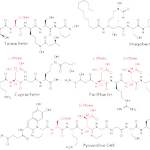
To confirm that we could actually use these trees to predict siderophore structures, Cliff, Jae, and Jean isolated four siderophores and stereochemically characterized the OHAsp residues. Each matched the subtype-based prediction! (10/11)
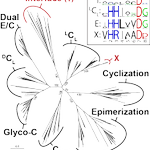
That still left the question of stereochemistry. Mapping reported OHAsp stereochemistries to our phylogenetic tree revealed that the IβH family of NRPS domains is selective for 3S hydroxylation, while the TβH family of standalone enzymes is selective for 3R hydroxylation! (9/?)

The reconstructed phylogenetic tree of β-hydroxylases shows that the functional subtypes we identified are true evolutionary subtypes that have diverged in reactivity over time. (8/?)

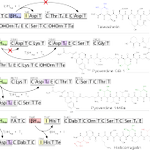
The IβH_Asp family of NRPS domain hydroxylases is found alongside a "broken" condensation domain that lacks a catalytic motif. Instead of condensation, we think that this "Interface" domain is responsible for bringing together two NRPS enzymes so hydroxylation can occur. (7/?)

Each type of β-hydroxylase is associated with a different NRPS domain that seems to be required for hydroxylation. When those domains are absent, no hydroxylation occurs. We also identified a family of histidine β-hydroxylases involved in siderophore biosynthesis. (6/?)
