

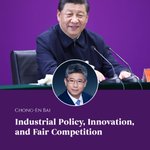






Between 2010 and 2022, the cost of utility-scale solar electricity fell by nearly 90 percent; battery packs went from well over $1,000 per kilowatt-hour to below $140.
Chong-En Bai argues that subsidies helped make that possible—and that the same subsidies, left in place once an industry matures, breed overcapacity, depressed prices, and retaliation. His remedy reverses current practice: the exporting country, not the importer, should levy a tariff offsetting only the excess subsidy, as measured by an independent body at the WTO.
An importer that imposes the duty profits twice; an exporter pays for its own restraint. The hard part of industrial policy is not starting. It is stopping.
cirsd.org/horizon-article/in…

The European Union runs a trade surplus with the world and a deficit of roughly €360 billion with a single partner.
In conversation with Vuk Jeremić, Arancha González Laya, former Spanish foreign minister, dismisses comparisons with German cars or Italian fashion: China holds over a third of global industrial capacity, heading toward 40 percent, its advantage amplified by state support and an undervalued currency.
Partner, competitor, rival still holds; it is all in the proportions. Nor is de-risking aimed at China alone—Beijing’s dual circulation was de-risking too. Everybody is playing the game.
Her new book imagines Europe in 2049, alone in the world. That future, she insists, is still a choice.
cirsd.org/horizon-article/it…

CIRSD retweeted

HORIZONS Vol.36 Autumn 2026
De-Risking the Win-Win?
The Trillion-Euro Question
EDITORIAL @CIRSD
TWO buzzwords have come to dominate the discourse surrounding Europe–China relations. Brussels speaks of de-risking: reducing potentially dangerous dependencies without cutting ties. Beijing speaks of win-win: cooperation in which both sides come out better off. To Chinese ears, de-risking sounds like protectionism with diplomatic finesse. To European ears, win-win increasingly sounds like China winning twice. This issue of Horizons examines whether the two can be reconciled, and what happens to one of the world’s most consequential commercial partnerships if they cannot.
SOME of the stakes can be measured. Two-way trade in goods and services exceeded €880 billion in 2025 and is edging toward a trillion. Europe’s goods deficit with China reached roughly €360 billion that same year. A relationship that large cannot remain that lopsided for long.
THAT imbalance is a symptom of something deeper: the nature of exchange itself has changed. For decades, the bargain was complementary: European capital goods and premium manufactured products traded for Chinese consumer goods. Today, the two economies compete head-on in automobiles, batteries, machinery, and clean technology—the sectors that anchor European industry. Our contributors disagree on the causes of this “second China shock.” Some point to state subsidies, overcapacity, and weak household demand that pushes China’s surplus output onto world markets. Others blame Europe’s own high energy costs, fragmented capital markets, and regulatory burdens. Few dispute that tariffs can buy time but cannot replace competitiveness.
NOR is the contest purely economic. Rare-earth export controls, the dispute over the chipmaker Nexperia, and the world’s reliance on Taiwanese semiconductors have shown how quickly interdependence can turn into leverage. For several authors, China’s role in sustaining Russia’s war economy places a hard ceiling on European trust. Chinese contributors push back against the “New Cold War” narrative. They argue that the two ends of Eurasia have no fundamental geopolitical conflicts of interest and are converging on multilateralism and climate action just as Washington retreats from both.
BETWEEN these poles, a more practical agenda takes shape. De-risking need not mean subtraction alone. It can also mean adding options: more suppliers, Eurasian corridors running through Central Asia, and financial bridges such as Hong Kong. Industrial policy could be disciplined by distinguishing between subsidies that help young industries learn and those that distort markets once those industries have matured. Chinese plants in Hungary and Spain could become channels for technology transfer rather than outposts to be resisted, and Brazil’s experience suggests that Chinese firms adapt when the rules are clear. In fields such as cancer research, cooperation under European standards may serve patients better than reflexive suspicion.
ALL of this unfolds inside a geopolitical triangle that Europe cannot control. Washington is increasingly transactional and Beijing increasingly confident, pushing Europe toward the pursuit of strategic autonomy it has long debated but only recently begun to build. In such a setting, neither buzzword seems entirely plausible. De-risking that builds no capability only preserves weakness, while win-win that ignores imbalance only breeds resentment. The trillion-euro question, then, is whether Europe and China can turn mutual dependence into a relationship balanced enough for both sides to call it fair.

Meet the contributors to the latest issue of Horizons! 🌍
In the new Autumn 2026 edition of Horizons — UNCENSORED: EAST MEETS WEST — discover insightful articles and perspectives from:
Arancha González Laya, Chong-En Bai, François Godement, Gene Ma, Brendan Simms, Katherine Simms, Han Hua, Zhandos Shaimardanov, Matthieu Grandpierron, Jing Qian, Li Cheng, Zhao Xiuye, Christopher Hui, Wang Yiwei, Feng Zhongping, Bruno Maçães, Jonathan Holslag, Henry Huiyao Wang, Velina Tchakarova, Wang Wen, Li Han, Sir Robin Niblett, Chen Dongxiao, João Philippe de Orleans e Bragança, Dimitris Avramopoulos, and Jan Oberg.
Explore diverse perspectives on Europe–China relations, global affairs, and the evolving international order.
📖 Read Horizons Issue No. 36 at cirsd.org/horizon-issue/hori…
🌍 The new issue of Horizons is here!
Horizons Autumn 2026 | Issue No. 36
🇪🇺 🇨🇳 De-risking or win-win? As Europe and China navigate an increasingly complex relationship, two competing visions are shaping the future of one of the world’s most consequential economic partnerships.
With bilateral trade approaching €1 trillion, growing industrial competition, and shifting geopolitical dynamics, the stakes have never been higher.
This issue of Horizons brings together leading voices to explore the challenges and opportunities facing Europe–China relations—from trade imbalances and technological rivalry to strategic autonomy, global security, and the future of cooperation.
Can Europe and China find a balance that truly benefits both sides?
cirsd.org/horizon-issue/hori…

“The Unbearable Lightness of Global Governance” — Horizons Issue No. 35 was launched in Vienna.
Hosted by CIRSD in cooperation with Global Neighbours, the event brought together diplomats, representatives of international organizations, business leaders, academics, and policy experts to discuss the future of global governance.
The discussion was opened and moderated by @jeremic_vuk , President of CIRSD and Editor-in-Chief of Horizons, alongside Jovanka Porsche, Siddharth Chatterjee, and former Prime Minister of Montenegro Igor Lukšić.
The conversation focused on the future of multilateral institutions, the Sustainable Development Goals, the role of private actors, Europe-China relations, and the challenges of international cooperation in an increasingly fragmented world.
At a time when only 18% of the Sustainable Development Goals are on track and global conflicts are at their highest level since 1945, the discussion explored what new forms of cooperation and institutional innovation are needed for the decade ahead.


The third edition of the Hili Forum 2026 in Abu Dhabi was the first major international gathering in the Gulf since the outbreak of the war, bringing together over 1,000 senior policymakers, diplomats, experts and thought leaders at a moment of exceptional regional and global uncertainty.
The Forum opened with remarks by Dr. Anwar Gargash, Diplomatic Adviser to the President of the United Arab Emirates, who set the tone for the discussions by addressing the urgent need for de-escalation, regional stability and a sustainable diplomatic framework for the period ahead.
@jeremic_vuk , President of CIRSD, former President of the UN General Assembly and former Foreign Minister of Serbia, participated in the Forum’s closing plenary, “Role of Middle Powers in a Ruptured Global Order,” alongside Carl Bildt, former Prime Minister and Foreign Minister of Sweden and Co-Chair of the European Council on Foreign Relations, and Zhandos Shaimardanov of the Kazakhstan Institute for Strategic Studies.
Jeremić stressed that strategic autonomy requires countries to diversify trusted partnerships, maintain good relations with their neighbours, avoid being drawn into other countries’ conflicts, and strengthen resilience at home.
He also highlighted the growing importance of technological and strategic partnerships as traditional security guarantees become less certain, arguing that middle powers are likely to play an increasingly important role in shaping the emerging international order.
The Hili Forum brings together policymakers, experts and researchers to discuss the geopolitical, economic and technological transformations shaping the Gulf and the wider international order.


CIRSD retweeted
Belgrade and Non-Alignment: 65 Years of a Grand Idea @CIRSD
cirsd.org/opinions/belgrade-…

Carolyn Rodrigues-Birkett, Guyana’s Permanent Representative to the UN and former Foreign Minister, is a leading candidate for the next UN Secretary-General.
In her vision statement, she calls for a more effective and proactive United Nations, firmly grounded in the UN Charter and multilateralism. Her priorities include stronger conflict prevention and mediation, faster progress on sustainable development, protection of human rights, reform of the UN system and deeper cooperation with Member States and regional organizations.
Rodrigues-Birkett argues that the next Secretary-General must combine principled leadership with pragmatism and ensure that the UN delivers tangible results for people around the world.
Read the full article here: cirsd.org/horizon-article/re…

CIRSD retweeted
Deeply grateful to @CEBRI for bringing together an exceptional group of thinkers and practitioners from around the world for the inaugural Paraty Dialogues.
At a moment of profound geopolitical change, the quality, candor, and diversity of the exchanges made this a genuinely meaningful discussion on global affairs—and a powerful reminder of the value of dialogue across regions and perspectives.
My warmest thanks to our Brazilian hosts for their vision, as well as for the extraordinary hospitality and generosity throughout our time in beautiful Paraty. I very much look forward to seeing this important initiative grow in the years ahead.


Gramsci's line about the time of monsters no longer reads as a warning.
Pascal Lamy, Vice President of the Paris Peace Forum. He is also Founder and Vice President of the Jacques Delors Friends of Europe Foundation takes it as a diagnosis. The triangle of Ricardo, Schumpeter, and Beveridge has come apart, and no welfare state compensates for years of imported overcapacity in steel, chemicals, batteries, and solar panels.
His fifth and most decisive driver is compute nationalism: the moment chips, frontier models, and data centers become sovereign resources, while a few private firms acquire quasi-sovereign power without accountability.
Europe was built by herbivores. It must now learn to survive among carnivores without becoming one.
Read the full article: cirsd.org/horizon-article/th…

A history written in the wrong register, Anatoly Torkunov and Vladimir Degoev argue, is not merely dull. It is disarmed.
Marking their new volume on the Russian state from its tribal unions to the Romanovs in 1613, they take Levitan's "Above Eternal Peace" as emblem and Collingwood's historical imagination as method.
Their quarrel is with the frameworks forced onto that past—imported feudalism, the Asiatic mode of production, the Eurasianists' Mongol "matrix"—and with a Russophobic narrative they trace to Nazi racial theory. There is no single key to Russian history, only a bundle.
Read the full article: cirsd.org/horizon-article/ru…

The Alabama Claims arbitration of 1872 converted a diplomatic quarrel into legal procedure; the Hague conferences then gave the practice a building.
With the WTO's Appellate Body paralyzed, the USMCA left unrenewed after its 2026 review, and investment disputes recast as security concerns, Teresa Cheng argues the urgent task is managing conflict rather than resolving it.
The International Organization for Mediation—45 signatory states, 16 ratifications, seated in Hong Kong—is the first intergovernmental body devoted only to mediation. It asks not who is legally right, but what arrangement can actually be sustained.
Read the full article: cirsd.org/horizon-article/me…

When Washington fell behind on its UN dues in the 1990s, it was a private citizen who pledged $1 billion and founded the UN Foundation.
Jovanka Porsche and Siddharth Chatterjee argue that the model must now be extended and sharpened: Track 2 and Track 1.2 diplomacy, permanent technical safe harbors, research capacity built outside the wealthy capitals, an independent scorecard measuring what institutions actually deliver against what they promise.
Drawing on three decades inside the system, from Somalia to Beijing, they insist the quiet rooms matter. Oslo was not born in a ministry.
Read the full article: cirsd.org/horizon-article/th…

CIRSD retweeted
Horizons Summer 2026 Vol.35
The Unbearable Lightness of Global Governance - EDITORIAL @CIRSD
The Beijing summit produced the calmest U.S.-China relationship in years, and both sides are dismantling what holds it up.
Total goods trade is down 28 percent since 2016; direct U.S. imports from China have fallen from 21 percent to 9. @CKupchan argues that “constructive strategic stability”—a Board of Trade, a Board of Investment, an AI working group with no lead agencies named—rests on an interdependence both governments are deliberately unwinding.
His analogue is the Soviet Union, stable only where it was walled off: the U.S. mined Haiphong harbor two weeks before signing SALT I.
Read the full article: cirsd.org/horizon-article/u-…

The twentieth century measured inequality in wealth. @DMiliband argues the defining division of the twenty-first is between those who live inside functioning states and those whose states war has dismantled—a divide invisible from the fortunate side, because institutions announce themselves only when they fail.
Twenty countries, home to 12 percent of the world’s population, account for nearly 90 percent of people in humanitarian need. Development is measured in years; institutional collapse takes weeks. The accident of birthplace should not set the boundaries of a human life. It increasingly does.
Read the full article: cirsd.org/horizon-article/th…

Eighty years on, no one has stopped believing in the United Nations, and that, @rafaelmgrossi argues, is the obligation rather than the comfort, because belief without delivery curdles into disillusionment.
With 18 percent of the Sustainable Development Goals on track and mandates duplicated, triplicated, quadruplicated, the gap between promise and result can no longer be papered over with declarations.
Drawing on six years running the IAEA through nuclear crises, the candidate for Secretary General sets one standard: not an institution that speaks of working, nor one that reforms in preparation for working, but one that delivers.
Read the full article: cirsd.org/horizon-article/a-…

What is in question is not whether the world needs the United Nations, but whether anyone still believes it can deliver.
@mfespinosaEC —former President of the General Assembly, former foreign and defense minister of Ecuador—argues it is slow where it should be decisive and procedural where it should act.
Her answers are specific: a Prevention and Early Action Hub reporting directly to her office, a Global Energy Security mechanism, mandate review as permanent discipline rather than crisis reflex. She has never served in the Secretariat, and treats that as a qualification.
Read the full article: cirsd.org/horizon-article/re…

Horizons 35: The Unbearable Lightness of Global Governance
The new, 35th issue of Horizons explores the crisis of global governance and a world in which the institutions created to carry the weight of the international order are becoming increasingly unable to respond to contemporary challenges.
Inspired by Milan Kundera’s The Unbearable Lightness of Being, the issue examines the weakening of the United Nations, the outdated structure of the Security Council, the growing influence of Asia and the Global Majority, emerging models of mediation and cooperation, and the rise of artificial intelligence as a force reshaping sovereignty, power, and decision-making.
At its core lies a defining question: can humanity build a new international order strong enough to bear the weight of the era ahead?
Contributors to Horizons 35 include:
Michelle Bachelet Jeria, María Fernanda Espinosa Garcés, Rafael Mariano Grossi, Rebeca Grynspan Mayufis, Carolyn Allison Farida Rodrigues-Birkett, Hugh Dugan, Richard Gowan, Peter Nolan, H.E. Abdirahman Mohamed Abdullahi, Branko Milanović, Pascal Lamy, David Miliband, Pascal Boniface, Anatoly V. Torkunov, Vladimir V. Degoev, Shyam Saran, David Daokui Li, Shuyu Wu, Cliff Kupchan, Mikhail Margelov, Jorge G. Castañeda, Ditmir Bushati, Kitila Mkumbo, Teresa Cheng, Jovanka Porsche, Siddharth Chatterjee, and David Harland.