






Pinned Tweet
In with the future-proof @NervosNetwork $CKB 🏋️♂️✝️🦍🔥🦖Blockchain Evolution RunCKB @Bitcoin @ethereum @Cardano @UtxoAlliance💯

Ghrelin++🦍 retweeted

📃 Kirea Finance
💰 Budget: $7,250
⏰ Voting closes: ~4days
📊 Quorum: 32,171,788/13,982,642
✅ Approval threshold: 100%/ 51%
Vote here👉 dao.ckb.community/thread/806…
Full proposal👉 talk.nervos.org/t/10809
All community members with Nervos DAO deposits are eligible to participate. Whether you support or oppose, voting is the way to have your preference counted in the final outcome.

📃 Kirea Finance
💰 Budget: $7,250
⏰ Voting closes: ~7days
📊 Quorum: 235,994/13,982,642
✅ Approval threshold: 100%/ 51%
Vote here👉 dao.ckb.community/thread/806…
Full proposal👉 talk.nervos.org/t/10809
All community members with Nervos DAO deposits are eligible to participate. Whether you support or oppose, voting is the way to have your preference counted in the final outcome.
Ghrelin++🦍 retweeted

A year on from our last CKBuilders article, we return to follow the journeys of old and new faces in our developer community: their experiences, challenges, and successes. The future of CKB is bright!
nervos.org/knowledge-base/CK…

Ghrelin++🦍 retweeted

Worth a read. 2026 is the year AI started finding weaknesses in cryptography, including in post-quantum candidates.
As the piece puts it: "If the destination is uncertain, the target becomes the ability to move again."
That's crypto agility, and it's why no signature scheme is built into CKB's protocol rules. Each one is a lock script, so a new scheme can be added, or a weak one left behind, without a hard fork.
Whether the next break comes from AI or a quantum computer, CKB can move.

AI is testing the limits of post-quantum cryptography.
An Anthropic AI model found an attack that halved HAWK's effective security in just 60 hours, prompting its withdrawal from NIST consideration.
Itan Barmes of QIZ Security explains why cryptographic agility now matters more than ever.
Read: thehackernews.com/expert-ins…

Ghrelin++🦍 retweeted

Happy to share some news from @ckba_build CKBA’s DevRel and Ecosystem Support teams: our paper on CCC (github.com/ckb-devrel/ccc/), When EVM Defaults Break: Three SDK Patterns for UTXO-Family Wallets, has been accepted for poster presentation at IEEE International Conference on Distributed Ledger Technologies (ICDLT) 2026!
Through this collaboration, @Hanssen0 (@CKBDevrel) and I (Ecosystem) built on the CCC team’s existing engineering work to distill three reusable design patterns:
• Transaction composition: helping applications handle inputs, change, and fees.
• Unified signing: providing a common interface across different wallet signing methods.
• Reusable wallet connectors: sharing wallet connection and onboarding components across applications.
The conference brings together academia and industry, with organizers from Nova School of Business and Economics, NOVA Information Management School, and the IEEE Portugal Section. It is part of BLOCKCHAIN. PT, a project funded through Portugal’s Recovery and Resilience Plan and the EU’s NextGenerationEU programme.
For us, this is an opportunity to bring CKB’s experience in developer tooling and application development into a broader conversation with researchers and builders.
Thanks to Hanssen and everyone who has contributed to CCC!


Ghrelin++🦍 retweeted
Crypto-agility is the right frame. Last week’s debate covered quantum computers and AI as a new wild card: AI could turn up unforeseen weaknesses in the underlying mathematics and shorten the time left to prepare. Both fronts lead to the same question: how long will the signature schemes on public blockchains today hold up?
Nobody can reliably quantify either risk. Changing a chain’s cryptography may take years, so waiting to see how it plays out is no longer a realistic option.
CKB has been crypto-agile since its mainnet launch in 2019. Any new signature scheme can be deployed as a lock script, with no protocol change.

Cryptography is not over. The internet is not over. Blockchains are not over.
We’re just entering the 🚨danger zone🚨, that’s all.
Whether quantumly or classically, major public key implementations will fall. Maybe soon.
We need to move to a crypto agile paradigm instead of assuming certain functions will work for decades.
All cryptographic infrastructure including blockchains has to be rebuilt around this realization.
That’s it.
Ghrelin++🦍 retweeted

If you want to track the decentralized efforts from CKB community this website is the place to go. Great work!

Live GitHub activity of the CKB ecosystem, drawn in 3D.
Each project is a block that lights up when people work on it. Live, last 24 hours or last 7 days. English, 中文, Português.
pulse-lab.lusocryptolabs.com…

Ghrelin++🦍 retweeted

$ckb fam let’s get a 100 likes 💚 below and see what’s cooking 👨🍳

The Nervos community is asleep.
Wake up giants!
100 ❤️ = we ship the coolest product you'll see on nervos this year 😄 yes, better than names, complimentary, definitely!
We won’t say whatl, but @FiberDevs is part of what’s coming.
No vague roadmap. No disappearing act.
We’re building something people can use today, and we’re doing it with the community.
Do you want to be part of it?
Old school comment, like, repost, quote, all the good stuff that makes a community thrive. ❤️

Ghrelin++🦍 retweeted

$CKB doesn’t hardcode secp256k1 into consensus. Signature rules are Lock Scripts on a RISC-V VM, so post-quantum crypto can ship without a hard fork.
SPHINCS+ (NIST FIPS 205) is already on mainnet, audited, and usable via Quantum Purse. Users migrate by moving funds to a new lock
Large PQC signatures are handled in witnesses, not blocked by protocol limits
Quantum resistance on CKB is opt-in and live, not a future hard-fork promise.Note for accuracy if someone replies: default addresses are still secp256k1. Protection applies after funds are moved to a SPHINCS+ lock.

Ghrelin++🦍 retweeted
You may have noticed that Crypto Twitter has spent much of this week arguing about whether AI could break the cryptography most crypto wallets rely on. You may also have struggled to follow the elliptic curves, ECDSA, lattice-based commitments and P = NP stuff.
That makes you completely normal.
Fear not: nothing has been broken, as far as anyone knows. Here is what happened, what is still unknown, and why it matters.
On Tuesday, OpenAI released 722 mathematical manuscripts, written by an internal model it has not made public, covering hundreds of open problems. Mathematicians are still working out what they represent.
Fewer than half have computer-checked main results, and a computer check confirms the logic, not the significance. Three papers were withdrawn within a day over a sign error. OpenAI has not claimed an attack on wallet cryptography.
One result nevertheless drew serious attention: claimed progress toward the Riemann hypothesis, a puzzle about prime numbers unsolved since 1859. Rutgers mathematician @AlexKontorovich said that if a human had done it, it would be "an instant Fields Medal, no questions asked."
The crypto world noticed. On Wednesday, Ethereum Foundation researcher @drakefjustin asked the industry to "calmly begin planning for bunker mode": preparing for the elliptic-curve signatures protecting most Bitcoin and Ethereum wallets to be broken by ordinary mathematics before quantum computers can do it. His worst case: "months not years."
@VitalikButerin took the concern seriously but cautioned: "don't rush anything." He advised favoring hash-based schemes where possible, adding: "I personally have lost more money in botched migrations than I have lost in all hacks combined."
In three bullets, the central idea:
⦿ Your wallet has a private key you keep secret and a corresponding public key
⦿ A signature made with the private key authorizes a payment; anyone can check it against the public key
⦿ The security rests on one-way math: easy to go forward, believed practically impossible to reverse on today's computers, so nobody can realistically work out your private key from your public key
Nobody has proved that last step cannot be reversed; it has resisted every known attempt on today's computers. The worry is that AI might find a shortcut.
There is a precedent for mathematical shortcuts: decades of work made factoring large numbers far easier than the obvious method suggested. Vitalik asks whether elliptic curves, and the newer lattice-based schemes built to resist quantum computers, hide shortcuts humans have missed but machines might find.
Not everyone is convinced. Coinbase's head of cryptography, @LindellYehuda, says there is "no evidence whatsoever" that the assumptions behind elliptic curves have been weakened, and called the warning FUD. Nobody claims a breakthrough has happened; the dispute is over how seriously to prepare for one.
However you weigh the risks, there are two clocks running. One is a quantum computer powerful enough to break this cryptography. It doesn't exist yet, and its development involves engineering milestones we can track. The other is a hypothetical mathematical breakthrough, which could arrive without notice and run on machines already available. Nobody can confidently date either.
What would be at risk if an attacker could recover private keys from public keys? The most immediately exposed funds would be those controlled by keys that are already public.
On Bitcoin, many address types hide the public key until you spend, and good wallets send change to a fresh address. On Ethereum, people commonly keep using one address, and its public key can be recovered as soon as it signs a transaction or a message. Bitcoin also has exposed keys in older outputs, Taproot outputs and reused addresses.
That distinction explains Drake's advice to move funds to fresh addresses that keep their public keys hidden behind a hash. A new address is not automatically safe, though: Taproot outputs, for example, include a public key from the start.
Sensible preparation starts with the ability to change. A blockchain may need to swap how it checks ownership as confidence in existing methods shifts, ideally without a network-wide upgrade. That is what crypto-agility means: engineering for flexibility.
On CKB, ownership checks are programs, so new ones can be added without changing the network's rules. A signature scheme built from hash functions, the family Vitalik advises favoring where possible, is already live on mainnet: SPHINCS+.
Our Chief Architect, Jan Xie, covers the quantum timeline and the challenges of migration in notes from a recent talk:
jan.la/posts/pqc-migration-t…
Ghrelin++🦍 retweeted

$CKB : Review 📜
What if the signature scheme Vitalik Buterin spent this week arguing crypto should move toward had already been sitting on another chain for a year?
Meet Nervos CKB, a proof-of-work Layer 1 where SPHINCS+ hash-based locks have been live as an option since late 2025. Its RGB++ protocol binds Bitcoin UTXOs without a bridge, and its Fiber payment layer just cleared every milestone on its build.
Let's explore the chain that keeps being early. 👇
⚪ CKB at a Glance
Marketplace Insight: CKB occupies an awkward and interesting position. The engineering is genuinely ahead of the market's attention, with a Bitcoin-native asset protocol that needs no bridge, a payment-channel layer doing atomic swaps with Lightning, and post-quantum locks that were deployed before the current debate about them started.
The token tells a different story, down 69% on the year and sitting near a market cap most people would class as microcap. The all-time high from March 2021 is now a distant number. What the past month shows is a project shipping steadily on Fiber and tooling while the L1 itself stayed deliberately still.
⚪ Mission
Nervos CKB exists to be the layer that stores and verifies, not the layer that executes. The architecture separates concerns on purpose: CKB handles state, security, and settlement through its Cell Model, while computation happens above it. The longer-term bet is that Bitcoin will need an asset and payments layer that does not require trusting a bridge, and that a proof-of-work chain with a generalised UTXO design is the honest way to build one.
🔵 A Brief History
Nervos launched its mainnet in November 2019, raising around $72 million across its token sales, with a proof-of-work chain running the Eaglesong hash function and a 25-year primary issuance halving schedule. The Cell Model, a generalisation of Bitcoin's UTXO design capable of holding arbitrary state, was the core architectural claim from the start.
The chain spent its early years relatively quiet.
The turn came with RGB++, which binds asset issuance and ownership to Bitcoin UTXOs through isomorphic mapping, letting assets settle against Bitcoin without a bridge contract holding custody. That removed the single largest attack surface in cross-chain design, which matters given the project's own history.
The security record is where the honest reading gets uncomfortable. Force Bridge, the cross-chain bridge infrastructure, suffered exploits that cost the ecosystem real money, including a $3.9 million incident in June 2025 that drew a warning from DAXA, the South Korean exchange consortium. The response was architectural: RGB++ exists partly because bridges keep failing, and the project moved toward a design that does not need one.
CKB Edition Meepo activated on mainnet on 1 July 2025 at epoch 12,293, and remains the current ruleset. Late 2025 brought the quantum-resistant lock work, deploying an optional SPHINCS+ lock script on mainnet. Governance restructured when CKBA, a Swiss Verein, replaced the Foundation as the coordination body, with the chain itself remaining permissionless proof-of-work.
The past month has been a Fiber month. Version 0.9.1 landed on 11 September with force-close settlement fixes, on-chain TLC reconciliation using verified settlement snapshots, configurable peer-message rate limits, and improved funding-failure diagnostics. Version 0.10.0-rc1 followed on 25 September with backup-RPC authorization fixes. Fiber Studio filed its completion report with all milestones done and signed builds for all three desktop platforms.
Node v0.210.0 shipped 17 September carrying dependency and security updates with no protocol change, alongside CKB-VM v0.24.15 and a transaction-pool architecture review.
On the ecosystem side, the Gone in 60ms Fiber infrastructure hackathon returned results, with Fiber Forge taking a category and FiberNuts, a Cashu ecash implementation backed by Fiber RUSD, placing first in another. CKB Off-Chain Aba ran in Abia State, Nigeria on 3 October with sessions on the Cell Model, RGB++, and Fiber, and a Vietnam meetup followed on 8 October. Dular wrapped a Fiber payments pilot with around 30 users in Kenya.
Not everything went up. UTXOSwap announced it is shutting down on 10 to 11 October, with liquidity providers told to withdraw before 16:00 UTC on the 10th. CKBA does not operate it and only amplified the notice, but a DEX closing is a real signal about ecosystem depth.
🔵 Ecosystem Narrative
The through-line across the past month is Bitcoin-adjacent payments, built
out while the base layer stayed still.
➛ The Cell Model. A generalisation of Bitcoin's UTXO design where each cell holds arbitrary data and a lock script, giving the chain programmable state without abandoning the UTXO security model.
➛ RGB++. Asset issuance and ownership bound to Bitcoin UTXOs through isomorphic mapping, with no bridge contract and no wrapped token holding custody between the two chains.
➛ Fiber Network. Payment channels on CKB with atomic swaps into Bitcoin Lightning through the Cross-Chain Hub, shipped 18 August. Multi-tenant hosted LSP for mobile wallets, Loop In and Out, and full payment-hash settlement remain in progress.
➛ SPHINCS+ locks. Optional hash-based post-quantum lock scripts live on mainnet since the late 2025 quantum-resistant lock work, the same signature family now being pushed as the conservative path for Ethereum's lean roadmap.
➛ Mobile and tooling. Pocket Node Android v1.8.4 on Google Play with the iOS build verified on hardware at the M1 stage, Khie merged as a P2P wallet-connect protocol, Omiga v1.2.0 expanding on-chain asset management with CCC wallet integration, and CKB Script Port experimenting with moving synced script state between light clients.
➛ Real-world pilots. Dular's Kenya payments pilot, Blackbox POS adding a receive-only Bitcoin rail where keys never touch the device, and FreightOnNervos and RIVET demoed at the Nigeria event.
⚪ Token Utilities
$CKB is the state-rent asset of the network, which is an unusual design.
➛ State storage: holding one CKB entitles you to store one byte of state on chain, making the token a claim on blockspace rather than only a gas asset.
➛ Transaction fees: paid in CKB for computation and state changes.
➛ Nervos DAO: locking CKB earns secondary issuance back, offsetting the dilution that uncapped issuance would otherwise impose on holders.
➛ Mining: proof-of-work issuance through Eaglesong, on a 25-year primary halving schedule.
⚪ Key Features
➛ Proof-of-work Layer 1 with a generalised UTXO architecture through the Cell Model.
➛ RGB++ binds assets to Bitcoin UTXOs with no bridge and no wrapped token.
➛ Fiber brings payment channels with atomic swaps into Bitcoin Lightning.
➛ Optional SPHINCS+ hash-based locks live on mainnet since late 2025.
➛ State rent model where token holdings translate directly into storage rights.
➛ Nervos DAO lets holders neutralise secondary-issuance dilution by locking.
🔵 Meet the Team
Nervos runs on a three-person founding bench that has stayed intact since 2018, through the 2019 mainnet launch and the long stretch of low attention that followed. For a project this old, nobody leaving is itself a data point.
▶️ Core Members:
➛ Terry Tai - CEO & Director | Leads the company and sits on the board, having moved from the founding team into the executive seat. He has carried the project through the Foundation-to-CKBA restructure and the post-exploit pivot toward bridgeless architecture.
➛ Kevin Wang - Co-Founder | The most visible outward-facing voice on architecture, particularly on the case for separating storage and verification from execution, which is the thesis the entire Cell Model rests on.
➛ Daniel Lv - Co-Founder | Came out of the Ethereum ecosystem engineering side and has focused on the protocol and VM layer, the part of the stack that produced CKB-VM and the Cell Model implementation.
➛ CKBA (Common Knowledge Base Association) | The Swiss Verein that replaced the Foundation as the coordination body, which closed membership applications on 15 September with five applications queued for the General Assembly. It does not control the chain, which stays permissionless proof-of-work.
➛ Nervos DAO and Community Fund DAO | Ecosystem funding and governance, with a community dashboard launched in late September, FiberLatch Access completed and paid, and Vellum passed in the recent cycle.
🔵 Ratings
➛ Use Case: ★★★★ (4/5). CKB is solving a problem that keeps proving itself real. Bridges fail repeatedly, and RGB++ binds assets to Bitcoin UTXOs without one, which is a structurally better answer than most of the industry has. The Cell Model is a serious architectural idea, Fiber extends it into payment channels with working atomic swaps into Lightning, and the SPHINCS+ locks mean the post-quantum conversation reaching Ethereum this week is one CKB already acted on. The 1-point deduction is adoption. The pilots are small, with roughly 30 users in the Kenya test, UTXOSwap is closing this week, and a market cap near $62M after seven years on mainnet reflects a chain whose engineering has consistently outrun its usage.
➛ Tokenomics: ★★★⯪ (3.5/5). The state rent design is genuinely original, tying token holdings to storage rights so that demand for blockspace translates into demand for CKB rather than only into fee burn. The Nervos DAO gives holders a mechanism to lock and recapture secondary issuance, neutralising dilution for anyone willing to commit, and primary issuance follows a predictable 25-year halving schedule. The 1.5-point deduction is that issuance is uncapped, with roughly 49.7 billion CKB circulating and the dilution offset available only to holders who actively lock. The token is down about 69% year on year and hit an all-time low in August, which is a long way from the March 2021 high and indicates the state rent demand loop has not yet reached the scale the design assumes.
➛ Audits: ★★★★ (4/5). Nervos holds a verified CertiK Skynet Score of 85.77, grade A, with eight passed security checks against a single informational flag and zero warnings or alerts. The architecture adds genuine weight on its own: proof-of-work consensus, a UTXO-derived model carrying narrower state assumptions than account-based chains, optional SPHINCS+ post-quantum locks live on mainnet since late 2025, and an RGB++ design that removes bridge custody entirely rather than attempting to secure it. Node and light-client security hardening shipped in the September cycle alongside CKB-VM v0.24.15 and a transaction-pool architecture review. The 1-point deduction is the exploit record and the scope of the rating. Force Bridge suffered multiple incidents including a $3.9 million exploit in June 2025 that prompted a DAXA warning, and the Skynet listing carries a partial rating badge with governance left unscored, so the A grade rests on fewer completed dimensions than a full panel.
➛ Community: ★★★★ (4/5). The community is small but unusually durable, having stayed through a 69% annual drawdown and years of limited attention. The activity is real rather than performative: the Gone in 60ms hackathon produced working infrastructure including FiberNuts and Fiber Forge, Off-Chain events ran in Nigeria on 3 October and Vietnam on 8 October with technical sessions rather than marketing, the Build on CKB campaign closed with 20 participants, and a Dev Rel AMA ran on 28 September with the CCC maintainer. Governance is participatory through the Community Fund DAO with a public dashboard. The 1-point deduction is scale and attrition, with twenty-participant campaigns and thirty-user pilots pointing to a committed core rather than a growing base, and UTXOSwap closing this week shows the ecosystem losing pieces as well as adding them.
🔵 Conclusion
CKB is a chain that keeps arriving early and waiting. The Cell Model predated the current interest in UTXO-based programmability, RGB++ solved bridgeless Bitcoin assets before the latest round of bridge failures, and the optional SPHINCS+ locks went live on mainnet roughly a year before the Ethereum research community started arguing publicly for hash-based signatures.
The engineering has been consistent and the past month shows it continuing, with Fiber reaching release-candidate stage, Fiber Studio completing every milestone with signed builds, and mobile tooling progressing on both Android and iOS.
The gap is everything downstream of the engineering. A $62M market cap after seven years on mainnet, an all-time low set in August, pilots measured in dozens of users, campaigns closing with twenty participants, and a DEX shutting down this week all describe a project whose technical output has not converted into usage or value. The Force Bridge exploit history sits on the record, and the Skynet rating that offsets it is still only partial.
What makes it worth watching is the specificity of the bet. If Bitcoin needs an asset layer that does not require trusting a bridge, and if the post-quantum conversation now reaching Ethereum pushes chains toward hash-based signatures, CKB has already built both.
Being right early only counts if the market eventually arrives, and that is the thing CKB has been waiting on for seven years.

Ghrelin++🦍 retweeted

if you've ever wondered how SPHINCS+ works..
great read👇

you're thinking too small. i don't need terabytes of random bits. i need a seed and a complete rejection of elliptic curves.
from this seed i grow an astronomical number of one-time secrets. each secret becomes a hash chain. you can walk forward through the chain but never backward. i arrange these chains into winternitz one-time signatures, and their public keys become leaves of merkle trees. those trees become leaves of larger trees. trees all the way up. a hypertree.
but first, at the bottom, i plant the FOREST OF RANDOM SUBSETS. FORS. the message is reduced to a string of ones and zeros. groups of bits select leaves from independent merkle trees. i reveal the corresponding secrets and the neighboring hashes, and you reconstruct the roots. the roots become a single hash. this is the message's signature, born from the forest.
now i sign that hash with a winternitz key. i prove the key belongs to a merkle tree by revealing its authentication path. i sign that tree's root with another key from the tree above. and again. and again. we ascend through layers of hash chains and sibling nodes until the entire structure collapses into ONE ROOT.
32 bytes. that's my public key. the entire forest is committed to those 256 bits.
i don't store the forest. i don't even remember which leaves i've used. the forest is deterministically regenerated from the seed whenever i need it. the message itself tells me where to go.
there are no elliptic curves here. no discrete logarithms. no hidden algebraic relationship waiting for a mathematician to invert. only preimages, hashes, and an unfathomable number of ones and zeros arranged into trees whose branches authenticate each other.
you can have my elliptic curves. you can have my RSA. but you cannot have the forest.
the forest is stateless. the forest remembers nothing. the forest verifies everything.
Ghrelin++🦍 retweeted
Recommend more news like these, for the sake of the people, our industry (and your business).
Jokes aside, crypto-agility is becoming one of the hottest engineering topics of this cycle.
Good to see Eli, @VitalikButerin, and others pushing this lately.
⦿ Cryptography ages; every algorithm has a shelf-life
⦿ Quantum is the first threat on the list, and there will be others
⦿ Chains that can swap out their cryptography without rebuilding everything underneath will come out ahead
We've been talking about this for ages, and we're glad to see the industry catching on.
CKB was built with crypto-agility in mind from day one.
Protocol-level account abstraction with no signature schemes baked into consensus. And the consensus layer is already quantum-safe because it's hash-based Proof-of-Work 😉
A NIST-standardised hash-based lock (SPHINCS+) is already running on mainnet.
ML-DSA, Falcon, and @Blockstream's SHRINCS on testnet.
But the most important part is: the community can add any post-quantum option at the application layer, at any time, without waiting for protocol upgrades.
This is the future.

One of the most important features a blockchain needs to have: Crypto agility.
Crypto agility means your chain can upgrade when needed, and it can do so without tearing down its foundations or requiring users to go through a difficult and lengthy journey for that.
Chains will need crypto agility to migrate to quantum-safety, they will need it to upgrade because of AI threats, and they'll need it for the threats we'll need only a few years from now.
This is becoming increasingly important.
Ghrelin++🦍 retweeted
Most self-custody wallets need you to install something, an app, an extension, a piece of software living on your device.
Fiber can run self-custody directly inside a browser tab, using WebAssembly and your device's passkey instead of a password or a separate app.
No account gets created anywhere. The keys are generated and held on your device, inside the tab you already have open.
That is what makes it possible to build things like a browser game or a small tool that takes real payments, without asking anyone to download anything first.
See how it works 👉 fiber.world/docs/build/toolc…
Ghrelin++🦍 retweeted

It's official: Scryve now speaks .cell.
Your .cell sits on your byline, and one click opens your name page, where readers pay you directly.
Your profile answers to your name, and a mention of a .cell links to its writer.
Claim yours: cellula.id

Ghrelin++🦍 retweeted
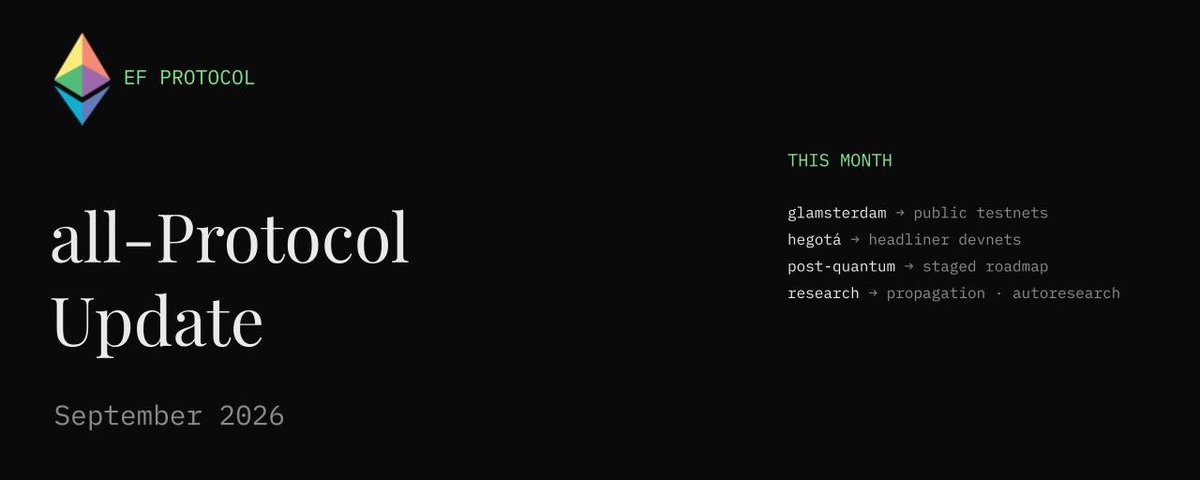
One of the most interesting parts of Ethereum’s post-quantum roadmap isn’t the specific PQ signature schemes it’s researching.
It’s crypto-agility.
Today, ordinary Ethereum accounts are tied to ECDSA/secp256k1. Ethereum’s proposed Frame Transactions (EIP-8141) would change that by making authentication programmable at the account level.
In simple terms, Ethereum would stop mandating a single signature scheme for ordinary accounts and instead let accounts define their own verification logic.
With Frame Transactions, a user could migrate from ECDSA to a post-quantum signature scheme, and later from that scheme to another one, without Ethereum needing a hard fork every time the cryptography changes.
This is what crypto-agility is all about, and what we’ve been raving about for some time now. If a PQ scheme is weakened, broken, or simply superseded, you want to be able to replace it without redesigning the protocol.
What Ethereum is trying to introduce at the account layer is conceptually very similar to something CKB already gets from its architecture.
On CKB, ownership isn’t hardcoded to one signature algorithm. Instead, Cells are protected by Lock Scripts: verification programs executed by the RISC-V-based CKB-VM.
A Lock Script can verify secp256k1 or SPHINCS+/SLH-DSA today, or some entirely different signature scheme introduced in the future.
The base layer doesn’t need to be redesigned around each new scheme. It simply executes the verification program.
It’s very cool to see a leading chain like Ethereum converging on the same conclusion CKB arrived at seven years ago:
Blockchains shouldn’t be built around the assumption that today’s cryptography will still be tomorrow’s cryptography.

Ghrelin++🦍 retweeted

$CKB — NERVOS NETWORK
One of the old infrastructure coins nobody talks about anymore.
But the thesis has changed.
Bitcoin × PoW × RGB++ × BitcoinFi
CKB is building around Bitcoin programmability and scalability, using RGB++, UTXO Stack and CKB Lightning without relying on traditional cross-chain bridges.
Now look at this:
~$0.0011
~$56M MC
Down massively from ATH
PoW secured
Bitcoin-style halvings
What I like:
1 CKB = 1 byte of onchain state.
More assets and applications using CKB means more CKB needs to be occupied.
The weakness?
CKB isn't fixed supply.
There is a 1.344B annual secondary issuance, although Nervos DAO depositors are designed to receive compensation against that dilution.
For me:
Project = A-
Bitcoin Narrative = A+
Technology = A
Token Utility = A
Tokenomics = B
Attention = D
Valuation = A+
Comeback Potential = A+
Old coin.
New Bitcoin narrative.
~$56M valuation.
If BitcoinFi gets another serious rotation, $CKB is one of the forgotten coins I’d watch.
Full research & setups ↓
t.me/Jus7Degen

Ghrelin++🦍 retweeted
CKB Off-Chain is coming to Vietnam! 🇻🇳
In collaboration with @bps_club, we will be hosting a builder-focused event involving CKBuilders, local blockchain developers and students for an evening of education, exploration and networking!
We will discuss what makes CKB interesting and unique for blockchain developers, ways to get started on CKB, as well as presentations from current CKBuilders about their own experiences. It promises to be an enlightening event!

Ghrelin++🦍 retweeted
Most payment networks are islands. Fiber is being built to reach the biggest one next door.
Fiber and Lightning share the same basic machinery, payment channels and multi-hop routing, so a Cross-Chain Hub can sit between them and link a payment on one network to a payment on the other.
Say Alice holds assets on Fiber and wants to pay Bob, who only takes BTC over Lightning.
The hub accepts her Fiber-side payment and makes the matching Lightning payment to Bob, and the two are tied together by the same cryptographic secret, so revealing it to settle one side is what settles the other.
The hub provides liquidity and connectivity, not custody.
It cannot claim the incoming payment without making the outgoing one, because if the condition is not met in time, both sides unwind.
See what's being built on Fiber 👉 fiber.world/showcase