

Assistant Professor @ChemistryMIT, Core member @broadinstitute. Biophysics. Single molecule microscopy. Physical chemistry.
Joined January 2018
- Tweets187
- Following308
- Followers746
- Likes460



Pinned Tweet
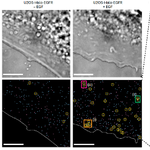
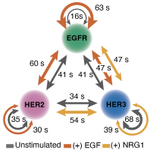
Excited to share our work on ErbB receptors published today @CellCellPress! Using multicolor, photostable UCNPs, we perform long-term (>15 min) single-particle tracking of EGFR, HER2, and HER3, enabling direct visualization of dimerization in live cells. cell.com/cell/fulltext/S0092…
Honored to receive the NIH Director’s New Innovator Award! Many thanks to my amazing group, collaborators, mentors, and @broadinstitute and @ChemistryMIT.

Congratulations to @yerinchen and @CTSPeng for receiving the @NIH Director’s New Innovator Award, and to JT Neal for his NIH Director’s Transformative Research Award. broad.io/HRHR2026

Sam Peng retweeted

Researchers in the Peng lab have recently revealed U-STORM—a revolutionary imaging tech using custom nanoparticles that blink indefinitely without fading, enabling sub-Ångström precision, marking a major leap for biological imaging.
chemistry.mit.edu/chemistry-…

Sam Peng retweeted

Spontaneous and indefinite blinking in upconverting nanoparticles for ångström-precision multicolour super-resolution imaging
Spontaneously blinking UCNPs enable single-source multicolor #superresolution imaging with 0.62 Å localization precision.
nature.com/articles/s41565-0…

Congrats to the whole team lead by Saptarshi Mandal @sappy_superchem! @broadinstitute @ChemistryMIT Also thanks to the editor and reviewers for a thoughtful peer-review process.

Mechanistic investigations revealed that the blinking behavior originates from the trapping of excited electrons at interfacial defect states. While an electron remains trapped, the UCNP does not emit light and stays in the OFF state. When the electron is released from the trap, the UCNPs turns back ON and emit light.

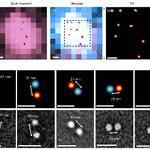
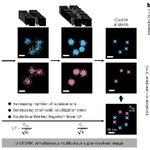
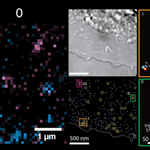
Using blue- and red-emitting U-STORM probes, we resolved a mixture of UCNPs within the diffraction-limited spot. The heterodimers containing Er3+ and Tm3+ UCNPs were indistinguishable in monochromatic scanning electron microscopy (SEM) but were clearly resolved by two-color U-STORM.

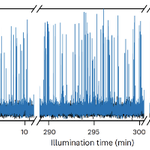
The spontaneous and indefinite blinking allowed us to achieve 0.62 Å localization precision over 88,000 localizations from a single UCNP.

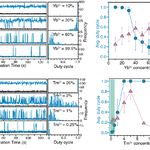
By increasing the sensitizer (Yb3+) concentrations and decreasing the emitter (Tm3+ or Er3+), we identified a regime with intrinsic ON-OFF switching and low duty cycles (~0.9%).

We’ve been using photostable UCNPs to image single molecules over long timescales. But the same stability that makes UCNPs powerful for long-term tracking also makes them poorly suited for STORM. However, by systematically tuning the UCNP composition, we engineered a class of UCNPs that can blink spontaneously and indefinitely!

STORM reconstructs a super-resolution image by sequentially measuring a sparse subset of fluorescent molecules in their ON state at a time. If a probe can blink indefinitely, it allows repeated localization of the same emitter, generating a dense localization cluster and thereby increasing the localization precision into the ångström regime.

Excited to share our work developing U-STORM super-resolution microscopy, now published @NatureNano! We engineered UCNPs that blink spontaneously and indefinitely, enabling two-color U-STORM imaging with sub-ångström localization precision using a simple optical setup without special imaging buffers.
nature.com/articles/s41565-0…

Sam Peng retweeted
Researchers in the Peng Lab use custom-built microscopy and nanotechnology to tag and follow the activity of individual proteins in real time.
chemistry.mit.edu/chemistry-…

Sam Peng retweeted

Now online! ErbB family receptor dimerization dynamics and dysregulation via long-term single-molecule imaging dlvr.it/TSHgdQ

Sam Peng retweeted
Congratulations to Samuel Charney, Cole English, Julianna Lian, Alvin Meng, Kiarra Ning, and Abigail Strausbaugh Hjelmstad, who were all selected to receive 2026 @NSF Graduate Research Fellowships!
chemistry.mit.edu/chemistry-…
