

Deep dives on the stocks for the long run. Full thesis and thoughts on substack. By @CKCapitalxx + @VantixResearch https://nitter.gq/t.co/O8KNqbHzzK
Joined June 2026
- Tweets105
- Following43
- Followers3.9K
- Likes189






Vicor Update, Part Four is live, and it is about the strangest license in this whole story.
In 2025, the Trade Commission found that Foxconn held a license to one of $VICR’s most important patents. Nobody negotiated it. Foxconn never paid for it. It came from fine print in a purchase order and ONE email from a Vicor salesperson about shipping dates. In Part Two we called this the question that should concern a bull most, because that ruling is the crack every respondent wants to widen.
That question just went on the record at the Federal Circuit, and Part Four walks through what was actually said, the battle of the forms, whose fine print won, and why we now think a ruling for Foxconn got LESS likely, while the other side confirmed the very mechanism the royalty thesis rests on.
Nothing in our earnings model changes. We never assumed a Foxconn royalty, and the $43 million quarterly floor does not depend on this case. Targets unchanged from Part Three, $245 base, $430 bull, $315 probability weighted, against a close near $147.
Inside, the full argument breakdown, the risk map after the hearing, and the dates that matter next, including a Commission target date on November 23 and management’s own words that new license deals could close THIS quarter while two hyperscalers sit on quotes rising 5% a month.
Part Four below.

The Market’s ATM is live, and it starts with the detail everyone stepped over on Thursday. The Philadelphia Semiconductor Index fell 12.3%, Micron fell 17.5%, the 3x semis ETF lost 38.5% in one session, and gold closed GREEN. That last part is the whole note.
For most of this year, gold fell whenever chips cracked. In September and October, SMH had nine days down 2% or more, and gold fell on eight of them. October made even less sense, real yields fell, the usual gold drivers all pointed up, and gold dropped 6.9% anyway.
The usual drivers do not explain that. Forced selling does. Crowded funds were using gold as the ATM, selling whatever still had a bid to meet the pressure elsewhere in their books. This week the ATM started to close, three ugly semi sessions in November and gold rose on all three.
Here is what we think actually broke, and it is not AI demand.
The market is repricing who can FINANCE new AI capacity, not who benefits from it, and it is selling both as if they were the same thing. The piece walks the full cascade, why the lender stocks, Blue Owl, Blackstone, Apollo, are the better tell than high yield spreads, which sit at 332bp, wider but nowhere near broken.
And it ends with the numbers that define the moment, NVIDIA at about 15x forward earnings growing 75%, Broadcom 19x growing 83%, while Costco trades at 47x growing 11%. The market is paying more for safety than for growth.
Inside, the credit tripwires we are watching, what would make us wrong, and the exact order we would buy AI back in. Hold, do not chase, and read this one before Friday’s jobs report.
Link below.

$FTAI Part Two is live!
Q3 was the best quarter in the company’s history. Aerospace margins came back to 31%. Modules hit a record. Power went from one order to more than 100 units under contract, and the customer paid $234 million before a single turbine shipped.
We read the filings line by line, and it tells a different story than the slides. The old margins were built on nearly free engines from FTAI’s own lease fleet, and that supply is almost gone. Most of the EBITDA beat came from a new definition. One customer was 37% of revenue. And the DOE rule on Chinese equipment, the biggest risk to Power, lands December 24.
The business got better. The stock got more expensive. We break down what that means and what we think FTAI is worth now.

Four companies account for 73% of the money owed to 15 data center builders in year three.
Microsoft $MSFT, Meta $META, Anthropic and OpenAI.
Only two of the four are investment grade. And most of that money doesn’t buy buildings. It buys about five years of compute, or leases that haven’t started yet.
That’s Part 2 of The Data Center Bridge.
What we found:
$53.0 billion in signed contracts come due between Nov 2028 and Oct 2029. Strip out the builders paying each other, like $CRWV paying rent to landlords such as $GLXY, $APLD and $CORZ, and it’s $50.2 billion.
Only 8.2% of it is what “hyperscaler tenant” makes people picture: a long lease from a company that will be there in a decade.
About two-thirds of the money sits before rent commencement, which is the point where the payer’s ability to walk away changes sharply.
$NVDA’s own 10-Q draws the line. Hyperscalers fund their own buildings. Everyone else needs help, and NVIDIA is now giving it, with guarantees capped at $105 billion on OpenAI’s 20-year leases.
$AMZN’s CEO said neoclouds are “about 3,500 basis points worse in operating margin than if you long lease them.”
In October the market sold every builder at once, from $NBIS to $IREN to $CRWV. The stock market hasn’t yet separated the few that are protected from the many that aren’t.
Part 1 said twelve of fifteen can cover their fixed bills once contracts pay. Part 2 asks who is actually paying, and what they can walk away from.
Full report below.

3
1
856


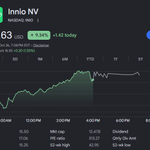
$INIO Update, Part Two is live. The Factory Filled Up. The Float Did Not.
On October 27, $INIO reported the best quarter in its history. Revenue up 57%, data center customers ordering $1.8 billion of engines in three months, EBITDA up 70%, the full-year guide raised, and backlog doubled in a year to $8 billion. Including services, $10.9 billion now sits in signed paper, roughly two years of revenue. Every test we set in Part One passed. The stock still trades below where Part One published.
Nothing went wrong with the business. Something is about to happen to the float, and that is what Part Two is about. On November 30, the lock-up on 646.5 million sponsor shares expires, 86% of the company, against roughly 103.5 million shares trading today. We walk through the one precedent this year for a sponsor-owned power equipment IPO crossing its lock-up, and why the first print AFTER the expiry is the one that re-rates the stock.
Also inside, the rule nobody noticed, INNIO takes no neocloud orders and prioritizes buyers holding 15-year hyperscaler offtakes. Committed capacity hit roughly 19 gigawatts, yet by our estimate only about a fifth of 2029 to 2031 is spoken for, which is where the next price reset lives.
We checked the Waukesha ramp through the city's planning files and the careers page, it is real and running early. And at current prices, our model says the market is paying for a factory that stops growing next year.
Target moves from $27 to $28. The full model, the float playbook, and what we got wrong in Part One, all inside.

885
Part One of our Data Center Bridge series is out, with more parts on the way.
In this part we covered the question hanging over the entire sector, is this 2000 again. We rebuilt the filings of eleven hosting and fiber companies from the dot com era and measured whether they could pay their fixed bills from the cash they actually made. None could, the median covered 17 cents of every dollar owed. We then ran the same measure on fifteen small and mid cap data center companies today. The median covers 52 cents, and ten of fifteen still cannot pay their fixed bills from current cash.
We also covered the part that does not rhyme with 2000. Back then the demand came from startups spending raised money. Today the end of the chain is $MSFT, $GOOGL, $META, and $AMZN with signed orders, and on contracts already in hand, twelve of the fifteen cover their bills by year three. The risk is not fake demand, it is timing. The cash has been promised, not paid, and for five of these companies more than half of next year’s cash comes from contracts that have not started yet.
That gap is what we call the bridge, getting from signed to earned to funded to delivered to paid. The market prices these fifteen companies as one trade. They are fifteen different bridges, and some are much longer than others.
Part Two covers who is actually paying and what stands behind them. After that, single name deep dives, starting where our numbers and the October selloff disagree the most.
Full piece on the Substack.

3
893
Reminder that $INIO reports tomorrow morning, with the call at 8:00 AM ET. A recap of the setup from our deep dive, The Grid Can Wait, The Data Center Can’t:
-Backlog grew from $1 billion to $6.6 billion in 18 months, with 15GW+ of engines committed into 2031
-Customers prepaid $1.4 billion, in an industry where nobody prepays for engines
-VoltaGrid’s 2.3GW order was the largest in company history, with Amazon running 280 Jenbachers in Pennsylvania and 620 more across Vantage, Oracle, and OpenAI sites
-Capacity path toward 10GW per year by 2030
-Full-year guidance stands at $3.8 to 3.9 billion, and last quarter beat on both lines
The Street looks for roughly $1.04 billion in revenue and $0.11 in EPS.
What we are watching is not the quarter, it is the backlog number, whether prepayments keep climbing, any update on the capacity expansion timeline, and whether the full-year guide moves up.
One structural note from the deep dive worth repeating into the print, the float is roughly 14% of shares, so the reaction in either direction will be amplified.

1
5
1,076
Our Tower Semiconductor deep dive is live.
Open a 1.6 terabit optical module and count the lasers. The mainstream design needs four. Built on the right $TSEM chip, it needs two. Lasers are the scarce input in AI optics, rationed through 2028 on Mizuho’s own capacity forecast, and Tower makes the silicon that wastes the least of their light.
Every 3 decibels lost demands double the laser power. Tower’s real product is the decibels it does not lose.
The customers already voted, $290 million prepaid in cash for wafers that do not arrive until 2027, with photonics running from 5% of sales in early 2024 toward a $1 billion annualized rate by year end. The stock still fell 35% in thirteen sessions on macro fear, pricing the wrong risk at the wrong time.
The piece covers what the Street is mis-modeling, including the April 2027 move to full ownership of the Japanese 300mm fab, and lays out our three cases with the dated tests that would change our view, the bear case included.
Full breakdown on the Substack.

$VICR Update, Part Three is live.
The number that matters from yesterday’s report. In the three months ending September 30, $VICR earned more than twice as much operating profit from companies using its patents as from everything it built in its own factory. Royalties hit $66.6 million against $21.7 million a year ago. The licensing campaign is no longer a story. It is the income statement.
The headline most people saw was a revenue blowout and an EPS miss, and the miss is misleading. In the first half, stock option exercises pushed Vicor’s tax rate negative and flattered the numbers. This quarter the rate simply normalized. Pre-tax income of $78.7 million came in well above what anyone modeled. The business beat. The tax line stopped helping.
Then the CFO gave the number the whole thesis now rests on. Fourth quarter royalty revenue of at least $43 million, assuming not a single new license gets signed.
The founder called that floor very conservative on the call. Net of legal costs, the floor alone is worth roughly $138 million a year of operating profit before anyone new signs, and his own stated goal is $300 million of licensing income within a couple of years.
Part Three grades every question we set before the print, the ones answered, the royalty estimate we got wrong by a third because the September license was bigger than we assumed, and the 800V product that is still missing. It closes with our full three-case valuation and how we weight them.
One half of this company is limited by how fast it can install equipment in a fab. The other half is limited by how long two hyperscalers can watch a price list rise 5% a month. The product line has to wait for the factory. The royalty line only needs a signature.
Full piece on the Substack.

$103.4 billion of contracted revenue. 2.5% of it actually running. That is the entire Nscale IPO in two numbers, and our full deep dive on it just went live.
Nscale is a three-year-old British neocloud trying to list in New York with the biggest backlog-to-reality gap we have ever analyzed. Five active sites totaling 55 megawatts, against contracts calling for roughly 1,370.
The bulls see a $100 billion backlog selling at a fraction of face value. We think the backlog IS the problem.
Here is why. Every contract transfers the risk of being late onto Nscale, and the anchor customer writes brutal terms, capped liability, step-in rights if Nscale stumbles, and no parent guarantee in the filed text. $MSFT has already terminated one tranche, the first reported at any neocloud, and let a 1.35 gigawatt letter of intent lapse.
And Nscale locked its biggest contracts at 2025 prices, around $2.55 to $3.80 per GPU hour, while the market rate spiked past $6. They see none of that upside until renewals in 2031, when today’s chips are two generations old.
Run the contracts one at a time and the equity is worth low to mid single digit billions. Stack every favorable assumption we could defend and it reaches about $15 billion. The IPO was pitched at $30 billion. Investors are reportedly already pushing back to $16 to 19 billion, and they are still above our math.
To be clear, this is not a neocloud hate piece. Delivered $MSFT capacity is a great receivable, and the well-run names in this space earn their multiples. The point is that not all backlogs are equal, and this filing shows a delivery schedule, a financing schedule, and a list of people who can walk away.
Full breakdown on the Substack, every site, every contract, every power connection traced.

$VICR just reported Q3.
-Revenue: $197.1M, up 78.5% year over year and 37.5% from last quarter
-Royalty revenue: $66.6M vs $21.7M a year ago
-Gross margin: 68.3%, up from 58.0% last quarter
-EPS: $1.33 vs $0.63 a year ago
-Cash from operations: $69.7M
-Cash: $513.1M
-Backlog: $406M, up 166% year over year
Key takeaways:
-Margins stepped up again. Gross margin is now 68.3%.
Royalties are over a third of revenue.
-The first license for the newest power delivery tech went to an AI OEM.
-They’re buying two more sites, which management says gives nearly 5X the capacity of Fab-1 across 3 fabs.
-Backlog keeps growing and demand is still ahead of supply.

Vicor guided the same quarter three times in 71 days.
Jul 21: Q3 up nearly 10%.
Sep 21: up more than 20%.
Sep 30: up more than 30%, so above $186.4M.
The product forecast never moved. Both raises came from one source: royalties on Vicor’s first non-exclusive Vertical Power Delivery license.
Back out what was already contracted, and that license works out to roughly $28.7M in a single quarter. For comparison, Vicor’s royalty for all of 2025 was $57.4M.
$VICR reports tomorrow before the open. Here’s what we’re watching.
First, is it a run rate or a catch-up? If the license pays per unit sold, part of Q3 is back royalties on units that already shipped. Vicor has done this before: Q3 2025 royalty spiked, then fell 33% the next quarter. Whatever the Q4 guide implies for royalty answers this.
Second, opex. The May license added $4.4M to SG&A for contingent legal fees. Royalty has no cost of goods, but it isn’t free. If opex jumps again, the new license carries the same cut.
Third, the product side. Customer feedback on Gen2 VPD, and how quickly the fab reaches $1.5B in capacity. Fab space isn’t what limits Vicor right now. Customers are.
Our line is simple. Q4 royalty under $25.4M means the new license doesn’t recur. Anything above that means Vicor now has two engines, and the second runs at nearly 100% gross margin.
Part 1 and Part 2 are on our Substack. Part 3 drops after the print tomorrow!
