

Father of 5️⃣ | Urologist @laheyuro | Associate Prof | MIS robotic onc | 🎸| Personal finance rants | Workplace efficiency enthusiast | Founder @wellprept 👈
Joined October 2012
- Tweets18.5K
- Following5.9K
- Followers22.4K
- Likes38.3K







Pinned Tweet
When I was 15, I learned firsthand what grit truly looks like.
It was 1990. My mother was 42 and two years into a confirmed Multiple Sclerosis diagnosis—a condition she had suspected since her twenties.
She was a dynamic middle school French teacher, beloved by her students. Her South African accent captivated them whenever she snuck in a few sentences in English. She had a way of lighting up any room.
My mother's passion for French took her from South Africa to Paris as a teenager, where she studied at the Sorbonne. Though English was her native tongue, she also spoke Afrikaans and Hebrew.
Fast forward to 1990: she was teaching at a private school in the NY suburbs, but the public schools offered better salaries (is this still true?). My mother wanted a position in the local public school system. However, the demand for French was dwindling, with Spanish on the rise. She couldn't get a public school teaching job.
So, she took a bold risk. She left her job and took a year off to get certified as a Spanish teacher. Only a year? How would that work? Despite not speaking Spanish, her strong foundation in romance languages gave her the confidence to learn quickly.
What she did next was remarkable. She went to the local community college and declared she wanted to take Intro and Spanish 101 simultaneously. The registrar said it was impossible—Intro was a prerequisite for 101.
"How about I register for Intro and audit Spanish 101?" she proposed. "If I pass both, you give me credit for both." They agreed.
She aced both classes.
That summer, she immersed herself in Spanish literature and Telenovelas. She used a Spanish-English dictionary and even a French-Spanish dictionary, finding it easier to map French to Spanish than English to Spanish. This detail still amazes me.
She repeated her (now precedented) request for Spanish 201 and 301 and aced them both, earning all the credits needed for Spanish Teacher Certification in one year. This landed her a job, eventually tenured, teaching both French and Spanish at the local public school.
My mother passed away from complications of Multiple Sclerosis three years ago. Her determination and resilience continue to inspire me.
Where did she get this incredible determination? Her father, my grandfather, immigrated from Lithuania to South Africa at age 14. He worked in a furniture factory, saving half of his weekly salary for English lessons. Through sheer hard work and perseverance, he eventually owned the factory.
As a young child witnessing her perseverance, I witnessed the true meaning of grit. Now, as I steer @WellPrept from idea into existence, and now help it expand... I frequently reflect on her tenacity. Every day, I try to embody her ability to tackle challenges head-on and her unwavering belief in herself.
I think you can see it in her eyes in the photo.

𝙳𝚊𝚟𝚒𝚍 𝙲𝚊𝚗𝚎𝚜 retweeted

UrologyWatch.com keeps an eye on urology. Two, actually! Come say hi.
I fully agree that surfacing evidence at the point of care will improve care quality dramatically.

Karan Singhal of @OpenAI on why new clinical guidelines can take 5 to 17 years to reach everyday doctors, and why he wants to compress that to days or even hours:
"You basically have a bunch of people writing papers, biomedical papers of various kinds, suggesting improvements or treatments. And then you have this yearly process across different specialties of building clinical guidelines."
"These clinical guidelines are roughly, you can consider them kind of flowcharts... that describe roughly what you should do in different scenarios based on the latest research."
"So you have the biomedical literature, you have the clinical guidelines, and then you have what do people actually do in practice. The final step, it turns out, is a massive bottleneck."
"People have found that this takes, depending on the study, like 5 to 17 years for that penetration to actually happen. You don't wanna be practicing medicine 5 to 17 years behind."
"One of the things that we think about is how do you compress that kind of period of practicing in the past down to weeks or days or even hours."
@thekaransinghal @JayRughani
𝙳𝚊𝚟𝚒𝚍 𝙲𝚊𝚗𝚎𝚜 retweeted

What if some of what weve been taught about testosterone therapy is just…wrong?
For years, we've worried about testosterone increasing the risk of heart attacks, fueling prostate cancer, and worsening urinary symptoms.
But here's the thing. The science has evolved. And now, even the FDA is rethinking some of its longstanding warnings and restrictions.
So what changed? And why did it take so long?
Tomorrow (Tuesday, October 20), I get to ask these questions to three people who have been right in the middle of it all.
I'm moderating a Urology Times webinar with Abraham Morgentaler MD, Mohit Khera, and Dr. Helen L. Bernie. Not only have they contributed to the research thats changing how we think about testosterone, theyve also been part of the conversations with the FDA.
And I have QUESTIONS.
Can men with a history of prostate cancer safely take testosterone?
What did the largest cardiovascular safety trial of testosterone actually show?
And what didn't it show?
Are we undertreating men because of outdated fears? Or are we sometimes overtreating men because testosterone has become so popular?
What happens when the FDA changes its position on something physicians have been taught for decades?
And perhaps my favorite question: What are we going to look back on 10 years from now and say, I can't believe we used to think that?
I love these conversations because medicine isn't supposed to be about defending what weve always believed. It's about being willing to change our minds when the evidence changes.
Whether you're a clinician who prescribes testosterone, someone currently on therapy, or just curious about where the science is heading, this should be a fascinating discussion.
Join us tomorrow! Its virtual, and well be taking audience questions.
Register here: globalmeet.webcasts.com/star…

I feel every word of this. Deeply.

AI was supposed to make us work less
I've never been this tired in my life
most days I have up to 10 agents running at the same time. one fixing a bug, one writing pages, one refactoring something I already forgot I asked for, 3 other I have no idea what they are doing but i suppose i ask it?
and I jump from conversation to conversation all day
compared to 5 years ago, I probably context switch 100x more
by the end of the day my brain is fried. completely toasted. nothing left, not even for the people I love
I call it the fried brain effect
thought it was just me but almost every founder I talk to lately says the exact same thing
we got superpowers, and somehow the pressure only went up. if you can ship 10x more, you feel like you have to ship 10x more. every single day
I don't have a solution
honestly I have no idea where this goes from here
anyone else feeling this?
In healthcare instead of saying "Out of an abundance of caution, we did X"....
Instead often it's "Out of an abundance of bureaucracy we did X...."
𝙳𝚊𝚟𝚒𝚍 𝙲𝚊𝚗𝚎𝚜 retweeted

UCLA Urology has a long history of impactful basic science discoveries, clinical innovation, practice-changing trials, FDA drug/imaging approvals, and mentorship of future leaders.
We are hiring a Vice-Chair of Research: recruit.apo.ucla.edu/JPF1131…
DM if questions/nominations


𝙳𝚊𝚟𝚒𝚍 𝙲𝚊𝚗𝚎𝚜 retweeted

IMO if you haven't tried out any of the personal AI assistants (muse, instinct, etc.) you shouldn't be allowed to talk on panels about what the "front door to healthcare" is
I'm very surprised at how many people that work in healthcare have not tried these tools out - my 2 cents is that the future of discovery, booking things, buying things, etc. is going to route through some form of personal AI agent.
The shape of how healthcare companies get discovered by these tools is going to be incredibly important + all human systems are basically going to get flooded by requests from personal agents and healthcare cos will need agents on their own side to filter/execute commands
If you haven't even TRIED them out yet when the barrier to doing so is essentially 0, how can you possibly opine on what the front door is?
It's even fine if you try it and come to the conclusion that this is NOT how consumer will interact with healthcare, but you have to try it!
𝙳𝚊𝚟𝚒𝚍 𝙲𝚊𝚗𝚎𝚜 retweeted
New on UrologyWatch: Urology on the Move.
Urologists starting new jobs, taking leadership roles, retiring and winning awards, from public announcements. Updated daily.
Filter by AUA Section, state and metro area, or share your own news.
urologywatch.com/moves

Delivered to patients using @WellPrept

Just created an educational video on testosterone therapy with @claudeai and other tools. Used programmatic animation instead of text-to-video to have complete visual control and reduce diffusion artifacts.
youtu.be/S-ZsBmMDPlg?is=Mf-u…
Inspiration: @kevin_t_ngo, @wustep, @claudeai Fable 5.1 launch video
Pipeline below in 🧵...

𝙳𝚊𝚟𝚒𝚍 𝙲𝚊𝚗𝚎𝚜 retweeted
New: UrologyWatch Fellowship Navigators for andrology and sexual medicine (43 programs) and male infertility (29).
Who is in the AUA Andrology Match, who hires directly, length, contacts and an applicant board.
urologywatch.com/fellowships…


𝙳𝚊𝚟𝚒𝚍 𝙲𝚊𝚗𝚎𝚜 retweeted
New on UrologyWatch: the GURS Fellowship Navigator.
All 29 reconstruction fellowships, with each program's case mix from the public GURS year-end logs set against the GURS minimums, plus deadlines, contacts and an application checklist.
Free: urologywatch.com/fellowships…

𝙳𝚊𝚟𝚒𝚍 𝙲𝚊𝚗𝚎𝚜 retweeted
① STAMPEDE analysis finds no significant cardiovascular risk increase with ARPI intensification
② AUA Census: fellowship-trained urologists rose from 40% to 46% over a decade, general urology fell
Today's urology Top 5, Oct 7: urologywatch.com

This really is an incredible video. Kudos to @lee_c_zhao
This should be mandatory for all trainees

Such an engaging watch: The Glass and the Stone, a 67-minute animated history of urology, from a bladder stone in an Egyptian grave to the surgical robot. Commissioned by @lee_c_zhao.
Now on our Urology History page: urologywatch.com/history
youtube.com/watch?v=Z_07R6bu…

This really is an incredible video. Kudos to @lee_c_zhao
This should be mandatory for all trainees
Such an engaging watch: The Glass and the Stone, a 67-minute animated history of urology, from a bladder stone in an Egyptian grave to the surgical robot. Commissioned by @lee_c_zhao.
Now on our Urology History page: urologywatch.com/history
youtube.com/watch?v=Z_07R6bu…
This is the way

We don't ask whether a model touched their prose. We ask authors to own every word.
@JACCJournals parted w/ICMJE & doesn't require disclosure of AI writing help: the rule is unenforceable, biased, & not good for medical communication.
My Editor's Page: jacc.org/doi/10.1016/j.jacc.…

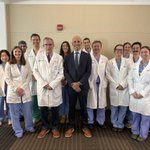
Tremendous thank you for having me today at @WVU_Urology. what an incredible department and fantastic group of residents!


𝙳𝚊𝚟𝚒𝚍 𝙲𝚊𝚗𝚎𝚜 retweeted

mm pattern 4 on biopsy far superior predictor of prostate cancer outcome than stage, grade, PSA, cores. We show using mm criteria rather than "favorable intermediate risk" would increase the number of US men eligible for active surveillance by >50,000. bjui-journals.onlinelibrary.…
