

Analysing Football. Studying the game, one phase at a time. Professionally unbothered. For business inquiries and collaborations: [email protected]
Joined October 2021
- Tweets55K
- Following1.8K
- Followers6.2K
- Likes22.6K





As I continue to develop my skills in tactical analysis, I would love to connect with fellow analysts who closely follow different clubs and have a deeper understanding of their respective tactical philosophies.
I primarily follow Manchester City, and I've realised that when analysing other teams, I may not always have the same level of familiarity with their tactical principles, recurring patterns and the broader context behind certain decisions.
I'll be sharing more tactical clips and observations from matches involving different clubs, and I'd genuinely appreciate insights, constructive criticism and alternative interpretations from those who follow these teams regularly.
I believe tactical analysis becomes much more valuable when different perspectives are considered, rather than drawing conclusions from isolated sequences without understanding the bigger picture.
So, if you're a tactical analyst or simply someone who enjoys studying the game, feel free to connect and engage with my posts.
I would love to learn from your perspectives, exchange ideas and improve together.

I understand that Liverpool's team intention in essence was to exploit the space in-behind the Brighton back-line.
Alisson's intention with that long-ball towards Barcola was also the same, although the latter was not on the same wavelength as he did not make the run initially.
Fortunately, the ball ended up in the space which was meant to be exploited as Barcola outpaced Boscagli, got the ball and put it on a plate for Isak, whose positioning and movement were inch-perfect.
@TacticNotes, I would appreciate your thoughts as you closely follow Liverpool and might be able to correct me if I am wrong. Cheers!
From a broader perspective, we tried to exploit the space in-between the lines against Brighton, while Liverpool tried to exploit the space in-behind the Brighton defensive line. The former can be difficult if the opposition keeps their structure compact.
That's the difference.
Attract, then release runners to exploit the space behind the opposition back-line.


One of the inherent vulnerabilities of teams that press aggressively as a unit is the space they inevitably leave behind their initial pressing lines.
This presents an opportunity for the opposition to deliberately attract pressure, drawing multiple players forward and creating spaces between and behind the pressing structure.
Through intelligent positioning, quick combinations and press-resistant dribbling, teams can exploit these spaces before the opposition has time to recover.
The key is to manipulate the pressing team's collective movements. By drawing the press towards one area and subsequently bypassing it, the opposition can disorganise their out-of-possession (OOP) structure, leaving defenders exposed and forcing them into reactive situations.
The more aggressively a team commits players to the press, the greater the potential reward for the opposition if they successfully break through it.
Here is an example where Gravenberch initiated the opposition press, and Kerkez and Wirtz exploited the space created as a consequence to reach the box.
For Rico Lewis.

Active Defending is one of my 9 coaching principles. And it's something I believe we should develop from a young age.
Too often, I see young players defending by reacting to what the opponent does.
They wait for the opponent to make a move.
They allow the ball carrier too much time and space.
They follow opponents instead of anticipating what might happen next.
And sometimes, they're simply afraid of getting beaten.
I want something different.
I want players who take responsibility for defending and actively try to influence the game.
Let me explain how I approach it.
//
1. Don't wait for the opponent to make a decision
When an opponent receives the ball, I want our nearest defender to recognise the situation immediately.
Can they close the space?
Can they apply pressure?
Can they prevent the opponent from turning?
Can they force the opponent into a less dangerous area?
The goal is to make the opponent's decisions more difficult.
For example, imagine an opposing midfielder receiving the ball with their back to our goal.
If we allow them time and space, they can turn, look forward, and potentially create a dangerous situation.
But if our midfielder closes the space quickly, the situation changes.
Now the opponent might need to protect the ball, play backwards, or make a quicker decision.
That's Active Defending.
//
2. Aggressive doesn't mean reckless
This is an important distinction.
I want players who defend aggressively, but that doesn't mean running towards every opponent at full speed.
Sometimes the right decision is to press immediately.
Sometimes it's to slow down, control the distance, and prevent the opponent from progressing.
And sometimes it's to delay the attack while teammates recover their positions.
For example, in a 1v1 situation, a defender might approach quickly but then slow down before reaching the attacker.
Why?
To avoid getting beaten too easily and give themselves a better chance of winning the ball.
The key is recognising when to:
Apply immediate pressure.
Challenge and try to win possession.
Delay the opponent.
Protect the most dangerous space.
//
3. Defending is an individual and collective responsibility
One player can apply excellent pressure, but if teammates don't react, the opponent might easily play around it.
This is why I want the whole team to defend actively.
When our winger presses the opposing fullback, what happens around them?
Does our midfielder close the nearby passing option?
Does our fullback support the pressure?
Do the players behind adjust their positions?
Good defending isn't just about the player closest to the ball.
It's also about how teammates support that player's actions.
//
4. Train players to recognise defensive situations
How do we develop this in training?
I like using directional small-sided games where players constantly need to defend, react, and make decisions.
For example, a 4v4 or 5v5 game with goals.
When the opponent has possession, encourage players to:
Close space quickly.
Apply pressure on the ball.
Recognise opportunities to win possession.
Cover teammates and protect dangerous spaces.
React immediately when possession changes.
Some simple coaching cues:
Can you get closer?
Can you prevent them from turning?
Is there an opportunity to win the ball?
If your teammate presses, how can you help?
If you can't win it, what space must you protect?
I also think it's important to recognise good defensive actions even when they don't lead directly to winning the ball.
Forcing an opponent backwards, preventing a forward pass, or delaying an attack can all be successful defensive actions.
//
One final thought.
We often talk about teaching players how to defend.
But I believe we should also teach them to want to defend.
To enjoy competing for the ball.
To take responsibility when their team doesn't have possession.
To see defending as an opportunity to influence the game, rather than something they simply have to do.
Active Defending isn't about chasing the ball. It's about taking responsibility, making good decisions, and actively trying to win the ball or prevent the opponent from progressing.
//
P.S. Want to build brave, fast, and competitive players?
Learn how to apply these 9 principles inside Football Coaching Hub.
Try 7 days free: skool.com/football-coaching-…

Currently rewatching the game between Liverpool and Brighton but my mind wanders off to the build-up sequence we had against Brighton in the 13th minute. I cannot wait to rewatch the game tomorrow to break-it-down structurally.


One of the inherent vulnerabilities of teams that press aggressively as a unit is the space they inevitably leave behind their initial pressing lines.
This presents an opportunity for the opposition to deliberately attract pressure, drawing multiple players forward and creating spaces between and behind the pressing structure.
Through intelligent positioning, quick combinations and press-resistant dribbling, teams can exploit these spaces before the opposition has time to recover.
The key is to manipulate the pressing team's collective movements. By drawing the press towards one area and subsequently bypassing it, the opposition can disorganise their out-of-possession (OOP) structure, leaving defenders exposed and forcing them into reactive situations.
The more aggressively a team commits players to the press, the greater the potential reward for the opposition if they successfully break through it.
Here is an example where Gravenberch initiated the opposition press, and Kerkez and Wirtz exploited the space created as a consequence to reach the box.

Brighton's counter-pressing is quite intense, and we cannot be lax on the ball as we have been during most of the transitions.
I have noticed a recurring issue.
From a defensive perspective, one of my biggest concerns with Rico Lewis is his tendency to react to situations rather than anticipate them.
This often leaves him a step behind the play, either caught out of position or on the wrong side of his direct opponent, particularly during defensive transitions.
Anticipation is crucial in these situations. Recognising potential passing lanes, adjusting his body orientation and positioning himself before the action unfolds would allow him to engage opponents earlier, rather than constantly having to recover.
The issue isn't necessarily his willingness to defend, but his ability to recognise danger early enough to prevent situations from becoming dangerous in the first place.
Where was Bouaddi primarily operating in the first-half? Right-sided midfield primarily.
Which space did Brighton exploit for their second goal?
You know what I am trying to imply, it's baffling how O'Reilly has to come all the way to track the runner in the right half-spaces.
Mad.
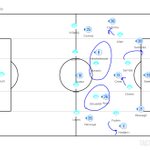
I don't understand the half-press and partial marking OOP (out-of-possession) structure we portrayed to stop Brighton from building their play out from the back.
It leaves so many of our midfielders/forwards in "no-man's land" exposing our defensive line in midfield, which can be/is dangerous as tracking back plus interception simultaneously with the opposition running at you can be a very difficult situation to deal with.
Either we press to push the ball to one end while blocking every immediate progressive option for the ball-player or we sit back and engage once the opposition midfielders or full-backs get the ball.
The half-press and partial-marking in midfield allows the opposition (in this case, Brighton) to drag our players out and the latter trait allows them to comfortable play 1-2s with one another to bypass our midfield and forward lines, exposing our defense completely.
We have a lot of OOP (out-of-possession) mechanics to fix, I recko and I'll love your thoughts.
Onto the next half.
