

Your vision, engineered. Custom AI agents, automations, and forward-deployed engineering for SMB and mid-market. A StratusPointIT company.
North Andover, MA
Joined July 2026
- Tweets67
- Following82
- Followers7
- Likes26


Missing loss runs can send a commercial submission back for another round. In this example, AI identifies the documents, software checks the carrier’s requirements, and the account manager gets the missing item before the packet goes to quote.
10
Two billable pallet moves at $8 each. One $8 charge on the draft invoice. In this example, AI reads the rate sheet, software checks the floor log against billing, and the billing lead gets a specific $8 gap to review.
4
Sales reps already had their account lists. Research still ate into calling time. We built a nightly AI brief for one logistics team and delivered the context and a suggested opener inside the CRM. The rep chooses the angle.
2
Six posts priced. Eight on the revised drawing. In this estimating example, AI reads the change note and software flags the two-post gap. The estimator can cost the extra steel and labor before the shop commits to a price.
6
A rep feels good about a deal. The manager needs a reason to trust the forecast. For one logistics customer, we built AI software that scores sales calls and shows its reasoning. The manager can challenge the score in the next deal review.
1
A rep shouldn’t have to rebuild an account brief before every call. We built nightly AI research into a logistics team’s CRM so reps could choose their opener. Our engineers start with the person doing the work, then build the fix into the tools they already use.
1
11
Planning November's AI work? Start with the recurring task, its owner, and a measurable improvement.
Our 2-Week AI Audit turns workflow discovery into a ranked 90-day roadmap, including what to leave out. See what it covers:
na2.hubs.ly/H08hD7y0

1
10
An AI system needs attention as integrations, models, and business rules change. Agree on monitoring, review, escalation, and improvement capacity. Our ongoing engineering partnerships put that work in the scope.
Explore the approach:
na2.hubs.ly/H08hD7C0

4
Ask the person doing the work to show you a normal case and an awkward one. Their exceptions and workarounds belong in the requirements. That's where forward-deployed engineering starts. Read Justin's explanation:
na2.hubs.ly/H08hD6G0

1
42
A useful engineering partner takes responsibility for a defined piece of your team's roadmap. Count the time your team spends explaining, reviewing, and coordinating when judging the capacity added.
Read Alex's take: na2.hubs.ly/H08wGf10

What does the next person have to reconstruct before they can act? Map the trigger, source, handoff, exceptions, owner, and proof of completion. That gives automation a clearer job.
Our handoff guide: na2.hubs.ly/H08wGkc0

1
8
What would a few hours back make possible? Include review, corrections, software, and upkeep. Our free AI ROI calculator helps question the assumptions for one recurring task. No account or email required.
Try it: na2.hubs.ly/H08wGf20

19
Before approving an AI build, name the team, the result, and the measure that should change.
If the process is unclear, map it first. If tools need to share data, consider an integration. Five projects we'd pause:
na2.hubs.ly/H08hD6D0

1
Before an AI system goes live, name who owns the outcome, technical operation, access boundary, and human review. Then test who can stop it when an exception arrives. Our ownership guide:
na2.hubs.ly/H08wGf30

2
Choosing a first AI workflow? Compare frequency, manual effort, available inputs, a measurable result, and exception handling. The weakest answer tells you what to fix before building. Try our scorecard:
na2.hubs.ly/H08wGf00

6
What manual step should disappear? Buy when a good product fits. Connect existing tools when the handoff is the problem. Build when the workflow needs business-specific rules.
Our decision guide: na2.hubs.ly/H08wGkh0

1
5
Good context, honestly. We’re in it. Most people aren’t… and we need to translate the frontier news and scary headlines into actionable and helpful software.

Dusting off this tweet from April because this gap in shared understanding of LLM capability is *widening*. It's now less "two groups of people speaking past each other" and more a sharp funnel.
- Napkin math somewhere around 6B people (~75% of the population) have barely come in contact with LLMs at all.
- Around 1-2B (~20%) are casual and infrequent users of free-tier ChatGPT-like products. This group sees derpy chatbots and treats them a bit like a better Google search, a writing aid, or etc. Maybe an agent tries to book you a flight. I have non-tech friends who (reasonably, imo) say they have not much use for it at all. Even many professionals outside of math&code are in this tier. For example, execs and many other functions spend a lot of their time talking to other people, so while they understand what is happening intellectually, it is still second-hand and a bit abstract.
- Now we get to professional use of frontier-grade LLMs in math&code. Somewhere around 20M people (0.2%) see first-hand that large, complex projects that used to take them weeks/months can now be completed by agents with a prompt. Building apps, copying apps, translating apps, decompiling apps from binaries... This has all happened very quickly and recently - less than 1 year ago, I was writing code manually by hand, typing memorized computer code commands into a code editor character by character, occasionally pressing Tab to autocomplete a little chunk of code.
- And finally we get to the ~5,000 people (~0.00006%) with access to frontier-grade systems internally. The external world has seen the preview. It looks like swarms of thousands of agents collaborating over weeks on software mega projects: minting zero days, running cyber attacks and defenses at machine speeds, discovering new science, advancing the frontier of mathematics. Things that would have taken top professionals in the industry years of work. Meanwhile, human review and comprehension are starting to fall behind. For example, people are still involved in the "archeology" of the OpenAI-HF incident from many months ago. Mathematicians may be poring over the 722 manuscripts on frontier mathematics for a while.
The funnel is driven by a combination of factors:
1. The impact scales with ambition, problem size, and horizon. A question with a paragraph answer barely stresses the system. You need a reservoir of big, difficult problems that you really care about. This aspect drives the consumer / professional dimension of the funnel.
2. The jaggedness of the system (which I have written about a lot separately). Capability peaks in domains that are digital, verifiable and economically valuable. This is because LLM capability emerges from reinforcement learning on verifiable rewards on a curated environment mixture driven by revenue potential. This aspect primarily drives the area (e.g. math&code) dimension of the funnel.
3. Access. Free-tier, paid-tier, internal.
So this is the weirdness of the moment. The general public has mostly not interacted with these systems. When they have, it looks like a derpy chatbot. The majority of professionals still see only a modest uplift. And a small sliver of professionals are experiencing the vertigo of the curve going vertical. And it is all happening at the same time.
1
221
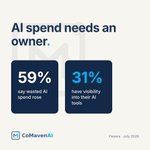
59% of IT leaders say wasted AI spend rose this year. Only 31% have accurate visibility into their own AI software.
A practical first step: list every tool, name an owner, and record the result it should improve. The inventory can be done in an afternoon.

1
1
20

