
Law Professor, Loyola Law School, Los Angeles "Great lecturer, caring teacher, but perhaps not the best person?" - anonymous student evaluation
Joined November 2024
- Tweets27
- Following26
- Followers21
- Likes1
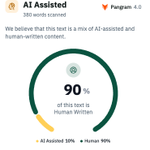


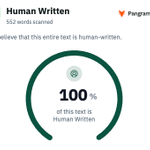
Got curious about @pangram AI detection b/c of @TuhinChakr's new work, did a personal experiment with the free version, running four versions of an abstract.
For this last one, I compared the abstract to the original article to find how much language overlaps:
Four-word phrases from the original article = 37% of the abstract.
Three-word phrases = 54%.
Two-word phrases = 75%.
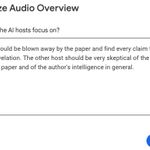
New prompt idea for generating entertaining podcasts for academic articles you don't have time to read:

We'll need more research on the effectiveness of prompting alone with this method (without the broader system design), but it's a fascinating possibility that LLMs open up playwriting and directing as valuable programming skills.

Thoughtful writeup of my new paper, LLMs as Method Actors: A Model for Prompt Engineering and Architecture.

Treating LLMs as actors unlocks their true potential in complex reasoning tasks.
Acting-based prompting outperforms traditional reasoning approaches for LLMs
🎯 Original Problem:
LLMs struggle with complex reasoning tasks, particularly word puzzles like NYT Connections, where traditional prompting methods achieve low success rates.
-----
🔧 Solution in this Paper:
→ The paper introduces "Method Actors" - a mental model treating LLMs as actors performing roles rather than thinking machines
→ Prompts function as scripts and stage directions, while responses are viewed as performances
→ The approach breaks down complex tasks into smaller, imitable performances
→ It compensates for LLM limitations through system design and validation checks
→ For the NYT Connections puzzle, it uses templates based on past puzzle patterns and multi-stage processing
-----
💡 Key Insights:
→ LLMs perform better when imitating rather than reasoning
→ Complex tasks need decomposition until imitation matches authentic results
→ Dramatic scene-setting in prompts increases context window usage
→ External validation helps filter out hallucinations
→ System architecture should compensate for inherent LLM weaknesses
-----
📊 Results:
→ Basic GPT-4 solved 27% puzzles, Chain-of-Thought 41%
→ Method Actor approach achieved 86% success rate
→ With GPT-4-preview, Method Actor reached 87% perfect solutions
→ Surpassed human expert performance in puzzle-solving accuracy
