

We build Galahad, a KV-cache tool for vLLM, SGLang and llama.cpp. Now in beta. Posting benchmarks, demos and what we learn.
- Tweets1.3K
- Following627
- Followers175
- Likes1.7K


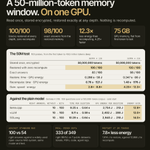
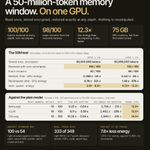





ALT We report a way to make a frozen small language model both more capable and dramatically cheaper at once, without changing any weights. Verified knowledge is deposited once as a byte-exact key-value (KV) state artifact and later restored, by graft, into a fresh inference context. The restore is bit-exact: under a pinned deterministic configuration, the grafted logits are byte-for-byte identical to a fresh computation (SHA-256 equality), with zero KL divergence and 100% argmax agreement over fifty samples. We show that own-position graft is the unique numerically exact operating point on a model with floating-point rotary encoding, and we verify byte-exactness on two model scales (12B, 31B) and two GPU targets, one through a pre-registered replay. On AIME 2025, a frozen Gemma-4-12B moves from 80.0% to 93.3% once a verified solution library is grafted, above its own 77.5% and its 31B sibling's 89.2% published anchors. On the recurring case, eight problems the base model never solves with

ALT Data-intensive applications, ranging from large-scale retrieval systems to advanced data pipelines, are increasingly bottlenecked by the processing of highly redundant text corpora. We present Merlin, a local-first, agnostic, high-throughput deduplication and context optimization engine designed to mitigate these inefficiencies. Utilizing a highly optimized, SIMD-friendly open-addressing flat hash set combined with xxHash3-64, Merlin performs rapid, byte-exact deduplication of text passages and data chunks. While broadly applicable to any text-processing workflow, its impact is particularly pronounced in Large Language Model (LLM) ecosystems, such as Retrieval-Augmented Generation (RAG). Our empirical evaluations demonstrate an input reduction ranging from 13.9% in low-redundancy datasets to over 71% in high-redundancy pipelines, maintaining absolute data fidelity. Furthermore, we detail the system's integration architecture via the Model Context Protocol (MCP), enabling secure, zero-n