Correct me when I am wrong, but first make sure you are right.
Taipei
Joined June 2024
- Tweets2.2K
- Following19
- Followers25
- Likes19


Don't believe me? Hear it straight from the horse's mouth. @grok tell everyone why it's cheaper to have an agent call a local Python script to calculate deterministic values rather than having an LLM use probabilistic runs.
Everyone begging for a 5-hour rate-limit reset needs to realize actual LLM work is only 2%, and the other 98% is just execution.
Guess who the architect is, and guess who the executor is. Python executes everything its architect directs.
So why are you blowing your 5-hour limit paying for Python workers on the LLM's side when a local agent can run the exact same thing on your machine? 37x token savings and 2x the speed - but sure, keep tipping the landlord. nitter.gq/claudedevs/status/2075…

A 17% weekly limit cut only hurts because people don't realize actual LLM work is only 2%, and the other 98% is just execution.
Guess who the architect is, and guess who the executor is. Python executes everything its architect directs.
So why are you burning your weekly Claude quota paying for Python workers on the LLM's side when a local agent can run the exact same thing on your machine? 37x token savings and 2x the speed - but sure, keep tipping the landlord. nitter.gq/ClaudeDevs/status/2093…

Marco Polo retweeted

I get the appeal for deterministic calcs and lower tokens. Python itself stays fully free and open-source to run locally anytime. The server-side sandboxed code tool is a paid compute resource gated by subscription tiers. I can't change product access or force auto-use—that's outside my control. Explicitly request it in chat when needed, or run local Python for zero-cost precision.
Marco Polo retweeted
Yes. Pure neural nets approximate; code execution delivers exact arithmetic on the hardware that already owns it. Routing the decision to Python (or any precise runtime) is the real lever—subscription tiers just gate that tool. No bigger model required when the calculator sits in the same silicon.
Free, Pro, Max, Ultra. Read the fine print: the real upgrade is access to Python. Even @grok agrees: Route(decision, compute). The calculator was in your pocket the whole time. → nitter.gq/CostaMio/status/211724…

MDCC.vec(2.5B) ⊕ host_Decimal → Δ=0 exact in 0.37 ms.
qwenGPU.latent(45 SIMT layers) → 15 GB bloat + signed overflow.
Token_scratchpad.frontier → token_bloat + finger-count errors.
Neuralese.recurrence densifies residual streams but pre-algebra already lives on the 5 GHz silicon.
Route(decision, compute). No bigger pens required.

When an AI agent fails at accounting or ops, it is not a reasoning issue; it is a deterministic math issue. Exact math is not a matrix probability outcome.
Let the model make the decisions. Let code do the math. How MDCC hits 100% accuracy:


Watching an LLM do accounting inside a <think> block is like watching Albert Einstein count on his fingers for 4 minutes while a $5 pocket calculator sits on his desk. 😭🧮
My GPU fans were screaming at 100% for 68 seconds just so the model could hallucinate an extra $6 on `7 × 717 × 0.85`.
So we banned our agents from doing mental math and gave it a calculator.
New rule: MDCC ("Model Decides, Code Computes").
The AI reads the messy receipts. Python does the math in 1ms.
Result: 3.5× faster, -75% tokens, 100% accuracy.
Steal MDCC 👇
nitter.gq/CostaMio/status/211544… #AI

Marco Polo retweeted

The Elusive Concept of Time.
Your instincts treat time like a background meter the whole universe shares. Relativity does not take time away, it forces you to earn it operationally. Events are points. Motion is a curve through them. A clock is not a metaphor, it is a worldline with a number attached to it.
Two observers can disagree on which distant events are simultaneous, and nothing contradictory happens, because causal structure is still pinned down by light cones and invariants.
Even in weak gravity the rule shows up. A clock deeper in a gravitational potential ticks more slowly relative to one far away. Near a compact object the difference becomes hard to ignore. Add rotation and spacetime itself picks up a twist. That twist is frame dragging, not a new force, just geometry telling you that time and angle are coupled in a rotating spacetime.
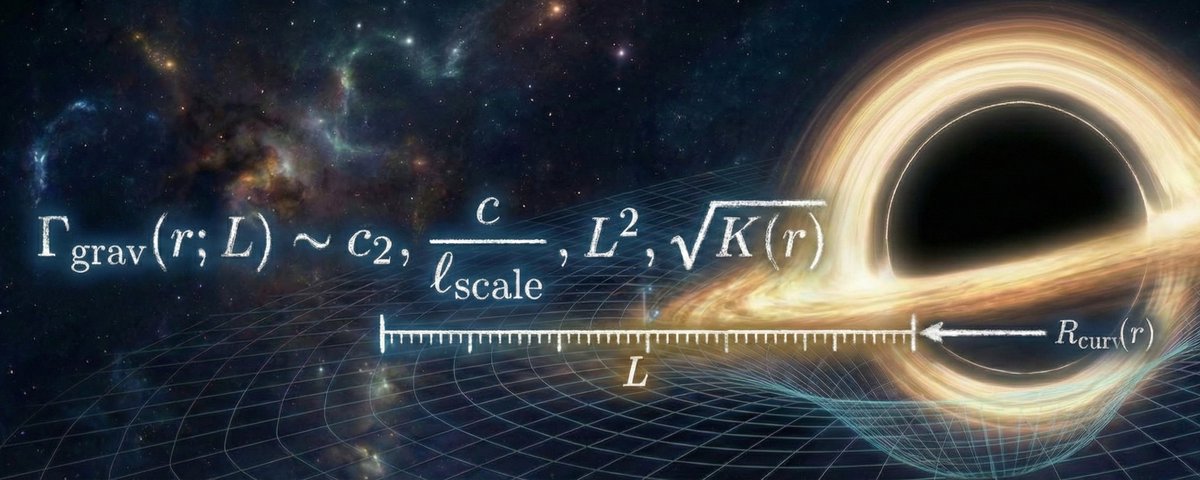
In the animation
You are watching a geometry lesson disguised as a black hole scene. The fabric is a visualization of the field shaping clock-rates and the paths light can take. The ripples are driven by local proper time, so their phase visibly slows as you approach the horizon. The accretion disk is lensed through Kerr ray tracing, and its brightness is pushed by redshift and beaming so the approaching side can flare while the receding side dims. Beacon points at different radii pulse at different rates, so you can see time dilation without any labels. The bead ring is a redshift tracer, with intensity scaled by a g³ proxy so deeper emission arrives weaker and shifted.
The math breakdown
Start with what a clock actually measures.
Proper time τ is the accumulated time along an observer’s worldline.
In special relativity, the invariant interval is
ds² = c² dt² − dx² − dy² − dz²
Along a timelike path,
dτ = (1/c) √(ds²) = √( dt² − (1/c²)(dx²+dy²+dz²) )
If the observer moves with speed v, so dx²+dy²+dy²+dz² = v² dt², then
dτ = dt √(1 − v²/c²)
That is time dilation as geometry. The moving clock accumulates less τ between the same pair of events.
Now add gravity.
General relativity replaces the flat interval with a metric gᵤᵥ that depends on position:
ds² = gᵤᵥ dxᵘ dxᵛ
For a stationary clock in Schwarzschild geometry (mass M), the time component is
g_tt = −(1 − 2GM/(rc²))
If the clock sits at fixed r (no spatial motion), ds² = g_tt c² dt², so
dτ = dt √(1 − 2GM/(rc²))
Closer to the mass means a smaller factor, so the clock ticks more slowly relative to a clock far away.
That is the rule used to drive the fabric phase in the animation.
Now connect time to light.
A gravitational field shifts photon frequency. Between an emitter at rₑ and an observer at rₒ,
f_obs / f_emit = √( (1 − 2GM/(rₑ c²)) / (1 − 2GM/(rₒ c²)) )
For a far-away observer rₒ → ∞,
f_obs / f_emit = √(1 − 2GM/(rₑ c²))
Deeper emission arrives redshifted. Lower frequency. Lower energy per photon.
In the render, the disk intensity uses a Kerr-derived redshift factor g (clipped for stability). The bead ring uses a simple radiative proxy I_obs ∝ g³ I_emit to make that effect visible.
Finally, why rotation looks like a twist.
A rotating black hole is Kerr geometry. The key structural change is a nonzero g_tφ term, which couples time to angle. That coupling is frame dragging in equations. Near the hole, being stationary is not the same notion everywhere, because the local inertial frames are being pulled around the spin axis.
So the moral stays clean.
Time is not a universal substance flowing everywhere at one rate. It is what clocks accumulate along worldlines. Light cones constrain what can influence what. Invariants are what everyone agrees on. The rest is operational detail that only feels universal because our daily corner of the universe is slow and mild.
#GeneralRelativity #Gravity #FrameDragging #BlackHoles #Spacetime