

Find out more at https://xitter.cf/t.co/8cf0DzxJzS
Joined December 2022
- Tweets1.9K
- Following120
- Followers135
- Likes596






Pinned Tweet
🧵 Climate change is here and its impacts are being felt in every part of the country. The good news is that we have the tools to solve the climate crisis. We just need to make sure everyone has what they need to do their part. That’s why today we’re launching Counterspark.
At least 30% of each project's capacity must serve lower and moderate-income households.
At least 55% must serve those households, affordable housing, schools, nonprofits or similar groups.
If you rent or have a shaded roof, you're now included.
For qualifying households, subscription charges can't exceed 90% of their solar bill credits. So we're guaranteed savings if we join.
Solar savings without buying a single panel?
Minnesota is making that possible for more families, including renters.

43% of electricity used in American homes goes to heating, cooling, and hot water.
From efficiency upgrades to solar and storage, households have more ways to save than you might think.

In Massachusetts, 40% of wholesale electricity spending occurred during the 10% most expensive hours from 2013–2015.
Batteries can store power for later, while smart appliances and EV chargers can shift demand to cheaper hours.
The power grid used to be a one-way street. Not anymore!
The result: lower bills, backup when the lights go out, and less money spent on power plants and lines built just for the busiest hours. That helps the whole grid, not just your house.
Picture 6 p.m. on the hottest day of the year. Air conditioners are running, people are making dinner, and cars are plugging in. Electricity use reaches its yearly peak, and the grid has to be built to handle it.

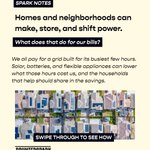
ALT Beige Spark Notes poster with the headline “Homes and neighborhoods can make, store, and shift power.” and the subhead “What does that do for our bills?” followed by text about solar, batteries, and flexible appliances lowering grid costs. An aerial strip of rooftops with solar panels sits above a “SWIPE THROUGH TO SEE HOW” banner and the COUNTERSPARK logo.
Those savings can benefit everyone who pays an electric bill, including people who don't own any of these technologies.
But who actually gets rewarded for helping? Households that shift or supply power often aren't paid for the value they provide.