

Tech, Finance, Economics. Currently in investment research, former startup operator
New York, NY
Joined October 2011
- Tweets2.5K
- Following1.5K
- Followers753
- Likes7.4K






This is the case for basically every company. The more controversial the company, the worse the reporting.

RIP to one of the greatest referral programs ever. Got >$500 of free stuff. Consistent give $75, get $75 to your whole contact list.
Always wondered how the math worked…


Achievement unlocked: First time I had someone say to me "I read this great post about [topic], I forget the author" and I was like "the author was me."
I feel like people are confused about AI coding margins and what they mean.
1) Software's high margins are not because it is distributed at zero marginal cost. Media is also distributed at zero marginal costs, but media businesses barely make any money.
Software has high margins because of pricing power through all the classic advantages: switching costs, network effects, bundling, and regulatory advantages. Zero marginal costs make it easier to grow quickly, but I don't think it has a huge impact on long-term margins.
2) Where AI margins shake out long term is entirely a function of this same pricing power question. Whether Cursor has a 90% margin or a 10% margin will depend on their ability to justify the additional value they are adding and how much competition eats away at this.
3) Even if the whole AI coding industry doubled prices, there'd still be a ton of demand. There is no risk of this industry falling apart if prices end up rising later.
So I don't think too much of these negative margins today and what it says about the industry's future.
The more internal emails come out, the more Zuck looks like one of the best strategic leaders of our time. Extremely clear thinker and writer.


This is the real benchmark we need to track. Most agents need 95% or even 99% accuracy for enterprise use cases, not 80% and certainly not 50%.


WSJ supports my view that Reeses is peak of American innovation, calling their Reeses + Oreo combinations the "Manhattan Project of Snacks"


The peak of American innovation is not the semiconductor or the airplane.
It’s @reeses peanut butter snacks.
Just when you thought they’d run out of ideas, they keep coming up with new ones.
How about normal Reese’s cup, but make it gigantic? Or do white chocolate? Or make a frozen dessert? Or make it an egg?
I just checked and there’s 198 different Reese’s products still being sold. They’ve probably tried at least 500 different concepts.
This is what America is all about 🇺🇸


30% MoM growth on a $10 billion dollar run rate. Wild!

The NYT had an exclusive on the OAI funding round.
- OpenAI has raised $8.3 billion at a $300 billion valuation, months ahead of schedule
- The round was five times over subscribed
- ARR is now $13 billion, up from $10 billion in June projected to surpass $20 billion by EOY
- business users who pay for ChatGPT has reached five million, up from three million a few months ago

It also makes it way easier to hire people around the world. Automated interviews and resume screening, easier to monitor/evaluate, etc.
I still think my piece on this holds up pretty well.


.@balajis says AI enables labor arbitrage at scale.
A lawyer in the US making $200K. A worker in the Philippines making $2K.
Imagine if AI plus human IQ convergence looks like $20K.
A 10x gain for the global poor. A 10x pressure on Western wages.
Great time last night.
I hope the Q&A makes the podcast, especially @tylercowen's comments on his favorite places to travel. Apparently Tokyo has the best French food in the world?

I feel like this is not optimal. Slack makes it very difficult to separate "urgent" from "non-urgent" and incentivizes lots of interruptions.
But nevertheless, every company I know still runs this way.


Charles Rubenfeld retweeted

[New Deep Dive: Tesla, Waymo, and the Great Sensor Debate]
Robotaxis are finally here, but Tesla and Waymo couldn’t be more different. With trillions of dollars of revenue and lives at risk, the stakes are higher than ever.
In our latest deep dive, we unpack the details:

My preferred proprietary measure of enterprise AI adoption is my friend who works in asset management at a highly regulated bank.
They finally have access to enterprise ChatGPT, but aren't able to use Deep Research. Also, no real connection to their internal data.
It's early.
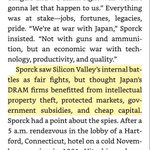
A foreign adversary using less sophisticated chips due to export controls and trying to get around them by leveraging neutral third countries.
China? No, the Soviet Union in the 1960s.

A country accused of IP theft, protecting home grown companies, and government subsidies in the semiconductor market.
China? No, Japan in the 1980s!

Update your timelines accordingly!
Humans are the bottleneck. Good thread

1) It takes *way* longer than anticipated to actually build/deploy custom AI agents for large enterprises.
AI makes the engineering fast. But sales, product, system integration, and implementation are *incredibly* slow.
Customers don't know what they want, getting stakeholders aligned on new initiatives takes time, product requirements change, underlying data is missing / wrong, legal needs to approve everything, internal APIs aren't documented correctly. I feel very confident that AI will not be able to automate a lot of this.