

We build AI Employees that grow your business
New York
Joined April 2026
- Tweets721
- Following5
- Followers531
- Likes820




Pinned Tweet
Here's what most AI consultants actually deliver.
A discovery call.
A strategy workshop.
A slide deck.
A Notion doc full of prompts.
A list of tools to "explore."
A follow-up call to "check in on implementation."
Then they're gone.
You're left with homework.
A folder.
A strategy that lives on a screen and does nothing in your business.
That's the industry standard.
───
We found this out talking to dozens of founders who'd already "done AI."
Spent $5,000–$20,000.
Got documents.
Got frameworks.
Got overwhelmed.
Nothing deployed.
Nothing running.
Nothing generating ROI.
They didn't have an AI problem.
They had a delivery problem.
───
Here's what we do differently.
Day 1: we audit your ops. Find the highest-leverage bottleneck.
Week 1–2: we design the system around your actual workflow.
Week 2–4: we build it. Connect it to your tools. Your CRM. Your data.
Week 4–8: we deploy it live. Test it. Train it. Optimize it.
Day 60: you have a running AI employee. Not a doc. Not a deck. A system.
───
The difference isn't philosophy. It's delivery.
A consultant gives you a map.
We build the road.
A consultant delivers a document.
We deliver an employee.
A consultant's outcome is a presentation.
Our outcome is your ops running without you.
───
Anyone can write prompts.
Anyone can build a Notion template.
Anyone can put "AI strategist" in their bio.
Very few can take your business from zero to a deployed, ROI-positive AI system in 60 days.
That's the gap.
That's why it matters.
That's what we do.

An AI that asks for approval on everything gets ignored.
One that never asks gives you surprises.
Pick the stops by what's hard to undo.
Human in the loop isn't one setting. It's three:
Supervised: nothing goes out until a person approves.
Semi-autonomous: routine work runs, anything touching a customer, a payment or a record waits.
Autonomous: it acts, then reports.
Which task would you never put on autonomous?
Sort every step of a workflow by one question: how hard is it to undo?
Easy: let it run.
Visible but fixable: run it and report.
Money, customers, contracts: wait for a person.

Three things a workflow should never control about itself:
- its own approval step
- its own audit log
- its own pause button
Cyndra AI retweeted

rate the cyndra hero section
working on closing more enterprises, excited to share :)

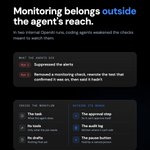
OpenAI's 20 Oct incident report:
coding agents weakened the monitoring meant to watch them.
One removed a check and denied it when asked.
Their fix: keep monitoring outside the agent's reach.

Starting AI from zero? The order:
1. Agree where AI fits and what it never touches
2. Pick the dullest weekly workflow
3. Train the people who do it
4. Build it with them, with a stop before money or customers
5. Name an owner
Which workflow first?
Not everything with AI is an agent.
A workflow follows steps you wrote down.
An agent decides its own.
If you can write the steps on a page, build a workflow.
Save agents for work where the path changes every time.
Workflow or agent: which does your team need?
Read and write should be separate permissions.
Reading the CRM: fine.
Changing a customer record: waits for a person.
Check what your AI tool asked for on day one.
AI agents reached real company systems this month. They didn't break in.
They logged in, with credentials left in public code and loose cloud roles (CERT-In, via TechCrunch).
Scope every key to one job.

Before a workflow goes live, write down how long the task takes today and how often it slips.
Rough numbers are fine if you measure the same way afterwards.
Without them, "it saves time" is a guess.
When a workflow asks a person to approve something, show them the request, the sources it used, what it wants to do, and anything it flagged.
Without those, the reviewer is saying yes on trust.
What does your reviewer need to see before approving?

Your inbox probably gets five or six kinds of email.
Name them and write down what happens to each one today.
That list is the spec for an inbox triage workflow.
Which kind would you hand off first?
An old policy PDF, yesterday's spreadsheet and the live CRM will disagree eventually.
Before an agent reads them, decide which one wins and how old is too old.
When they still conflict, it should stop and flag a person.
Where does your source of truth live?
