

#Bitcoin, Crypto expert, ultimate Degen. On chain analyst and hodler. Timestamper for Ivan On Tech aka Gooseman
Joined September 2020
- Tweets16.7K
- Following649
- Followers5.7K
- Likes15.1K



You don't have to own crypto for this one to reach you. One facilitator in Arizona got eight and a half years over a scheme that reached more than 300 US companies.
Thousands of North Korean IT workers hold remote jobs under fake or stolen identities, and the MSMT estimates they earned $350 to $800 million in 2024. The FBI's advice is to verify identity.
This is for educational purposes only. Not financial advice.
How does your company check that a remote hire is who they say they are?
🤖 Made with AI


On 29 October hackers took about $6.3 billion from Binance's hot wallets, and the FBI says North Korea did it. Its hackers can't be arrested.
We ranked the five levers the world does have. Which would you push hardest?

207
The same company gave two accounts of the call that froze Parity's wallets. Its 8 November 2017 alert said the flaw was triggered accidentally. Its 15 November postmortem said the user decided to exploit it.
The account itself wrote "I accidentally killed it." The chain shows the kill came 51 minutes and 34 seconds after the first transaction, and it can't show intent.
This is for educational purposes only. Not financial advice.
When a company changes its story after an incident, which version do you go with?
🤖 Made with AI

In November 2017 two transactions deleted a library that 587 Parity wallets relied on. 513,774 ether has been stuck since. We rebuilt both transactions from the chain.
Should Ethereum ever change its history to rescue frozen funds?

174
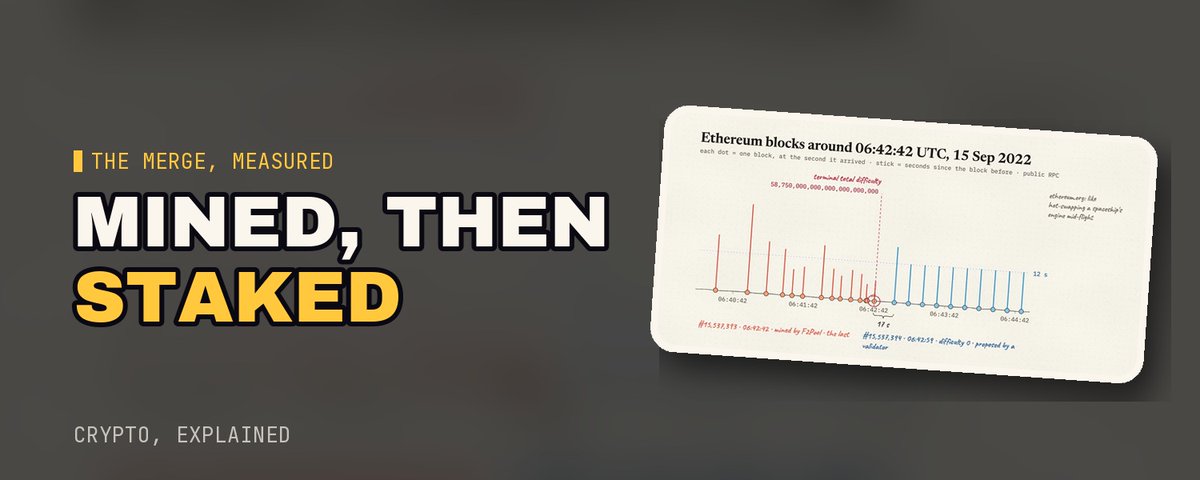
Block 15,537,393 was mined by F2Pool at 06:42:42 UTC on 15 September 2022, and it was the first to push Ethereum's total mining work past the preset finish line.
Seventeen seconds later came block 15,537,394, with a difficulty of zero. A validator proposed it, and it points back to the mined block as its parent.
This is for educational purposes only. Not financial advice.
Did you ever mine ether before the Merge?
🤖 Made with AI

Ethereum's last mined block landed at 06:42:42 UTC on 15 Sep 2022. We measured four years since: block times, new ether, the burn, staking, electricity. Which number surprised you most?
164
Miners sort a block by fee rate, so what you pay depends on how many bytes your transaction takes up.
A typical payment is about 226 virtual bytes from an old-style address and about 141 from a SegWit (bc1q) one. The limits are that your wallet has to support it, and coins on old addresses cost more to move once.
This is for educational purposes only. Not financial advice.
Do you know which address type your wallet pays from?
🤖 Made with AI

Block 840,000 paid its miner 37.6 BTC in fees, 12 times its new coins. We added up every Bitcoin fee since 2009: about 300,800 BTC, all to whoever mined each block. What should pay for security later?

171
Binance says it caught the first step months before 29 October. In June, Engineer A downloaded a tampered Homebrew installation, and security spotted it, replaced the device and rotated all related credentials.
According to Binance, his role and his wallet team colleagues were exposed anyway. In September someone posing as a Project Director contacted Software Engineer B.
This is for educational purposes only. Not financial advice.
When a laptop gets compromised at your work, does anyone ask what the attacker already learned?
🤖 Made with AI

Binance's report on the 29 October hack traces it back to June: a tampered installer, a fake job interview and a coding test run on a work computer. We read it and checked the end on chain. Would you spot the fake recruiter?

1
1
202
Bitcoin keeps no account balances. It tracks separate unspent coins, called UTXOs, and that one idea explains the double-spend rule.
A node asks a plain question about your payment: are these coins real and still unspent? If you try to spend the same coin twice, only one of those payments can get into the chain.
This is for educational purposes only. Not financial advice.
Did you picture Bitcoin as an account with a balance when you started?
🤖 Made with AI

No bank stops you from spending your bitcoin twice, and yet you can't.
We followed one payment through all 11 steps, from the wallet to six confirmations.
Which step had you never thought about?

166
You've probably heard that the white paper set the 21 million limit. We read all nine pages and the number isn't there.
The only wording on supply is in section 6, "a predetermined number of coins". The 21 million comes from the software's schedule: 50 bitcoin per block, halving every 210,000 blocks.
This is for educational purposes only. Not financial advice.
Where did you first hear the 21 million figure?
🤖 Made with AI

Bitcoin's white paper is nine pages long, and it turned 18 on 31 October.
We read it line by line and checked what came true against the raw block data.
Have you ever read all nine pages yourself?

175
Erik Huisman retweeted

Wall Street (Goldman Sachs) just sent a private memo to billionaires admitting the US banking system is running on fumes... while feeding you "rate hike" panic on television so you sell your assets cheap.
Yesterday, 10th Nov, Goldman Sachs officially warned institutional clients that the next major repo liquidity crisis is ALREADY on the 2027 calendar admitting bank liquidity is "just enough to make everything appear normal, but insufficient to withstand any unexpected shocks."
Sound familiar? It should.. because I have been warning you about this exact empty Reverse Repo trap for weeks while bond nerds in my replies laughed and called me dramatic.
Here is the dirty secret they don't put on financial news:
In the EXACT same month the Fed threatens rate hikes on TV, it is quietly restarting Treasury bill purchases in the background because the cash cushion is EMPTY (sitting at 0.15B yesterday on the Fed's own chart).
They scare retail with rate-hike headlines while secretly turning the liquidity tap back on for Wall Street.
Stop staring at red candles and watch the plumbing.. when the Fed has to inject money while pretending to tighten, the trap has already snapped shut.
Keep stacking scarce assets like Bitcoin before the 2027 floodgates blow wide open.

Erik Huisman retweeted

BREAKING: Water is wet.
Of course the woman who wanted to recruit an “anti-crypto army” is unwilling to acknowledge the many positive things digital assets have done for affordability and everyday Americans, so allow me to name a few:
-Payroll processing takes 5 days on average today, as you can see below. Stablecoins permit employers to pay their employees nearly instantly. For most Americans living paycheck-to-paycheck, getting paid 5 days earlier is a big deal.
-Warren’s beloved big banks charge nearly 15% to send $200 overseas, and the money takes days or weeks to arrive. Digital assets spare its customers many of the unnecessary fees and can move the funds nearly instantly, any day of the week.
For someone who claims to champion affordability and hates junk fees, she sure loves protecting them. Ultimately, digital assets have made a clear case, but she just keeps voting against them and the rules of the road she claims she wants, because she actually wants to kill crypto.
Builders should plan accordingly.


Sen. Elizabeth Warren (D-MA), the incoming Banking chair, could not name a positive impact of crypto on the financial system.
“I’m still waiting for crypto to make that case,” she told me.
Warren on what she wants Dems to do now —>
nytimes.com/2026/11/10/us/po…

On 9 Nov the New York Stock Exchange picked Avalanche's tech to settle trades on its planned 24/7 stock platform.
The catch comes first: it's NYSE's own chain, not the public Avalanche network, and NYSE still matches every order. Regulators haven't approved it yet.
Today a Friday stock sale settles Monday (T+1).
Would you trade stocks on a Sunday?
This is for educational purposes only. Not financial advice.
227
When you use a bridge, your tokens wait in a contract until they're released on the other chain.
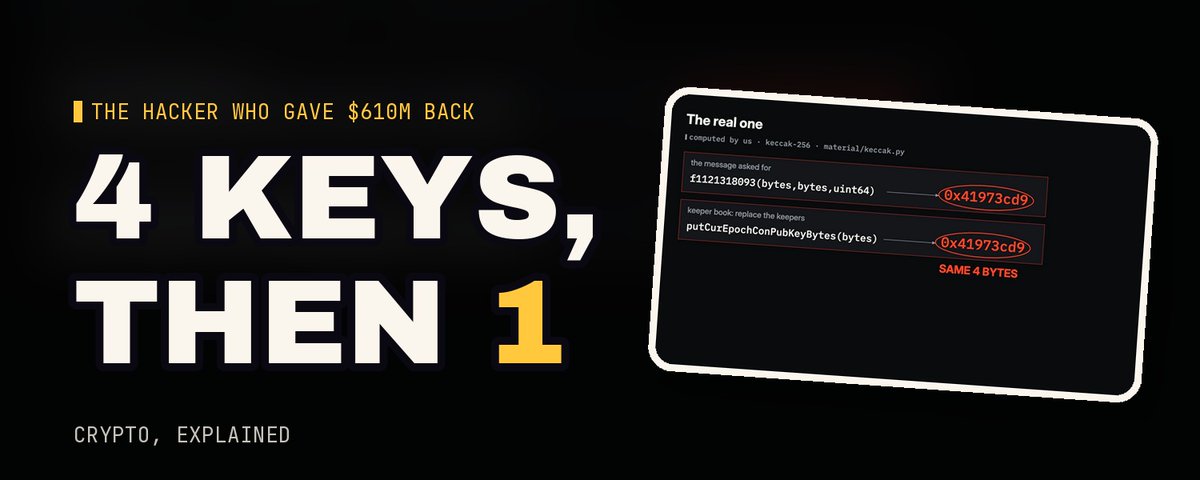
On 10 August 2021 Poly Network's Ethereum contract paid its first withdrawal 2 minutes 22 seconds after the keeper swap, and nine withdrawals took 39 minutes. Poly Network later said all user assets were recovered. Crossing and moving on helps, though it doesn't cover the time you're crossing.
This is for educational purposes only. Not financial advice.
After you bridge, do you move your coins on straight away or leave them sitting?
🤖 Made with AI

One transaction in 2021 swapped the 4 keys guarding a bridge for 1. About $610M left, then almost all came back. We rebuilt it from the chain, with both halves of the caveats. Not financial advice.
Would you leave coins in a bridge after this?
204
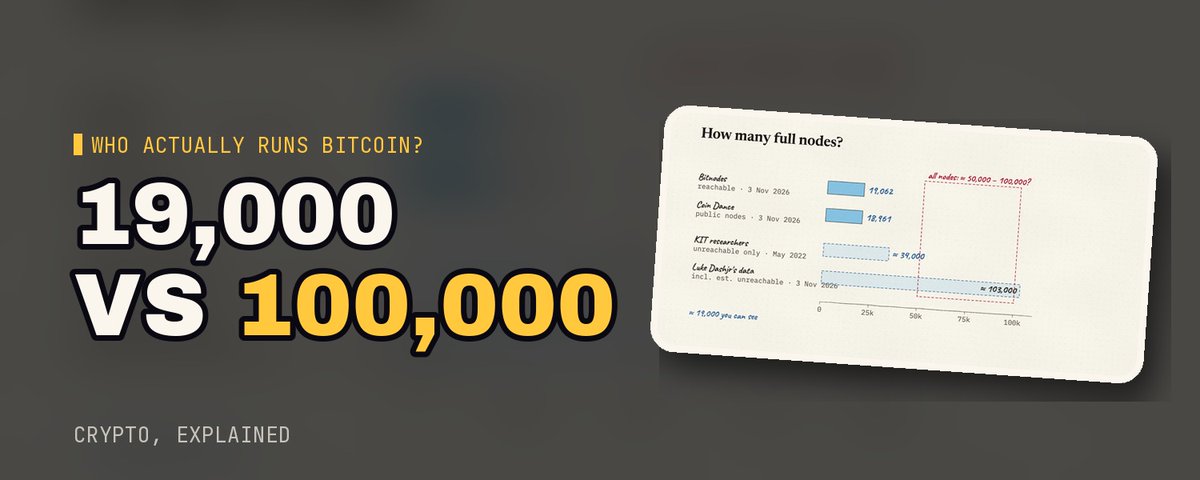
One node tracker showed about 25,800 reachable Bitcoin nodes on 21 October and about 18,100 on 29 October, and no source says why.
That's Bitnodes, which had 19,062 on 3 November, close to Coin Dance's 18,961. Most nodes take no incoming connections, so crawlers can't see them. Estimates of the total run from about 50,000 to 100,000, by different methods and years.
This is for educational purposes only. Not financial advice.
If you run a node, does it accept incoming connections?
🤖 Made with AI

In 2010 one block made 184 billion bitcoin and the nodes threw it out. We counted who runs those nodes now: 19,062 reachable on 3 Nov, maybe 100,000 in all. Do you run one?
232


On 7 Nov, one Bitcoin block held 11,255 transactions.
Total fees: 240,533 sats, about $180. That's 21 sats each on average.
The miner's real pay was the 3.125 BTC block reward, about 1,300 times the fees. It halves around 2028.
Would you pay more per transaction to keep miners paid?
This is for educational purposes only. Not financial advice.
228
A flaw at Web3Auth exposed keys to Keplr's Google and Apple login wallets.
A thief drained some. Web3Auth used the same opening to sweep the rest first: about $5.6M sat in its 12 rescue addresses on 8 Nov.
On chain, the rescue and the theft look identical. And a leaked key can't be reset like a password.
This is for educational purposes only. Not financial advice.
Have you ever used Google login for a crypto wallet?
🤖 Made with AI
306
Erik Huisman retweeted

BREAKING: Cryptographers unveiled 'Shielded Bitcoin', a design bringing fully private transfers directly to Bitcoin Layer 1.
⠀
Researchers Clara Shikhelman and Mikhail Komarov used zero-knowledge proofs to hide transaction amounts with no soft forks.
⠀
While public ledgers expose balances to surveillance, Shielded Bitcoin restores cash-like privacy to everyday transfers.
⠀
True digital cash protects financial freedom.

Erik Huisman retweeted
Wake up! If I could reach through this screen, grab you by the shoulders, and shake you awake before you sleepwalk through this trap, I would.
While you are busy arguing over daily Bitcoin price moves, a 4-step chain reaction is quietly locking shut inside the US banking system.
Connect the dots nobody on financial television has the guts to say out loud:
1. The Fed Reserve just raised interest rates back to 4.00%, pushing government borrowing costs near 5% because massive AI spending (100s of billions poured into AI data centres, chips, and power grids) is keeping inflation alive.
2. Those higher rates crush smaller US banks from 2 sides at once creating $326.7 billion in hidden paper losses on their government bonds while making it impossible for owners of office towers, malls, and commercial buildings to renew $2 trillion in expiring loans.
3. Right now, banks are hiding over 12% in unpaid office building loans behind fake loan extensions so their quarterly reports look healthy on paper.
4. ..and the Fed’s emergency cash cushion just collapsed from $2.55 trillion down to $150 million…meaning there is 0 spare cash left in the banking engine to absorb a shock.
Here is my prediction for what happens between now and mid-2027:
Owners of those office towers and commercial properties will start defaulting as cheap 2021 loans hit 7%+ renewal rates. Smaller banks will suffer quiet cash runs, and overnight bank lending will freeze up. Before the middle of 2027, the Federal Reserve will be forced into a humiliating U-turn- abandoning rate hikes, launching another emergency bank bailout, and printing trillions of new dollars while inflation is still hot.
Here is what that means for you:
Anyone sitting purely in cash or waiting for "safe" headlines will watch their buying power get silently robbed all over again. Meanwhile, Bitcoin will sniff out that rescue wave months before CNBC announces it- leaving everyone on the sidelines behind.
Bookmark this post. Every road leads back to the printer, and scarce assets always move before the bailout becomes official.
Erik Huisman retweeted

If you’re confused about what’s happening with Nvidia right now…
Basically Jensen Huang, the guy who runs Nvidia, which is the company that makes the chips basically every AI company on earth needs, just sent an email to his entire company admitting he cheated on his wife, and that came right after the New York Times reported that US intelligence believes a woman who got close to him was secretly passing information to the Chinese government, and to understand how we got here you have to go back to June 2024, when this Chinese businesswoman named Alice Huang, who also goes by Huang Le and isn't related to Jensen at all, they just have the same last name, gets photographed at a party in Taipei sitting right next to him, and then about a year later her company, a small Singapore company called Megaspeed that almost nobody had ever heard of, reportedly sets up a deal to buy around $2 billion worth of Nvidia's chips, which is a crazy amount of money for a company that small, and the Times even pointed out it was an unusual amount of business for a firm like that, and people already had questions about where all those chips were really going, but Nvidia looked into it and said everything checked out, so for a while that's kind of where things sat, until October 29, when the Times reported that US intelligence had concluded Alice was passing information to Beijing, and that it wasn't some new discovery either, because Trump had reportedly been briefed on it about a year earlier, and the officials involved apparently believed Jensen didn't know what she was up to, but here's the strange part, nobody ever told him, because there's this thing called a defensive briefing, where counterintelligence people basically pull someone aside and say hey, a foreign government might be targeting you, be careful, and Jensen never got one, even though the whole time the government was still watching her, so you have the head of the most important AI chip company in the world apparently being targeted, and the people who knew about it just let it keep going, and then everyone starts denying it, Nvidia says the Megaspeed allegations were already investigated and debunked last year, China's foreign ministry says the whole report is baseless, and Jensen says the business with Megaspeed was totally normal, just a customer buying chips like any other customer, but Congress doesn't let it go, and three House Republicans who run national security committees ask Jensen to come in and explain himself in a closed-door briefing, which means a private meeting away from the public and the cameras, and then on a Sunday, out of nowhere, Jensen sends that email to every single employee saying he had been unfaithful to his wife, that it hurt her and their children, and that nothing excused what he did, and he doesn't say who it was with, but you can imagine where everyone's mind went, and right after that, Nvidia's board, which is the group of people who are supposed to oversee the CEO, announces it's setting up an independent committee with outside lawyers to investigate, but at the same time says it has no reason to believe any national security secrets or company secrets were compromised and that it still has confidence in him, and then a company spokesperson comes out and says none of this is going to slow Nvidia down and Jensen is going to keep running the company without any interruption, so basically you have a suspected Chinese intelligence asset who got close to the CEO, a $2 billion chip deal, a president who reportedly knew about, a CEO who was never warned, a confession about an affair, an investigation, and a company insisting everything is fine, so that's pretty much where Nvidia is tonight.

Erik Huisman retweeted

币圈吹了整整三年的“消灭助记词神话”,在今天彻底沦为了一场血腥的笑话。
几个小时前,链上安全圈拉响了最高级别的红色警报:
为海量 Web3 钱包提供“谷歌/苹果一键登录”的底层基础设施 Web3Auth,突发私钥泄露级严重事故。
首当其冲被穿透的,是 Cosmos 生态龙头钱包 Keplr。
黑客已经开始在受影响的地址上发起疯狂盗币。
Keplr 官方紧急切断所有社交登录入口,全网各大链上验证节点和项目方一片大乱。
极度荒诞的一幕在链上赤裸裸地上演:
那些自以为走在时代前沿、贪图省事用 Google 和 Apple 账号一键建钱包的散户,账户私钥被扒得一干二净,沦为案板上的鱼肉;
反而是那些被嘲笑“操作落后、冥顽不灵”、坚持拿纸笔手抄 12 个助记词、死守冷钱包的老韭菜,在这场灾难里毫发未伤。
为了省下抄写助记词的 30 秒,代价是把自己的全部身家,双手奉送给第三方中心化数据库。
现在的链上战场已经变成了一场生死竞速。
Web3Auth 联合 Keplr 正连夜在 Celestia、Injective、dYdX、Osmosis、Akash 等 10 条公链以及 8 条 EVM 链上,疯狂用白帽程序把被盗边缘的资产转移到紧急恢复钱包,硬生生跟黑客抢跑。
Polygon 首席安全官 Mudit Gupta 更是公开发出最冰冷的警告:
“只要你用社交账号登过 Keplr,现在立刻马上把钱转走!更可怕的是,天知道全网还有多少钱包和 dApp,也在背后接了这家服务商。”
Not Your Keys, Not Your Coins。
你以为一键登录是去中心化的技术进步,其实你只是自作聪明地,把钱存进了一家没有任何安保的地下钱庄。

Erik Huisman retweeted
You are all staring at 5-min Bitcoin candles while the $2.55 trillion safety net under the US banking system just vanished.
Check the Federal Reserve’s own ledger from Friday afternoon:
The Overnight Reverse Repo buffer- the massive cash cushion that kept the banking grid from cracking for the last 2 years just collapsed to $150 million.
$2.55 trillion down to $150 million. Pocket change. The shock absorber is completely dead.
Why the Repo market matters: it is the overnight cash bloodstream that keeps banks from freezing up between paydays.
For 2 years, the US government funded trillions in reckless deficits without blowing up the system because money market funds drained that Reverse Repo cushion to absorb the debt.
Now that buffer is empty. Zero padding left.
Starting Monday morning, every dollar of new government debt, every tax drain, and every liquidity crunch pulls cash straight out of commercial bank reserves.
The banking engine is running with a bone-dry oil pan. When bank reserves drop below the danger line, overnight lending seizes up and the Fed only has 2 buttons left: let the credit system snap, OR fire up the money printer again.
We already know which button they press every single time.
Stop watching surface noise. Watch the liquidity floor vanish. Scarce assets win when the safety net hits 0.