

An (annoying) Arcanaloth masquerading as a (surplussed) Microbiologist masquerading as a (retired) Lawyer. For now.
Edmonton, Alberta
Joined September 2022
- Tweets3.5K
- Following82
- Followers927
- Likes3.3K




Pinned Tweet
I'm an independent hobbyist investigator and commentator with an “unlaw” focus. I’m not really interested in law, legal theory, etc. Methodologically, I’m a microbiologist who studies law-related things. I measure court processes and activities, and track pseudolaw phenomena.
I engage in data-driven research using science-based investigation and analysis. Little is known on how Canadian courts truly operate. My studies quantify Canadian appellate litigation, including the controversial SRL phenomenon. I also investigate anti-authority false-law pseudolaw phenomena, Canadian pseudolaw groups and their beliefs, and how pseudolaw is embedded in the junkheap of information sociologists call the “cultic milieu”.
I used to be an Alberta Court of King's Bench staff lawyer, the “Complex Litigant Management Counsel”, who assisted management of problem litigants and litigation. Any of my often cranky statements and publications are my own opinion and perspective, and not that of my former workplace, its personnel, and judges.
Most of my published research is archived on ResearchGate, if you are curious (researchgate.net/profile/Don…).
Oh yeah, and I’m an unrepentant weirdo. It kind of leaks through, sometimes.
(Fursona art courtesy of brightkarma - furaffinity.net/view/5808345…).

The CBC's 5th Estate news program has released a video on pseudolaw "Sovereign Citizens" who have defrauded the Canadian government using Strawman Theory related techniques, possibly up to $300 million:
youtube.com/watch?v=07u-4qiG…
I was contacted by the CBC for this program. I do not appear because I refuse to participate in any video or permit photographs of myself.
I'm kinda weird that way.
I write frequently about pseudolaw - but pseudolaw also involves "real law". And sometimes non-pseudolaw types make pseudolaw claims.
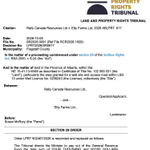
Which brings us to Rally Canada v Etty Farms. This is a decision of the Alberta Land and Property Rights Tribunal. What's that? Well, it's pretty typical that the person who owns the land above minerals is different from who owns those minerals, or the right to extract minerals.
This is a point of friction. Land owners like farmers or ranchers who own land may find companies like petrochemical firms have the right to pump out oil or gas from underneath their land. The surface rights owners have a right to compensation for mineral extraction on their part of the land - the underground rights depend on a kind of trespass on surface rights.
When there's a disagreement on the amount of that compensation, that goes to the ABLPRT, which is a very busy tribunal.
Here the scenario is:
-Rally is extracting something, probably natural gas, from under Etty Farms.
-Rally and Etty agree to payments of $4,000 per year for surface access.
-There's some confusion following the death of the owner of Etty Farms. That leads to some wonderfully polite exchanges between the two parties.
-It becomes apparent that a Rally employee unilaterally reduced payment to $2,900. Eventually that gets to the ABLPRT to determine what should have been paid over a couple years.
And the ABLPRT cites Meads v Meads and another Alberta pseudolaw case for the rule that you can't foist a contract on someone else. Contracts require agreement:
In contract, silence does not mean consent or agreement.
So there you go. Big corpo tries a classic pseudolaw stunt. Gets told no.
This isn't the first time I've seen pseudolaw judgments providing basic legal rules in other contexts. Kinda neat.
Full judgment is here:
Rally Canada Resources Ltd v. Etty Farms Ltd, 2026 ABLPRT 617 - canlii.ca/t/knm7k

Most pseudolaws involve two competing legal systems, where one (imaginary) legal system provides secret advantages.
An older Canadian pseudolaw variation has Indigenous or Aboriginal law as superior to ordinary law.
And now in Canada, that may be true. Incrementally.
The typical version is the one taught by gurus like Glenn “Spirit Warrior” Bogue, that if you can cram yourself into an “Indigenous” or “Aboriginal” box, you are only subject to that kind of law and administration. You might have your disputes heard in a special Tribal or First Nation court, and then enforced in ordinary Canadian courts. Canadian law is inactive or excluded, depending on Indigenous (self)-identity
Of course, it’s not true - yet - that someone can slap an Indigenous licence plate on a “personal conveyance” in Canada, and now you don’t need to follow traffic legislation or pay your speeding tickets.
But the underlying concept, that there is another legal system in Canada that draws off Indigenous heritage and rules, that is becoming real. The process started when the Supreme Court of Canada in a decision titled Reference re An Act respecting First Nations, Inuit and Métis children, youth and families, 2024 SCC 5 concluded that three separate legal systems are recognized and involved in child welfare:
(1) the conventional Canadian legislation and court-made rules (common law)
(2) international treaty law
(3) Indigenous law.
The Court describes these three legal systems as “braiding together”. What does that mean? No idea. What is Indigenous law? How can I learn about that? Read the rules and so on? No idea.
It might even be a cultural secret.
But what this means is when pseudolaw gurus say there is a separate Indigneous-oriented/sourced legal system and rules in Canada, they are now correct. Courts after the Reference judgment at least when it comes to child welfare probably could get into real trouble if someone marched in, declared a child is Indigenous, and then tried to enforce Tribal Law or something like that.
Which is actually what happened here (MD v Alberta (Director of Child and Family Services), 2024 ABKB 565 - canlii.ca/t/k70fw), but the Alberta Court of King’s Bench wasn’t especially sympathetic. If you know that court you're probably not terribly surprised.
Well, things have progressed. A new SCC decision, R v Cope, 2026 SCC 32 (canlii.ca/t/knm9q) has returned to the “braiding” concept. This time the “braiding” was between an ordinary Canadian criminal court evaluating an assault between an intimate couple where the male injured the female. Both were Indigenous.
There’s a bunch of stuff about whether the sentencing court should prioritize the part of the Criminal Code that says Indigenous offenders should not receive custodial sentences, and another part that seems to say the opposite, that where complainants (victims) are indigenous women then that warrants “denunciation and deterrence.” Which applies? Both do, of course! They are “distinct threads woven into a common fabric”.
I have no idea what that means. Sounds pretty though, doesn’t it?
But then there’s the “braiding” of Indigenous and Canadian law. The offender was Indigenous and was the subject of a “sentencing circle” process by Indigenous individuals. Indigenous legal principles led to the recommendation that the offender receive no further jail time. Off you go! That was not possible under Canadian legislation, so the sentencing judge didn’t do that.
But at the SCC there was much discussion about sentencing circles as sources of law. The long story short is that these are Important. And beyond that, I don't really understand how you would apply a sentencing circle sentence, aside from that “braiding” thing. In this new regime Canadian criminal sentencing braids together sentencing circle outcomes and the law that applies to everybody else.
But this time there’s a split. With the Reference decision, all nine judges were on board with “braiding”. This time only five of the justices go with the “braiding” thing: Canadian and Indigenous criminal laws are somehow on a level-ish playing field.
Now four of the SCC justices (Chief Justice Wagner, Justices Côté, Rowe and Jamal) react quite badly to the “braiding”. They observe “the braiding analogy” means that the sentencing judge is being limited by the outcome at the sentencing circle. That means this Indigenous law thing, whatever it is, is muscling into the exclusive territory of the Crown and Court to conduct criminal proceedings and sanction criminal offenders.
Which means, again, gurus like Glenn Bogue are at least partially correct. There is a separate legal system (or systems, it’ll arguably be “First Nations” based, of which there are hundreds) with peer-like and neighbor status to the law I learned about in law school and working inside a court. How’s this going to work? No idea whatsoever. It'll be "contextual" and "offender-specific" though, I'm pretty sure of that.
I’m so very, very glad I’m retired.
But, if you’re a sentencing judge, and some guy who says he’s the Chief of a First Nation you’ve never heard of, and he has the decision of the Common Law Court Sentencing Circle for the offender under trial? Well, that judge probably is going to have a very long day.
So I fully expect to encounter “sentencing circles for hire” sooner than later.
And this is probably just the start of the “braiding” process.
Excerpt from Outlawed by Harry Hobbs and Stephen Young discussing the notorious Meads v Meads judgment I've never heard anything about:
insidestory.org.au/judge-roo…
Yes, I forwarded the link to John so he can have a chuckle.

Where I live a lawyer or ex-lawyer is prohibited from serving in juries. I kinda regret that.
But in Australia you just show up! Cool!
Yes, this is a pseudolaw thing.
I'll say this: the Common Law Court of the Sovereign Peoples Assembly of Western Australia has beaten out any Canadian court I've attended on one key point: they supply branded water bottles! (wacommonlaw.au/court/)
Pretty aggressive sentences, too. This judgment (wacommonlaw.au/court-verdict…) imposed 150 year, and $300 million (gold bullion) penalties on a bunch of psychiatrists.
I also like how the judgment clarifies the exchange rates for gold and worthless fiat currency at the judgment date. It's these little details that encourage institutional trust.
Too bad this isn't a Canadian outfit. It'd give me an excuse to write about the CLC SPAWA and in a legal constitutional sense evaluate what would be the consequences of such a judgment. Yes, it's probably not enforceable. There would likely not be any criminal prohibition breached in Canada by the Court, though its Sheriffs could be in trouble.
But what I find intriguing in a goofy law formalities/procedure sense is what about the "No Appeal" clause. At least in Canada that would not work. But explaining why would be fun.
Oh well.

Nicola & David Suppa reversed the taxation process. They took ordinary Canada Revenue Agency money deposit forms, scribbled on them, declared those were a “Coupon of Money” & demanded the CRA pay them $4,494.530.03.
The CRA didn’t pay. The Suppas sued.
Didn't work.
A recent decision of Justice Duchesne of the Federal Court of Canada tells and illustrates the tale! He calls what the Suppas did "defacing" CRA documents:
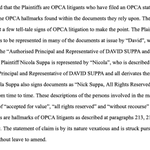
in order to create fictitious “negotiable instruments” to make millions of dollars payable to them by the CRA based on a tortuous reading of legislation supplemented by dictionary definitions of various terms. The statement of claim falls within the ambit of OPCA litigation, fails to disclose a reasonable cause of action, and is plainly and obviously doomed to fail.
The pseudolegal theory behind the Suppas’ claim is a bastardized interpretation of the Bills of Exchange Act and Financial Administration Act purportedly transforms an IOU into a final payment. That is a pretty common Canadian “money for nothing” pseudolaw gambit. The Suppas version is what I would politely call “unsophisticated”.
The Suppas then used a series of notices, including a “Notice of Dishonour of Non-Acceptance” and “Notice of Dishonour” that purport to create a binding outcome against the CRA by non-response and non-acceptance. This is commonly referred to as a “Three/Five Letters” strategy.
The judgment attaches some of these documents, both the “defaced” receipts and the Three/Five Letters. They’re kind of small and fuzzy the resolution isn’t the greatest, but if you want to review them and have a good giggle, there you are! See the “Schedule” at the end of the judgment.
One such document is simply a payment receipt re-labelled as “Money order”, with:
PAY TO THE ORDER OF
NICK SUPPA
WITHOUT RECOURSE
By: [signature Nick Suppa]
NICK SUPPA, VICE PRESIDENT
What’s kind of fun the exact language and “defacing” changes evolve from document to document, which shows the Suppas were experimenting and feeling around looking for that magic language that would get them tasty tasty free money.
Justice Duchesne described the process this way:
The thread running through the alleged “registered negotiable instruments” is that the Plaintiffs have taken a GST/HST tax owing remittance voucher or a similar form of document, written in manuscript on the face of the voucher that the document is a money order or other type of document payable to the either of the Plaintiffs, signed the document “without recourse” and then endorsed the remittance slip with the words “accepted for payment” or “accepted for deposit”, or “for value”, again, “without recourse”. The stamped signatures on the documents are signed by the either of the Plaintiffs as Agents for themselves as a “Principal”. A demand letter replete with OPCA language and demands that the CRA pay them the amount they inscribed on the voucher by defacing it based on their own unsound interpretation of BEA and the FAA, along with various dictionary definitions, then follow. ...
A very accurate summary. Though he’s polite when it comes to calling this scheme garbage:
The documents relied upon by the Plaintiffs to substantiate their claims in this proceeding purport to unilaterally impose a payment obligation on the CRA when the underlying documents said to substantiate the alleged debts, or payments by the Plaintiffs or either of them to CRA, have no basis in law and are plainly fictions.
Naturally the Suppas’ lawsuit to enforce their magic documents was identified immediately, challenged, and tossed. The Suppas were ordered to pay $2,000 for wasting everyone's time.
It must be getting a little discouraging for pseudolaw types to have their arguments slapped down like this. The Federal Court of Canada is a very businesslike and efficient place. Abusive litigation is targeted aggressively. As this decision illustrates, both the government lawyers and the court know their stuff.
Full decision and silly pictures are here:
Suppa v Canada (Attorney General), 2026 FC 1191- canlii.ca/t/knc62
I made a short effort to learn more about the Suppas. Didn’t find anything interesting.

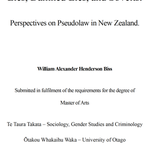
New Zealand has its first broad survey of pseudolaw caselaw in MA thesis by William Biss:
hdl.handle.net/10523/52479
Biss identifies & surveys 267 NZ court judgments that involve pseudolaw, plotting a progressive increase over the past decade.
Notably, half involve a NZ Maori-specific/linked conceptual base that Biss describes as a novel local adaptation of pseudolaws' more common general structure.
Biss also uses interviews and law enforcement reports to evaluate the NZ pseudolaw ecosystem, including:
-the role of the COVID-19 pandemic in the propagation of these ideas
-the source populations for these claims (lower income/economic status)
-the absence of leading guru figures, or rather the proliferation of numerous micro-gurus with small to negligible follower bases
-employment of Indigenous arguments that are incoherent to the developed law in NZ
-the limited record of violence from pseudolaw adherent populations, but deep personal disassociation state and social norms
-that Australian and NZ pseudolaw are following different patterns, at least partially attributable to the different (not)-legal reasoning in the two jurisdictions
There's good stuff here written by an investigator who has been musing about both what is going on nationally, and in other jurisdictions.
Looking forward to more digging by the author and other NZ investigators.

Continuing to read this master's thesis on pseudolaw in New Zealand.
The author suggests "paper terrorism" should be replaced with "procedural terrorism".
I really like that.
Reading a new grad thesis on pseudolaw where the author made an observation I'd never thought of.
The plight of a witness in a criminal proceeding facing a defendant who is deploying pseudolaw, making all kinds of crazy and threatening challenges.
That would be frightening. Intimidating. If the Crown/state prosecutor hadn't prepared the witness, or the judge doesn't intervene, that could be a deeply disturbing experience.
Not sure how you would deal with that. I've seen state witnesses, like police, experience that kind of attack, but they understand enough law to know this isn't relevant. Plus they've probably been witnesses many, many times in the past. For them the court is a foreign but familiar space.
But what if you were just a layperson, particularly a victim of a violent pseudolaw-using criminal?
I don't know if there's a good answer, at least in Canada. In Canada, criminal accused and their lawyers have pretty much carte blanche on how they run their defence. A judge would have to think very hard before intervening in questioning from a self-represented accused.
What an interesting and unpleasant puzzle.
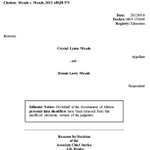
Happy Meads v Meads day! 14 years!
From the CanLII website & my notes, the decision has been cited in 536 court judgments worldwide.
Not bad for a trial-level decision that, purportedly, is nothing but obiter.
Here's a link: canlii.ca/t/fsvjq (It's long...)

And even persistence has an endpoint. One of Canada's largest and certainly most sophisticated pseudolaw "Detaxer" schemes was the Paradigm Education Group, that operated in the early 2000s.
Its key promoters, a husband and wife team, made roughly $1.4 million. They were found guilty of counselling fraud and incarcerated.
Then the CRA came calling, and used the findings of the criminal proceeding as the foundation to seek unpaid taxes on that income. The PEG promoters at the Tax Court of Canada deployed the same arguments they'd sold to customers. They lost. This is 2025.
They ran those arguments up to the Supreme Court of Canada which today refused to hear their appeal. The promoters never really adapted their arguments much, so it was face into brick wall, over and over.
For 20 years.
Call it “vignettes from an invisible war”.
Written for interested laypersons, “Outlawed”, by Profs. Harry Hobbs (Australia UNSW) and Stephen Young (New Zealand UOtago), introduces pseudolaw, surveys its history, operation, and manifestations worldwide.
I recommend Outlawed to those who are curious about pseudolaw, pseudolaw’s origin and evolution, the weird persistence of these concepts in the face of inevitable failure. The authors are academics who have written extensively about pseudolaw, related litigation, and its host populations. These are well-informed subject experts.
Hobbs and Young provide probably the best summary I’ve ever read of pseudolaw’s multistage growth and incubation in dissident US political/cultural circles. The authors have expertly identified key characters like King of Hawaii and Judge Plenipotentiary David-Wynn: Miller and friend of elves and fairies Winston Shrout to illustrate how pseudolaw grew both as a nest of interwoven concepts and as a marketplace product. Other individual personalities and their activities that are explored in Outlawed were obviously selected to be interesting – or appalling – but these individuals usually are also fair representatives of the travelers in this strange shadow-world.
The text does not conduct a technical deep descent into the “law law” of this stuff. As the authors observe, you can go to academic texts and the famous Canadian Meads v Meads court judgment for that. But key points are covered, particularly Strawman Theory, the weird duality of flesh and something imaginary that is the hallmark of most pseudolaw schemes worldwide. More importantly, the “why” of these ideas and their appeal is an ongoing narrative thread. In doing that Hobbs and Young explore one of the critical mysteries of pseudolaw schemes, their promoters, and proponents. Why would you invest money and time to use something that never works? Outlawed explores a number of explanations:
-desperation with no apparent (legitimate) recourse
-alienation from state and (real) law
-political and religious ideology
-marginal and subcultural affiliations
-the drama and theater of pseudolaw
-a social sense of empowerment and resistance, but one with no real operational effect.
All these are valid. The one motivation that is not examined is quick and easy money – simple greed – but to be fair to the authors, the “mercenary” populations (my term) who operate in that manner are not well understood at present. Arguably, the mercenary subtypes are not really pseudolaw adherents. But now I’m meandering.
What matters is that Outlawed recognizes and digs deep into why there is no simple explanation or foundation for people adopting this weird not-law. Hobbs and Young correctly (in my opinion) conclude that with such a complex set of motivations and personalities there cannot be a quick and easy fix. Pseudolaw, as a mind-virus, is going to spread until it exhausts its potential hosts, and, even then, it won’t disappear. Believers get seriously invested. Some are probably too embedded in a conspiratorial and irrational zeitgeist to ever operate in a way most of us would consider “rational”.
Now that leads to a delicate point. Pseudolaw harms people. Pseudolaw leads to violence. Outlawed identifies and describes in sometimes quite graphic detail violence that has resulted from pseudolaw beliefs. That’s important. These are dangerous ideas. We should not minimize that fact, and the risks posed to state, court, and law enforcement actors. But Hobbs and Young also explore how pseudolaw harms its users. That’s a tricky balance. We are looking at a kind of conceptual pathogen, a memetic disease, that badly damages all those it contacts. That makes its users victims in a very meaningful sense. Those who propagate pseudolaw for profit warrant no such sympathy. But Outlawed walks a fine line between deserved denunciation, alarm at consequences, but also pointing to the wreckage left behind – all of it.
That’s critical, in my opinion. This arms-length perspective separates disease symptoms from the mind virus that caused those. It’s easy to make fun of these people – and sometimes they deserve it – but in a social, functional sense, it’d be better to find other ways to manage pseudolaw and its deleterious effects. We benefit little if we stand back and watch infected hosts hurl themselves into heaps of razor wire. And sometimes they drag us in with them.
Outlawed tries to propose solutions and mechanisms. However, the authors acknowledge there isn’t any simple answer. I agree.
Outlawed has certain weaker aspects. The authors focus mainly on pseudolaw’s manifestations in the US, which is important and necessary in a historical sense, and on the Australian and New Zealand branches, the authors’ regional domain of expertise. I do the same when I write on this subject. I know Canadian pseudolaw better than other alternatives, and so I draw many examples from that admittedly well-studied milieu.
But this focus means the reader will not fully experience the weird global complexity of pseudolaw phenomena. That’s not to say Outlawed doesn’t acknowledge and touch on the international nature and expansion of pseudolaw, but that’s secondary. The book’s jurisdictional focus is a comparatively minor issue. What would make an interesting deeper investigation is why pseudolaw’s manifestations in different jurisdictions are sometimes very different. For instance, pseudolaw has never really taken hold in Canada, at least compared to the US, Australia, and New Zealand. Nobody knows why, but when the authors discuss how to manage pseudolaw and its believers, the markedly different international outcomes are not addressed. To be fair, commenting on that would involve a lot of guessing and hypothesis. Inter-jurisdiction variation is an issue that will likely be the subject of much discussion in the emerging academic community of pseudolaw investigators.
Hobbs and Young are sharply critical of how the common law operates in an institutional sense. Law is oblique and overly complicated. Law uses opaque and cryptic language. In a practical sense law is more a playground for the wealthy than those who more often suffer its negative effects. Litigation is expensive – at least if you want a lawyer on your side. I don't disagree with that, but the authors use that as the foundation to argue for more access to legal professionals, for plain-language materials, for resources pulled out from behind paywalls, even judges taking on a more public role. I don’t think that’s wrong, but my perspective is skeptical at the institutional level. I very much doubt the common law tradition and its rules could ever be a functional apparatus. But then again, I’ve never believed in “the law” in the same sense as most who practice, teach, and judge in that domain. Just label me a heretic, but the result is I personally find those propositions somewhat quaint.
Instead, if you asked me what to do? Decapitation. No no no, I’m not saying capital punishment, I mean targeting key node individuals. In Canada pseudolaw populations suddenly turned belly up when their leader figures were the subject of criminal prosecution, so there’s a precedent.
These are comparatively minor concerns. I do not always agree with Hobbs and Young, but I did not at any point identify any errors in Outlawed. The citations I checked were accurate. The language is clean, accessible. The only jargon is the jargon of pseudolaw itself, and Outlawed usually digs down to explain that language when comprehension is relevant, rather than just a muttered “WTF?”
Outlawed introduces a world that is a weird and peculiar place. But then, that’s really what it’s like. If not even weirder than you would expect from this introduction.
It’s a pity the book is still pricy. With taxes this set me back $70 Canadian, ordering through Amazon and with import duties. I’d have thought a Penguin publication would be a little cheaper? Maybe subsequent regional editions? There should be local editions.
But it’s a good piece of work, and one I don't hesitate to recommend. There are no other publications in the marketplace that serve this niche. But that’s not a “win by default” conclusion. Outlawed is a solid, thought out, nuanced investigation. No special education or training is needed to make good use of Outlawed. I am already using it as a reference for my own writing in this subject area.
The authors should be commended. I expect Outlawed will stand as an authoritative important text, a milestone in commentary on this subject.
Author: Harry Hobbs, Stephen Young (@SteveIsInOtago)
Title: Outlawed: Responding to the Global Rise of Sovereign Citizens and Legal Conspiracies
Publisher: Penguin Australia
Publication date: August 18, 2026
261 pages, no illustrations
ISBN 978-1-76162-174-1

I've been tracking self-represented litigant activity at the Supreme Court of Canada.
Something might be going on this year at the SCC.
So far SRLs make up 45.7% of appeals (N=308).
If activity so far in this year is representative, that means 2026 is among the lowest total new appeal years at the SCC in 30 years.
But the average frequency of SRL applications is 24.7% (1997-2026). The highest previous frequency is 33.7% (2016).
On a Z score calculation, that makes the SRL frequency in 2026 is 3.2 standard deviations off mean. The highest previous deviation was 1.42 standard deviations (2016).
The year isn't over. And I wouldn't say we've entered some new phase unless there is at least one more year of SRL activity that is at least 2 standard deviations off mean. But these are pretty high numbers...
Oh hey, the SCC got rid of all filing fees! Do you think that made a difference? Everybody loves a freebee!
*fiendish cackle*
Here's a 2021 academic article on women's roles in US anti-state communities, including Sovereign Citizen and affiliated groups.
mdpi.com/2075-471X/10/2/41
It's good! Not my core area of interest, but has a nice overview of outsider populations in the US.

I criticize how Canada manages abusive litigants and litigation. A recent Ontario Human Rights Tribunal decision shows those injuries are sometimes self-inflicted.
Person is subject to gatekeeping screening by the Tribunal. She instead acts as a representative.
*facepalm*
I’m not criticizing the HRTO. They did not make the rules. Appeal courts say that limits to advancing proceedings in courts and tribunals must be as small and narrow as possible. There is no “anticipation” of bad conduct, no matter how obvious. The current approach organizes around a catchphrase: "Access To Justice". That seems to mean litigants get to do whatever they want, repeatedly. And oh, they do ever.
In this instance Stephanie Tonner “(formerly Steven Tonner)” was declared a vexatious litigant before the HRTO after a series of problematic HRTO applications. By this time Tonner had established an impressive record of interventions to manage Tonner’s activities, including at least four “vexatious litigant” orders:
(1) Ontario Provincial Court General Division - Justice Bell – January 27, 1998
(2) Ontario Superior Court of Justice - Justice Belobaba on October 23, 2006
(3) Ontario Superior Court of Justice - Justice McNamara on January 20, 2012
(4) Federal Court – Justice Phelan – January 26, 2016
(The transition between provincial Ontario courts to the Federal Court is the classic form of “forum shopping” in Canada.)
The HRTO in Tonner v Real Estate Council of Ontario, 2026 HRTO 199 (canlii.ca/t/kj2qb) was pretty explicit that Tonner’s conduct at the HRTO and other adjudicative bodies was not appropriate:
... A review of all Applications before the Tribunal confirms that the applicant continues to display the very hallmarks of vexatious litigation that resulted in the applicant being declared a vexatious litigant by the courts. The applicant advances claims that are unsupportable, demonstrates ongoing disregard for procedural rules and Tribunal directions, and engages in a continued pattern of unacceptable conduct.
... The applicant has engaged in a pattern of abusive and threatening communications directed at the respondents and the Tribunal, including by email and telephone. Despite the Tribunal’s endorsement ordering the applicant to stop sending offensive communications to the Tribunal and to the respondents, the applicant continues unabated.
... The communications include statements that, threaten individual respondents and organizations, contain extensive profanity, advance unsubstantiated allegations of judicial fraud, assail the honesty and integrity of judges, assert criminal and hate-based misconduct without evidentiary foundation, and make threats to the safety of respondents. Given the nature of the language used, the Tribunal declines to reproduce the communications in this Decision.
... The record demonstrates a consistent pattern in which the applicant indiscriminately names multiple respondents, encompassing judicial officers, government employees, and individuals associated with public and private institutions, including those that interacted with the applicant in the performance of their duties or rendered decisions adverse to the applicant’s position. The applicant has compounded this conduct by seeking grossly disproportionate damages and advancing claims that lack any reasonable prospect of success. This conduct is indicative of vexatious litigation rather than the legitimate pursuit of Code-based relief.
Tonner’s existing HRTO complaints were tossed. The HRTO quite reasonably put in place a requirement that in the future Tonner must request permission prior to making additional HRTO complaints, and a process to establish a basis for those complaints.
All fine. In fact, the HRTO did the only reasonable thing – and the only thing it’s authorized to do. Tonner engaged in bad conduct. Tonner was subject to gatekeeping.
But at the same time, Tonner had filed another HRTO application, purporting to represent a minor as a litigation representative. Now a second process was conducted to evaluate whether Tonner should be permitted to act as a litigation representative. In Tonner v Khan, 2026 HRTO 1058 (canlii.ca/t/km1zs) the HTRO concludes that Tonner should not be operating as a litigation representative by default, and:
(1) gave Tonner 14 days to file materials to establish Tonner should have permission to represent the minor, and if not
(2) the parent of the minor then had 42 days to retain a lawyer or other representative for the minor.
I’m not here to critique the HRTO for their steps. It’s not their process that’s the problem. It’s the broader rules.
Why, why would anyone think if you restrict someone’s access to courts or a tribunal for abusive conduct, that the abusive person is an appropriate representative for anyone? This is among the most obvious ways for an abusive litigant to circumvent management and continue their problematic activities.
“Oh, I’m not running this lawsuit! It’s the ghost of my dead sister who is running and directing the lawsuit!”
I AM NOT MAKING THIS UP!!!
(VWW v Wasylyshen, 2013 ABQB 327 (canlii.ca/t/fz327), see paragraphs 62–75)
It’d be so obvious, so simple. Have a legal rule in Canada that an abusive litigant is never or presumed to never be a suitable litigation representative. There. That’s all it takes. Simple. Obvious.
Predictable.
But no, apparently, that impinges on Access To Justice. Sacred holy Access To Justice.
*sigh*
South Africa’s High Court issued an important judgment, a comprehensive rejection of core pseudolaw motifs. Judge Du Plessis explicitly adopts Canadian and other commonwealth approaches, especially Meads v Meads.
This arose against a mortgage elimination claim. The Adams, a husband and wife duo, claimed they are “sovereign Aboriginal living persons” and therefore not subject to court authority. The Adams stopped paying in 2021. They deployed typical Strawman Theory arguments, they had “allodial” title, and are only subject to “common law” and an “Aboriginal legal system”. Banks do not lend money but instead the funds were from the ADAMS or Adams, themselves.
Cutting to the chase? They get a free house.
Judge Du Plessis explicitly sets out to conduct a comprehensive rebuttal of the pseudolaw arguments deployed by the Adams:
I deem it necessary, to some extent, to address the main submissions as grouped together above, to develop an approach that is appropriate in instances such as these, where litigants purport to deliberately place themselves outside the rules and the law and rely on pseudolegal arguments to do so. Guidance can be found in foreign case law.
And Du Plessis turns to Australian, New Zealand, but mainly Canadian caselaw. Meads is just the starting point, Du Plessis also reviews other key Canadian cases that describe Strawman Theory, and which conclude that simply raising Strawman Theory motifs are “a marker of bad faith and vexatious, abusive litigation.” Yup. Kick ‘em while they’re down.
New Zealand caselaw provides the theoretical authority to deny Indigenous claims in relation to private contract. The “banks make money from thin air” argument is rejected with reference to more Canadian cases from Ontario, New Brunswick, and Alberta.
It’s worth reading this decision to see just how much the activities of courts in certain foreign jurisdictions here have assisted where pseudolaw emerges in a new context. But Judge Du Plessis goes further, he then takes those principles to rule on how pseudolaw applies (or rather doesn’t apply) in South Africa. Take this rebuttal of Strawman Theory:
... The ALL CAPS/strawman theory is inconsistent with the basic principles of legal personality under our law. Legal personality is conferred on legal subjects, and there are two categories: natural persons (all human beings) and juristic or artificial persons. A juristic person, such as a company or bank, is a legal subject distinct from its members, often incorporated under general binding legislation. Such a juristic person has its own rights, duties and capacities to act through its various functionaries, and those actions of the functionaries bind the juristic person. Nothing in our law recognises a third category of hidden “strawmen” attached to natural persons via typography or birth registration, nor does the use of capital letters in a person’s name create a separate legal subject.
... In other words, a natural person’s name may appear in different typographical forms in documents and records. This does not create a second legal person or a juristic person, nor does it affect their capacity to contract, or their liability should they fail to honour the contract.
... the bank is incorporated as a public company under South African law and is a recognised juristic person. It is entitled to sue and be sued in its own name, and to enforce contracts into which it has lawfully entered. Nothing in our law prevents a bank, as a juristic person, from contracting with natural persons (or from being represented by attorneys and counsel in enforcing its rights). The “strawman” / ALL CAPS theory, therefore, provides no basis in law for the respondents not to be held to the contract.
Judge Du Plessis does the same for pseudolaw arguments on jurisdiction and indigenous status and rights, and banks do not lend money and “securitization” arguments.
The Adams arguments are tossed, and the bank takes possession of the residence:
The respondents’ submissions are advanced with conviction, but conviction does not convert pseudolaw into law. Foreign courts have observed that OPCA strategies can, in fact, compound the prejudice of indebted homeowners by delaying resolution and increasing costs. South African courts must, in my view, follow the same path: treat such arguments as legally ineffective, while ensuring that defendants are heard and that ordinary defences, where properly raised, are fully considered.
... I therefore find that the defendants have not disclosed a bona fide defence as required by Rule 32(3)(b). Their affidavit is largely argumentative and ideological, but does not raise any triable issue on the validity of the loan, the bond, the default, or the quantum.
The Adams counterclaimed for millions on various pseudolaw bases, which naturally gets nowhere. The Adams are ordered to pay the bank’s litigation expenses per the mortgage contract.
This decision is a solid, careful piece of work. I recommend that judges where possible do not just reject pseudolaw schemes, but explain why they are incorrect. Judge Du Plessis did exactly that. As noted above, foreign caselaw provided the foundation and framework, and demonstrates the Adams’ ideas were not some eccentric novelty, but instead a part of a global phenomenon, where the same not-law is advanced over and over, with no success.
This decision is a solid foundation for future pseudolaw-related jurisprudence in South Africa. While this is the first judgment from that jurisdiction that I am aware of to identify and attack pseudolaw squarely with that nomenclature, this judgment was not the first point where pseudolaw has been promoted in that country.
In the 2010s a guy named Michael Tellinger promoted “Ubuntu” pseudolaw theory, set up a marginal political party, and claimed you can pay off debts with glorified IOUs. Tellinger is a colourful character, a former 1980s pop star and expert in the Anunnaki, those nasty Sumerian gods who created humanity as gold mining slaves. DAMN YOU ENKI!!!
Tellinger did try his promissory note arguments in court. Where they flopped repeatedly:
Standard Bank of South Africa Limited v Tellinger (13340/2011) [2011] ZAGPJHC 70 (3 August 2011) - saflii.org/cgi-bin/disp.pl?f…
ABSA Bank Ltd v Terblanche and Another (17330/2012) [2012] ZAWCHC 369 (30 November 2012) - saflii.org/cgi-bin/disp.pl?f…
Birch v Firstrand Bank, Pike N.O. and Others v Firstrand Bank, Firstrand Bank v Pike N.O. and Others (1050/2011, 1415/2012, 3774/2015) [2016] ZAECGHC 54 (3 June 2016) - saflii.org/cgi-bin/disp.pl?f…
But you’re not surprised now, are you? Again, this goes to show how nothing much in the pseudolaw world is ever new. Recycle, rinse, reuse.
Here’s Judge Du Plessis’s Adams decision: saflii.org/za/cases/ZAGPJHC/…
Worth the read and review as a template response to pseudolaw.

New academic article by Polish investigator Ewa Iwanowska that evaluates a Polish pseudolaw online community, ideas, and links to Anglo-Saxon pseudolaw traditions:
researchgate.net/publication…
It's in Polish, but does a really nice job discussing the interconnections between pseudolaw's ideas and host populations.
Some observations are not really a surprise. Like many other European countries, Polish pseudolaw is not so much based on the "Duel of Laws", as a "Duel of States", where the current government is invalid.
As usual, Strawman Theory has a central role.
Good stuff!

I just reviewed my ResearchGate account & noticed a couple new publications from the 1990s. I had not entered these.
They're viral genome data I discovered while working as a military defence researcher.
Apparently Genebank pubs are automatically added to my account! Cool!
Something weird about lawyers. You put a document with big ink and/or blood fingerprints on it, postage stamps with cryptic codes, and a signature line that reads UCC 1-308 ALL RIGHTS RESERVED!
And you ask the lawyer to notarize it.
A surprising number say Okey Dokey!
This makes me crazy. I’ve seen this hundreds of times. Documents with duplicate names in different cases and colours. Documents that purport to be contacts between BILL SMITH and Bill Smith. Documents invoking bible passages as law. Documents that are called “Notary Judgments”, and that if you read ‘em, purport to be binding supra-court decisions.
Documents that threaten law enforcement, court staff, judges. Documents that purport to create a licence to kill.
Okey Dokey!!! Okey Dokey!!!
Do I seem pissed off? I’m pissed off. If there is a profession on the planet that ought to have an internal checkbox that I maybe should scan something before I slap my signature on it and seal it with a magic stamp? It’s lawyers.
But they #^&@# keep notarizing the F’ing things.
I’m posting about a lawyer in Alberta who finally got a professional sanction for doing this. Her name is Grace Akpan, of Calgary. Her activities led to a string of court judgments and now, finally, a disciplinary outcome.
Akpan notarized documents purporting to unilaterally terminate a drug prosecution. Drug trafficker and illegal handgun owner sends them to the Alberta Court of King’s Bench threatening court staff. The ABKB (ACJ John Rooke) reacts negatively and fines Akpan:
R v Ayyazi, 2022 ABQB 412 - canlii.ca/t/jprk7 (This one attaches the documents Akpan notarized and the obviously fake Government of Canada ID she accepted) (Shure looks real to me - the back is even worse.)
R v Ayyazi, 2022 ABKB 836 - canlii.ca/t/jtjk2
The Alberta Court of Appeal overturns the sanction on the basis of procedural (un)fairness. Goes back to the ABKB:
Akpan (Re), 2024 ABCA 232 - canlii.ca/t/k5fvk
ABKB (ACJ Blair Nixon – Rooke is now retired) does it over and again fines Akpan:
Akpan (Re), 2024 ABKB 417 - canlii.ca/t/k5q50
Akpan (Re), 2024 ABKB 651 - canlii.ca/t/k7qsl
Back to the ABCA, where the Court says yes, Akpan did a bad lawyer thingie. But courts shouldn’t sanction lawyers for bad lawyer thingies. That’s up to the Law Society of Alberta.
Akpan (Re), 2025 ABCA 47 - canlii.ca/t/k9fwb
Now, throughout all this Akpan takes the position that she never did anything wrong. She was acting as a notary. She witnessed someone sign a document. She looked at the dude’s (fake) ID, checked the name signed, looked at the picture on the (fake) ID, and it’s the dude. That ends it. Notaries witness signatures. And anyways, she’s never heard of Organized Pseudolegal Commercial Arguments or OPCA. Can’t mean anything.
The various court decisions all agree that Akpan in doing that ignored three things.
(1) Notaries in Alberta have professional obligations to not endorse or validate fraudulent documents, and pseudolaw documents are fraudulent documents. That’s a duty imposed by the Alberta government.
(2) Both the Alberta trial and appeal courts have instructed lawyers should never notarize or formalize pseudolaw documents. What is a pseudolaw document? That is detailed in the Meads v Meads, 2012 ABKB 571 decision.
(3) The Law Society of Alberta has explicitly instructed its members on multiple occasions to not notarize pseudolaw documents.
I am pleased to report that the Law Society of Alberta has concluded a disciplinary process in response to Akpan’s activities, and suspended her for one month for having brought the administration of justice into disrepute. That’s actually a pretty strong sanction for something like this. Here are the decisions:
Misconduct: Law Society of Alberta v Akpan, 2026 ABLS 4 - canlii.ca/t/kjp3c
Sentencing: Law Society of Alberta v Akpan, 2026 ABLS 17 - canlii.ca/t/kmr9l
Akpan’s arguments in the disciplinary proceedings did not benefit her. Her position continued to be she did nothing wrong. Akpan admitted she had received notification from the Law Society of Alberta not to notarize pseudolaw documents, and that pointed to where there was information about how to identify those materials. Akpan’s argued what she notarized wasn’t unusual. She acknowledged the drug trafficker’s documents targeted the court as a “complaint”. That’s fine. People should be allowed to “complain” to and about courts.
Akpan said she is not a litigator. Therefore, she did not have to read the Law Society’s warnings about pseudolaw documents.
Akpan rejected that OPCA/pseudolaw documents are something that she knew about then or currently. The LSA decision quotes her exact words. They’re worth reproducing:
Like I said in my testimony yesterday, as at the time, I was not familiar. And, even today, I may not be familiar with this concept because it's not written in any book to say, okay, look at it. This is how it looks. This is what they say. Even document, in my understanding, is untrue, is false, is this, and that. I acknowledge what I'm going through. But if I see it -- a -- an OPCA document, I may unlikely recognize it because it's a difficult task. That's just what I'm saying. It's a difficult task. It's a concept that not everybody is aware of it.
Now, I note that Canada has the most extensive corpus of legal case law detailing the nature and substance of pseudolaw arguments, and what the relevant documents and materials look like.
There is also a large volume of Canadian academic writing on the subject, most of it by yours truly. I even wrote a paper cautioning lawyers to please not notarize pseudolaw documents. Akpan is practicing in the province where there is a literal textbook on pseudolaw pretending to be a court judgment. Some people even report to me that it’s kind of fun to read!
Akpan concluded she did nothing wrong. In fact, she’s the victim. So many lawyers notarize pseudolaw documents (and that’s true!) that she here is the subject of unfair treatment. She was been targeted. That is bias and discrimination. I note here that Akpan is of Nigerian origin and was trained as a lawyer in that jurisdiction. That allegation was rejected by the Law Society. If she did something wrong, then Akpan’s position is that the only punishment she should receive is an instruction to get educated.
The Law Society concluded Akpan’s misconduct was serious, she defied court and Law Society instructions, and her continued rejection of pseudolaw as a category of problematic conduct warranted a month suspension, mandatory education, and $7,000 in costs.
This is a step in the right direction, in my opinion. That’s a meaningful sanction. Hopefully lawyers in Alberta and Canada will take note. What doesn’t get stressed in the Law Society’s analysis is the dangerous aspect of notarizing pseudolaw documents which is specific to Canada (though I’m aware the same motif is now appearing in the U.K.).
There’s a myth that was invented by the founder of the Freeman-on-the-Land movement Robert Menard that notaries are in fact super-judges, with the highest legal authority. Pseudolaw types in Canada frequently use the “Three/Five Letters” process to create what is purportedly a binding judgment, the notary being the "super-judge" who endorses the last document. And that (supposedly) overrides all court and state authority. You can naturally see why that makes notary services very, very popular in Canadian pseudolaw circles.
The documents Akpan witnessed include claims of authority by the drug trafficker to use force to respond to law enforcement and Crown Prosecutor activities. They are outlaws. While it’s not explored anywhere in any detail in the disciplinary or court records, Akpan’s client looks to be a Moorish Law affiliate, a pseudolaw movement linked to organized gang, drug trafficking, and violent crime.
Now I’m waiting to see if Canada’s lawyer education organizations track me down, since I’m Canada’s subject expert on this stuff. I think I’ll strip-mine Monty Python’s “How to Recognize Different Types of Trees From Quite a Long Ways Away” format.
(Actually that’s quite a valid approach. Strawman Theory motifs are the easy give away that should lead anyone to say “Do Not Touch”.)
(Ok, blood on paperwork should probably also count.)
