





Ave_Christus_Rex retweeted

Let us talk more about the raid on Nur Khan - and why IAF spared all those big juicy targets - so many C-130s and the IL-78 refueler which would have made for great propaganda. The IAF used 2 munitions. The first was most likely a BrahMos that wrecked the two NG-MCC vans and set fire to a C-130. The 2nd was definitely a SCALP (as we know from the sound of the microturbo jet). The diagram shows the layout of BROACH variant used to penetrate hardened targets. The penetrator, using a shaped charge, punches a hole and the secondary warhead goes through and destroys what is inside (typically underground). As we can see, degrading AD C2 capability was more important to the IAF than a cheap propaganda hit 🙏 😈

Downfall of bihar needs to be studied. Where did all went wrong.

Once the capital of ancient India, ruled by kings whose power even the Greeks hesitated to challenge, it later emerged as a central hub of Indian culture philosophy, religion and trade which even attracted chiness.
To an hillbilly state of utter chaos, how far Bihar has fallen.
1
58


Ave_Christus_Rex retweeted

The 26/11 terrorists left behind 8 kg of RDX and dozens of live grenades to trigger a second wave of blasts in Mumbai.
The reason those bombs never went off? Four Labradors from the Mumbai Police.
18 years after 26/11 and 10 years since we lost the last of them almost nobody talks about Max, Caesar, Tiger, and Sultan.
When gunfire stopped at CST, Nariman House, and the Taj, the danger wasn't over. The attackers had planted explosives meant to wipe out rescue teams and stranded civilians. The Mumbai Police’s Bomb Detection and Disposal Squad (BDDS) sent in these four dogs to walk straight into the blast zones first.
What they actually stopped:
• Max sniffed out 8 kg of RDX, 25 hand grenades, four detonators, and shrapnel. Amitabh Bachchan later honoured him with a gold medal for his work.
• Caesar spotted two live hand grenades left behind at CST station and worked the search sweeps at Nariman House.
• Tiger and Sultan, part of the Goregaon BDDS unit, swept Colaba and stayed posted outside the Taj Mahal Hotel to make sure no hidden explosives were missed.
Before 26/11, they had already worked the 2006 Mumbai train blasts and they went back on duty again for the 2011 serial blasts.
After retiring, all four lived together at a farm in Virar, looked after by animal activist Fizzah Shah.
This is the part of their story that breaks everyone is how they left.
In 2016, within just six months, all four passed away one after the other. When Max died in April, the other three refused to leave his grave and kept going back to his empty kennel. Sultan followed in June, and Tiger in July. Caesar sat next to Tiger’s body at the burial and wouldn't move. Months later, in October 2016, Caesar the last survivor of the squad passed away too.
All four were wrapped in the tricolour and laid to rest with full state honours.
On 26/11, remember the men in uniform and remember the four dogs who walked ahead of them into the dark.
@ajaykraina @samartoor3086
@TinyDhillon @AadiAchint @DRSB06 @TGD_06


Ave_Christus_Rex retweeted
Remembering the brave heroes of 26/11. 🫡
Your sacrifice will never be forgotten or go in vain.
India will NEVER forgive. India will NEVER forget. #MumbaiTerrorAttack
Ave_Christus_Rex retweeted

One brother earned the MVC & Bar, the other the VM & Bar!
Gautam's younger brother, Wg Cdr P Ashoka (4653), won two trophies at the Empire Test Pilots' School, Farnborough, in 1963. He earned his Vayu Sena Meda for expanding the flight envelope of the HF-24 Marut and a Bar for his pioneering work on the HS-748 freighter.
He spent 24 years as Chief Test Pilot at HAL, successively at Kanpur, Nasik and Bangalore. His memoir, 'Riding the Wind', published in 2019, chronicles a remarkable flying career spanning half a century and also of the growth of military aviation in this country.
#IAFHistory @IAF_MCC


On this day in 1972, one of the IAF's finest Canberra pilots accomplished an extraordinary feat of flying. He brought an engineless MiG-21 down intact in an agricultural field outside Pune. Tragically, it was what happened after touchdown that cost him his life.
Wg Cdr Padmanabha 'Bob' Gautam (4482), MVC & Bar, VM, was just 39. He was one of only two IAF officers to have been awarded the Maha Vir Chakra twice.
An alumnus of 3 JSW at Dehradun, the precursor to the NDA, Gautam was commissioned with the 60th Pilots' Course on 1 April 1953. He started his flying career on fighters, followed by a stint instructing on Harvards at Jodhpur. In 1958, he converted to the Canberra with the very first Jet Bomber Conversion Unit (1 JBCU) course at Agra.
In October 1961, Gautam was amongst the pilots of the six-Canberra detachment of 5 Squadron sent to the Congo under Wg Cdr AIK Suares as part of the UN mission.
The Katangese forces possessed a Fouga Magister jet, flown by mercenary pilots, which had been harassing UN ground forces. On 6 December 1961, Suares and Gautam attacked its base at Kolwezi, nearly 1,300 km from their operating base, through exceptionally difficult weather.
The Fouga had been parked away from the runway in a jungle clearing. Despite heavy ground fire, Gautam destroyed it, attacked three other aircraft and damaged airfield installations. The raid effectively broke the back of the Katangese air arm. Gautam subsequently flew several close air support missions over Elizabethville, earning a Vayu Sena Medal for Gallantry.
By the 1965 War, Sqn Ldr Gautam was commanding JBCU at Agra. The conversion unit and its instructors were pressed into operational service, with Gautam undertaking some of the most demanding missions of the Canberra fleet.
On the night of 13 September, six Canberras raided Peshawar, at the extremity of their operating range, deep inside Pakistan. Gautam was the pathfinder, responsible for locating and marking the target for the other bombers. Despite intense anti-aircraft fire, he accurately placed the Target Indicator Bomb and inflicted damage on the runway. On their way out, the Canberras were intercepted by a Pakistani F-104 Starfighter, which fired a missile at one of them. All six returned safely.
Gautam also undertook reconnaissance, airfield attacks and ground strafing missions against Pakistani troop concentrations in the Gujrat and Chawinda sectors, braving ground fire and Sabre opposition. He earned his first Maha Vir Chakra.
Between 1967 and 1969, Gautam served as a flying instructor in Iraq, flying the MiG-15 and MiG-17. Remarkably, while in Iraq, he accomplished a near dead-stick landing on a MiG-17, earning commendations from both the Iraqi government and the IAF.
Returning to India, he took command of 16 Squadron at Gorakhpur. In December 1971, Gautam and his navigator, Sqn Ldr Kalyan Kumar Dutta (5450), flew six missions together across both theatres of the war, including daring night raids on Mianwali. Gautam earned a Bar to his MVC and Dutta a Vir Chakra.
In 1972, Gautam moved to Pune as Officer-in-Charge Flying of 2 Wing and converted to the MiG-21. Interestingly, his Station Commander, Air Cmde Dilbagh Singh, the first CO of the IAF's first MiG-21 squadron and a future Air Chief, was himself converting to the Canberra.
On the morning of 25 November, Gautam was on his eighth training sortie after conversion, flying a MiG-21 FL of 8 Squadron, when he suffered an engine failure.
The Senior Air Traffic Control Officer on duty, K. Parthasarthy (6175), asked Gautam over the radio, “Ejecting?”
“Belly landing,” came the response.
With its delta wing, high landing speed and rapidly diminishing energy in unpowered flight, the MiG-21 was a particularly unforgiving aircraft to force-land. Attempting it with the undercarriage retracted, outside an airfield, was quite another proposition.
Parthasarthy watched in astonishment as Gautam brought the aircraft down in a large harvested field. The MiG touched down intact and travelled a considerable distance before striking a wall of boulders and catching fire.
Barely half an hour earlier, Gautam and Parthasarthy had been making plans to take their annual physical fitness test together.
In less than twenty years of commissioned service, Gautam had fought in three conflicts, instructed pilots in two air forces and earned three gallantry decorations. His two younger brothers, P Ashoka and P Ajit, were also IAF pilots, both qualifying as test pilots.
There is a little-known tradition at V.S. Satav School in Wagholi, near Pune. Gautam is believed to have steered his stricken aircraft away from the school before attempting the forced landing. More than half a century later, the school reportedly continues to pay homage to him.
#IAFHistory @IAF_MCC
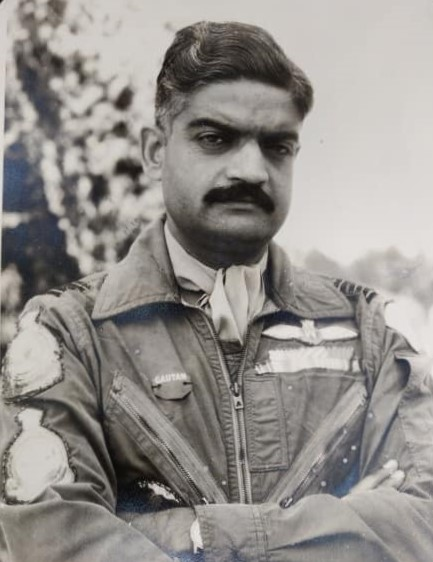
Ave_Christus_Rex retweeted

On this day in 1972, an exceptional pilot of the Indian Air Force (IAF) accomplished a feat that is counted among the remarkable events of aviation history. He safely landed an engine-less MiG-21 fighter in a field outside Pune. But the accident after the aircraft touched down claimed his life.
Wing Commander Padmanabh 'Bob' Gautam (4482), Maha Vir Chakra and Bar, Vayu Sena Medal, was only 39 years old at the time. He was one of only two IAF officers to have been awarded the Maha Vir Chakra twice.
An alumnus of 3 JSW (Joint Services Wing) in Dehradun, Gautam was commissioned into the Air Force on 1 April 1953 with the 60th Pilot Course. This institution later became the forerunner of the NDA.
He began his flying career on fighter aircraft. He then worked as an instructor on Harvards at Jodhpur. In 1958, he began flying the Canberra with the first training batch of the No. 1 Jet Bomber Conversion Unit (1 JBCU) at Agra.
Extraordinary military operation in the Congo-
In October 1961, a detachment of six Canberras of 5 Squadron, led by Wing Commander AIK Suares, was sent to the Congo under a United Nations mission. Gautam was part of this detachment.
Katanga's forces had a Fouga Magister jet, flown by foreign mercenary pilots. This aircraft was continuously harassing the UN ground forces.
On 6 December 1961, in extremely difficult weather conditions, Suares and Gautam attacked its base at Kolwezi, about 1,300 kilometres from their operating base.
The Fouga was parked away from the runway, in a clearing in the middle of the jungle. Despite intense enemy ground fire, Gautam destroyed that aircraft. He also attacked three other aircraft and damaged the airfield's structures.
This attack almost completely eliminated Katanga's air combat capability.
Gautam then flew several close air support missions over Elisabethville. For his gallantry he was awarded the Vayu Sena Medal.
The 1965 India-Pakistan War-
At the time of the 1965 war, Squadron Leader Gautam was the commander of the Jet Bomber Conversion Unit at Agra.
The unit's instructors and aircraft were also put into combat operations. Gautam took part in some of the most challenging Canberra missions.
On the night of 13 September, six Canberras attacked Peshawar inside Pakistan. This was close to the limit of their operating range.
Gautam was the pathfinder for this mission. His job was to locate the target and mark it for the other bombers.
Despite heavy anti-aircraft fire, he accurately dropped the target indicator bomb and damaged the runway.
On the return, a Pakistani F-104 Starfighter intercepted the Canberras and fired a missile at one of them. Even so, all six aircraft returned safely.
Gautam also completed several other missions, including reconnaissance against Pakistani troop deployments in the Gujarat and Chhamb sectors, attacks on airfields, and machine-gun strikes on ground targets.
For his gallantry in these operations, he received his first Maha Vir Chakra.
Instructor in Iraq and an extraordinary landing on a MiG-17-
From 1967 to 1969, Gautam was posted in Iraq as a flying instructor. There he flew the MiG-15 and MiG-17.
During this time he performed the extraordinary feat of safely landing a MiG-17 almost without engine power. For this he received praise from both the Iraqi government and the Indian Air Force.
After returning to India, he took command of 16 Squadron at Gorakhpur.
The 1971 War and the second Maha Vir Chakra-
In the December 1971 war, Gautam and his navigator, Squadron Leader Kalyan Kumar Dutta (5450), together flew six missions on both fronts of the war.
These included risky night air raids on Mianwali.
In this war, Gautam was awarded a Bar to his Maha Vir Chakra. His navigator Dutta was awarded the Vir Chakra.
Thus Gautam joined the rare IAF officers who received the Maha Vir Chakra twice.
25 November 1972: The historic emergency landing of the MiG-21
In 1972, Gautam was posted to 2 Wing in Pune as -
1/2

Ave_Christus_Rex retweeted

Is @SAFRAN giving us a first glimpse of the Super Rafale, a heavily modernized version of the French fighter jet expected to enter service around 2033-2035?


Ave_Christus_Rex retweeted
On this day in 1972, one of the IAF's finest Canberra pilots accomplished an extraordinary feat of flying. He brought an engineless MiG-21 down intact in an agricultural field outside Pune. Tragically, it was what happened after touchdown that cost him his life.
Wg Cdr Padmanabha 'Bob' Gautam (4482), MVC & Bar, VM, was just 39. He was one of only two IAF officers to have been awarded the Maha Vir Chakra twice.
An alumnus of 3 JSW at Dehradun, the precursor to the NDA, Gautam was commissioned with the 60th Pilots' Course on 1 April 1953. He started his flying career on fighters, followed by a stint instructing on Harvards at Jodhpur. In 1958, he converted to the Canberra with the very first Jet Bomber Conversion Unit (1 JBCU) course at Agra.
In October 1961, Gautam was amongst the pilots of the six-Canberra detachment of 5 Squadron sent to the Congo under Wg Cdr AIK Suares as part of the UN mission.
The Katangese forces possessed a Fouga Magister jet, flown by mercenary pilots, which had been harassing UN ground forces. On 6 December 1961, Suares and Gautam attacked its base at Kolwezi, nearly 1,300 km from their operating base, through exceptionally difficult weather.
The Fouga had been parked away from the runway in a jungle clearing. Despite heavy ground fire, Gautam destroyed it, attacked three other aircraft and damaged airfield installations. The raid effectively broke the back of the Katangese air arm. Gautam subsequently flew several close air support missions over Elizabethville, earning a Vayu Sena Medal for Gallantry.
By the 1965 War, Sqn Ldr Gautam was commanding JBCU at Agra. The conversion unit and its instructors were pressed into operational service, with Gautam undertaking some of the most demanding missions of the Canberra fleet.
On the night of 13 September, six Canberras raided Peshawar, at the extremity of their operating range, deep inside Pakistan. Gautam was the pathfinder, responsible for locating and marking the target for the other bombers. Despite intense anti-aircraft fire, he accurately placed the Target Indicator Bomb and inflicted damage on the runway. On their way out, the Canberras were intercepted by a Pakistani F-104 Starfighter, which fired a missile at one of them. All six returned safely.
Gautam also undertook reconnaissance, airfield attacks and ground strafing missions against Pakistani troop concentrations in the Gujrat and Chawinda sectors, braving ground fire and Sabre opposition. He earned his first Maha Vir Chakra.
Between 1967 and 1969, Gautam served as a flying instructor in Iraq, flying the MiG-15 and MiG-17. Remarkably, while in Iraq, he accomplished a near dead-stick landing on a MiG-17, earning commendations from both the Iraqi government and the IAF.
Returning to India, he took command of 16 Squadron at Gorakhpur. In December 1971, Gautam and his navigator, Sqn Ldr Kalyan Kumar Dutta (5450), flew six missions together across both theatres of the war, including daring night raids on Mianwali. Gautam earned a Bar to his MVC and Dutta a Vir Chakra.
In 1972, Gautam moved to Pune as Officer-in-Charge Flying of 2 Wing and converted to the MiG-21. Interestingly, his Station Commander, Air Cmde Dilbagh Singh, the first CO of the IAF's first MiG-21 squadron and a future Air Chief, was himself converting to the Canberra.
On the morning of 25 November, Gautam was on his eighth training sortie after conversion, flying a MiG-21 FL of 8 Squadron, when he suffered an engine failure.
The Senior Air Traffic Control Officer on duty, K. Parthasarthy (6175), asked Gautam over the radio, “Ejecting?”
“Belly landing,” came the response.
With its delta wing, high landing speed and rapidly diminishing energy in unpowered flight, the MiG-21 was a particularly unforgiving aircraft to force-land. Attempting it with the undercarriage retracted, outside an airfield, was quite another proposition.
Parthasarthy watched in astonishment as Gautam brought the aircraft down in a large harvested field. The MiG touched down intact and travelled a considerable distance before striking a wall of boulders and catching fire.
Barely half an hour earlier, Gautam and Parthasarthy had been making plans to take their annual physical fitness test together.
In less than twenty years of commissioned service, Gautam had fought in three conflicts, instructed pilots in two air forces and earned three gallantry decorations. His two younger brothers, P Ashoka and P Ajit, were also IAF pilots, both qualifying as test pilots.
There is a little-known tradition at V.S. Satav School in Wagholi, near Pune. Gautam is believed to have steered his stricken aircraft away from the school before attempting the forced landing. More than half a century later, the school reportedly continues to pay homage to him.
#IAFHistory @IAF_MCC