

Ecologist, Professor, Utah State University
Logan, Utah
Joined February 2022
- Tweets804
- Following173
- Followers744
- Likes149




Pinned Tweet
Explore the science behind the headline in our open-access article here: doi.org/10.1002/ecm.1627

BBC: There’s a lovely film on Youtube called How Wolves Change Rivers. It describes how wolf reintroduction to Yellowstone precipitated a series of ecological benefits…It’s a beautiful and uplifting notion but, according to some scientists, total nonsense.discoverwildlife.com/animal-…

Our critique is now published in Forest Ecology & Management. We show why the corrected 17.5× increase in average sapling density still overstates aspen recovery: mean-based metrics are driven by a minority of plots, while most showed little or no change. authors.elsevier.com/a/1mMLU…

Painter et al. have issued a corrigendum conceding that the headline 152× increase in aspen sapling density was an error (now 17.5×) consistent with our critique. doi.org/10.1016/j.foreco.202…

Painter et al. have issued a corrigendum conceding that the headline 152× increase in aspen sapling density was an error (now 17.5×) consistent with our critique. doi.org/10.1016/j.foreco.202…
About that “152×” Yellowstone aspen claim (see WaPo headline). In a new preprint we show it’s a math error that inflated the effect by 768%. Corrected: 17.5×. Preprint: doi.org/10.32942/X2W949

About that “152×” Yellowstone aspen claim (see WaPo headline). In a new preprint we show it’s a math error that inflated the effect by 768%. Corrected: 17.5×. Preprint: doi.org/10.32942/X2W949
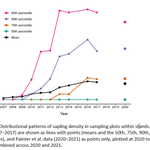
Even 17.5× is inflated—it reflects average sapling density driven by a minority of plots. Most aspen plots (green = median) stayed flat—half had no saplings, and only a small fraction (purple, pink) increased.
doi.org/10.32942/X2W949

ALT Line chart showing Yellowstone aspen sapling density from 2007–2021. Median and 75th-percentile lines stay near zero, while only the upper percentiles (90th and 95th) rise sharply—indicating gains in just a few plots.
Claims about “wolves reshaping ecosystems” are powerful—but only if they’re accurate. This Aspen Times article on Colorado’s wolf reintroduction shows why getting the Yellowstone trophic cascade story right matters for public understanding and policy:
aspentimes.com/news/colorado…

Researchers challenge claim of a strong Yellowstone trophic cascade after wolf reintroduction phys.org/news/2025-10-strong…

You may have heard that large carnivore recovery in Yellowstone National Park triggered one of the world’s strongest trophic cascades. Our new open access article explains why that story doesn't hold up: sciencedirect.com/science/ar…

Have large carnivores in Yellowstone triggered one of the world’s strongest trophic cascades? Our new preprint identifies major flaws in the analysis underlying this claim. Read: doi.org/10.32942/X2QQ0C
Dan MacNulty retweeted

A bill that would deregulate killing of mountain lions and mandate trapping throughout the state stems from concerns over struggling mule deer, despite scant evidence that killing cats will help deer populations.
@Koshywrites has more ➡️ wyofile.com/no-limit-year-ro…
Bills seek to ramp up wolf killing in Montana
missoulacurrent.com/wolf-kil…

Montana seeks to cap its wolf population at 450. House Bill 176 proposes several measures to reduce wolf numbers when the population is at or above 450, including allowing a single hunter to kill an unlimited number of wolves. Hearing: today, 3 PM MST. bills.legmt.gov/#/laws/bill/…
Key detail from yesterday's hearing is that MT FWP equates 450 wolves with 15 breeding pairs, which is the minimum number of breeding pairs MT must maintain to avoid triggering a status review by USFWS & potential relisting, as per the 2009 delisting rule: federalregister.gov/document…

The challenge with managing for the minimum number of wolves is that it requires accurate & precise population estimates, which brings attention back to FWP's controversial iPOM model. Curiously, H.B. 176 mandates that FWP continue using the iPOM model. doi.org/10.1002/eap.2714

Dan MacNulty retweeted
BREAKING: Grizzly bears in the Greater Yellowstone Ecosystem and the Lower 48 will stay protected under the Endangered Species Act, per a @USFWS proposal.
This blocks Wyoming, Montana, and Idaho from gaining control or allowing hunts for now. wyofile.com/feds-yellowstone…

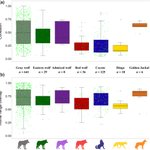
New paper by John Benson et al. in @ESAEcology explores the drivers of group cohesion in social canids. Cohesion varies widely, shaped by life history, prey, group size, and humans. In wolves, it declines as pack size grows or human disturbance increases. doi.org/10.1002/ecy.4492

Much appreciate @SoSeaEmerald for helping the public understand our recent @ESAMonographs paper, debunking the myth that fear of wolves drives aspen recovery in @YellowstoneNPS. The lead image features another wily canid—the coyote. doi.org/10.1002/ecm.1627 southseattleemerald.org/news…
