When it comes to marketing and social media, following a narrative is dangerous. Because narratives are often not based in fact.
Following data can also be dangerous. Especially for teams, there's so much data out there that's dependent on the team's record and the size of their fan base, that can paint an inaccurate picture of how effective different pieces of content are on social media.
In the
@NHL, it's been widely publicized how the league's new generation of players -- Macklin Celebrini, Connor Bedard, the Hughes Brothers, etc. -- are the league's "TikTok" players.
Thanks to data from
@mondometrics /
@nickcicero, I recently dove into the performance of every NHL team TikTok post in 2026, through October 20, to try to cut through the narrative and try to find what the data actually supports.
For every NHL team, I first established their Median Exposure Rate for all of their TikTok posts.
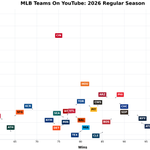
For 10 of the league's most popular players -- featuring both the younger wave of stars as well as some of the league's more established stars -- I then calculated the Median Exposure Rate for all of their team's posts "focusing" on them.
By "focus" on them, I mean the player couldn't just be included in the post. He had to be the primary focus of the content.
This allowed me to calculate how much of a percentage increase each player delivered compared to one of their team's Median posts, which essentially allowed players to be compared fairly, without their market size or overall success of their team's social media strategy skewing the results.
Some of the results fit the narrative...Quinn Hughes of the
@mnwild has been BY FAR the TikTok king of 2026.
But the rest of the results didn't fit the narrative...the next four ranked players were all born before the year 2000. Sidney Crosby/
@penguins and Alexander Ovechkin/
@Capitals, born in the 80s, provided more of a boost for their teams than Macklin Celebrini and Connor Bedard, born in the 2000s.
None of this is to suggest that the players who ranked lower on this chart aren't major draws on TikTok. All 10 players generated a measurable lift above their team's baseline, and they're among the biggest names in a league with more than 600 players.
The bigger takeaway is what this type of analysis makes possible. By measuring the impact individual players have on content performance, teams can instead apply this analysis to all of their players on their own roster, rather than comparing superstars on different teams.
This can help them make informed decisions about who to feature, how to build their content strategies, and where opportunities exist to turn audience interest into revenue.
It's not about proving one superstar is more valuable than another.
It's about understanding what actually resonates with an audience, rather than assuming we already know.