

Stock and Sports | Shouldn’t be considered financial advice | Free Newsletter ⬇️
Charlotte, NC
Joined March 2011
- Tweets8K
- Following148
- Followers672
- Likes5K


Pinned Tweet
I write two newsletters. One is a daily financial markets newsletter and the other is a once a week financial planning newsletter
Check them out here
Markets - dansheehan.beehiiv.com
Financial Planning - the-planning-blueprint.beehi…

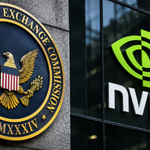
SEC Investigating NVIDIA's Accounting Methods
$NVDA's sell off has reached extraordinary levels, with shares falling another 12% today and the company heading for its seventh consecutive weekly decline, a losing streak not seen since the 2008 financial crisis.
The stock has now fallen 44% over seven weeks, wiping approximately $2.8 trillion from its peak market capitalization in just 45 days.
To put that into perspective, Nvidia has reportedly accounted for around 40% of the S&P 500's market value losses since its October 6 peak.
Reuters reports that the US Securities and Exchange Commission is investigating potential accounting issues at Nvidia, adding another layer of uncertainty to a company already dealing with the fallout from Jensen Huang's resignation and growing scrutiny from Washington.
The precise scope of the SEC investigation remains unclear, and an investigation does not establish wrongdoing.
However, attention is increasingly turning towards Nvidia's financial reporting, including changes to how it categorizes geographical revenue and its involvement in complex AI financing arrangements.
Last year, Nvidia changed its geographical revenue reporting methodology from customer billing addresses to customer headquarters, a move that removed Singapore from its geographical breakdown despite the country's significant role in chip sales.
There are also growing questions about the financial relationships between Nvidia and the companies purchasing its chips, particularly arrangements where investment and financing commitments help support the very infrastructure driving demand.
What's remarkable is that all of this is happening immediately after Nvidia delivered another exceptional earnings report.
Revenue exceeded $115 billion, Data Center sales more than doubled, and management increased its revenue growth outlook for the next financial year to 75%.
Nvidia is now trading at approximately 9.3 times forward earnings, compared with around 29 times for AMD. The company that once dominated the global market capitalization rankings has fallen to fourth place.
A business generating more than $1 billion in revenue every day, delivering triple digit growth and sitting at the center of the AI infrastructure boom is experiencing its longest weekly losing streak since the global financial crisis.
I've previously suggested that Nvidia's valuation was becoming increasingly difficult to ignore, but with the regulatory scrutiny continuing to intensify, it's now becoming equally difficult to assess what multiple the business should command. Strong fundamentals are one thing, but pricing in the potential consequences of these investigations is quite another.

If you think the AI trade is about to end badly, the last two crashes in 2000 and 2008 deserve a closer look
dansheehan9.substack.com/p/w…
The Nasdaq fell 78% after March 2000, and the S&P 500 fell about 55% from its 2007 peak. I went back through both and reviewed the data relating to the question - What happened to the investors who were already diversified when the trouble started?
Four things I found:
$100 in an S&P 500 fund at the end of 1999 was worth $71 nine years later. The same $100 in a plain balanced fund was worth $109.
From 2000 through 2002 the S&P 500 lost 37%. Small cap value gained 24% and REITs gained 53% over the same three years.
Cisco was the most valuable company in the world in March 2000. Its stock took 25 years to get back to that price.
The ten largest stocks are about 39% of the S&P 500 today, with Nvidia alone at 8.4%. At the dot-com peak the top ten were about 26%.
I don’t think what we are experiencing is 2000 or 2008 by I wanted to address with more doomsday calls coming on social media. The full piece explains why, how long each recovery took, and the one year diversification failed.
$QQQ $SPY $ANT
1
47
A record breaking @AnthropicAI $ANT IPO, a brutal market sell off, and AI stocks under serious pressure.
Sentiment is turning increasingly negative, but history tells us that some of the best opportunities emerge when investors are at their most pessimistic.
The question is, are we there yet?
More in today’s Market Pulse.
dansheehan.beehiiv.com/p/his…

29
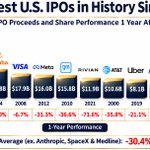
Ahead of the Anthropic $ANT IPO I decided to take a closer look at some of the largest US IPOs since the dot-com bubble and how their shares performed in the first 12 months after listing.
I looked at nine major IPOs with a full year of trading history, including Alibaba, Visa, Meta, General Motors, Rivian and Uber.
What I found was that all nine had delivered negative returns after their first year, with an average decline of 30.4%.
Rivian was the worst performer, falling 71.6%, followed by General Motors at 36.6%, AT&T Wireless at 35.8%, Meta at 31.3% and Alibaba at 30%. Even Visa, which has been an exceptional long-term investment, was down 6.7% in its first year.
Of course, this is a relatively small sample, and the companies listed in very different market conditions. It also says little about their longer term performance.
But with Anthropic and SpaceX raising such significant amounts of capital, I think it's worth looking at what has happened historically and there's an important difference between investing in a successful business and paying the right price for its shares.
Are you investing in the Anthropic IPO?

138
The Biggest IPO Ever Lands Today
Anthropic starts trading today at a valuation of around $1.5 trillion after pricing its IPO at $83 a share, above the expected range.
It is now the largest IPO in history, breaking a record that SpaceX only set earlier this year.
The S&P has just recorded five consecutive losing sessions, NVIDIA couldn’t hold its post earnings bounce, and the market has spent weeks questioning whether too much money has gone into AI.
Then investors effectively queued up to pay above the range for one of the companies right at the center of that spending boom.
Anthropic’s growth helps explain why. Revenue for the first nine months of the year was around $33 billion, up roughly 1,200% from a year earlier, with the company’s run-rate revenue reaching close to $81 billion by the end of October.
That is extraordinary growth but I’d separate excitement about the business from excitement about the stock on day one.
When I looked at this around the SpaceX IPO, the ten largest IPOs of this century were down around 28% on average a year after listing. A great company, a successful IPO and a good entry point are three very different things.
After weeks of questioning whether enthusiasm for AI has gone too far, investors are still willing to put enormous amounts of capital behind the companies at the centre of it.
The appetite clearly hasn’t disappeared.
AND NOT TO LEAVE IT OUT, HAPPY GRAND THEFT AUTO DAY TO THOSE WHO CELEBRATE
Full Market Pulse below 👇
$ANT $SPCX $NVDA
dansheehan.beehiiv.com/p/the…

27

Anthropic IPO: Nearly $500 Billion of Demand Is Chasing One of AI’s Biggest Listings
Anthropic hasn’t even started trading yet and investor demand is already drawing major headlines.
Institutional orders are reportedly around $400 billion, with retail demand approaching another $100 billion, potentially giving Anthropic close to $500 billion of indications of interest for its IPO.
The Numbers
• Initial price range: $70-$78 per share
• Reported pricing discussions: Above $80, with one report suggesting as high as $85
• Shares offered: 825 million
• Potential proceeds at $78: ~$64B
• Nine month revenue: $33.24B, up roughly 1,200% YoY
• October run rate revenue: ~$81B
• Customers spending $100K+: More than 11,900
• Expected ticker: $ANT
Anthropic generated just $2.5 billion of revenue in all of 2025. Nine months into 2026, that figure had already surpassed $33 billion, driven heavily by enterprise adoption and Claude Code.
Amazon and Google are already major shareholders, while Google, Microsoft, NVIDIA, AMD and others have collectively committed billions more around the offering.
Depending on the final price, Anthropic could enter the public market worth well above $1 trillion. Investors are therefore being asked to pay today for an enormous amount of future growth.
The AI trade has been under pressure, yet demand for direct exposure to one of the leading AI labs appears almost insatiable.
After months of debate about whether the AI boom has gone too far, investors appear willing to put hundreds of billions of dollars of orders behind one of the companies sitting at the very center of it.

1
1
170
NVIDIA Earnings: The Business Just Made the Sell Off Harder to Justify & Doesn't Intend To Rehire Huang
$NVDA delivered an exceptional quarter, beating expectations across the board and issuing stronger than expected guidance in its first earnings report since Jensen Huang’s resignation.
The Numbers
• Adjusted EPS: $2.68 vs. $2.48 expected
• Revenue: $115.84B vs. $109.10B expected
• Revenue growth: +103% YoY
• Data Center revenue: $107.6B vs. $101.9B expected, up 110% YoY
• Q4 revenue guidance: ~$130B vs. ~$125B expected
• New share buyback: $150B
Revenue there more than doubled to $107.6 billion, with another sequential increase expected next quarter. That is difficult to reconcile with the idea that AI infrastructure demand is suddenly falling away.
My view last week was that Nvidia had lost its most influential leader, not its competitive advantage. These results reinforce that.
The company is still selling enormous amounts of compute, hyperscaler spending remains strong, Vera Rubin is beginning to ramp and there is still no clear evidence that customers are materially pulling back.
That doesn’t make the leadership situation irrelevant, and far from it. The bigger question remains whether Nvidia can replace Jensen’s long term vision, or whether the growing possibility of his return eventually changes that discussion altogether.
The operating business has just delivered another quarter of extraordinary growth.
The investment case now comes down to how much damage does the leadership crisis ultimately cause, and how much of that risk has already been priced into a stock that has fallen sharply despite fundamentals that remain this strong?
Nvidia Chair Harvey Jones says board doesn’t intend to reinstate Huang as CEO
1
221
Nvidia beats earnings
• EPS: $2.68 vs $2.47 est
• Revenue: $115.8B vs $109B est
$NVDA
200
The SEC has opened an investigation into Nvidia amid the Jensen Huang situation, per WSJ.
$NVDA
182
Jensen Huang Officially Wants To Return As NVIDIA CEO
Just days after resigning from $NVDA, Jensen Huang has released his first public statement, acknowledging his mistakes and making it clear that he would be willing to return as CEO if the board wanted him back.
Last week, following Jensen's resignation, I argued that Nvidia had lost its most influential leader, not its competitive advantage. I also suggested that the sell off was beginning to create an interesting opportunity for investors.
Jensen's statement introduces a completely different possibility. What if Nvidia doesn't have to navigate the next decade without the man who built it?
Reports suggest senior employees are already pushing for his return, warning the board that failing to reinstate him could result in the loss of irreplaceable talent. That tells you something about just how important Jensen remains to the people within the organization.
Of course, wanting to return and actually returning are two very different things.
The board has reportedly ruled out reinstating Jensen, at least for now. Whether it is prepared to reconsider that position remains unclear, but his public willingness to return, combined with growing pressure from employees and investors, introduces a possibility that appeared to be off the table just days ago.
The congressional investigations are becoming increasingly serious, with Jensen expected to face questioning in Washington next month over potential national security concerns.
The board cannot simply ignore those issues, particularly when the investigations could have consequences that extend well beyond Jensen himself and potentially affect Nvidia's business.
Nvidia has lost hundreds of billions of dollars in market value during this crisis, yet fundamentally, what has changed?
The demand for AI infrastructure remains enormous. Nvidia still dominates the market for advanced AI chips, and so far there has been no clear evidence of a material deterioration in customer demand.
My concern last week was about the next decade, and whether Nvidia could replace the vision that Jensen brought to the business.
If there's now a realistic prospect of him returning, that potentially changes the longer term investment case considerably.
If Nvidia delivers another exceptional set of results tonight, with strong guidance and no indication that customers are pulling back, does the market begin to question whether the scale of the sell off was justified in the first place?
I think we're approaching a particularly interesting point for Nvidia investors because the business may be considerably stronger than the share price suggests, while the possibility of Jensen returning introduces another potential catalyst for a recovery.
The board has an incredibly difficult decision ahead, and I wouldn't underestimate the political and reputational obstacles to bringing him back.
But I also wouldn't underestimate the value of having Jensen Huang running Nvidia.

Over the past week, I’ve been overwhelmed by the love and support of friends, industry colleagues, and people I've never met. Thank you to everyone who has shown kindness to my family and me. It means the world to me.
I came to the United States 53 years ago, and becoming an American citizen is one of the greatest gifts and proudest moments of my life. NVIDIA has been my life’s work. Building it into the company it is today alongside my colleagues has been a privilege and an honor. Nowhere but in America could a company like NVIDIA be possible. I love our country, and I love NVIDIA.
I did not live up to the standards expected of everyone at NVIDIA, and I have made serious mistakes in my personal life. I created problems for the Board that I deeply regret. I own my mistakes completely, and I am committed to cooperating with the Board’s independent investigation.
Since my departure, I’ve seen an outpouring of calls from NVIDIA’s employees, investors, business partners, and customers for me to return as CEO. Many continue to reach out to me directly as the company navigates complex technology, market, competitive, and geopolitical dynamics. NVIDIA is a once-in-a-generation company. If the Board of Directors decides that my return is in the best interest of our shareholders, our employees, the company, and America, I would be honored to answer these calls and return as CEO.
Thank you again to everyone who has shared their good wishes. I am profoundly humbled by your support. To my family: I love you, and I will spend the rest of my life being worthy of yours.
Jensen
86
Airlines expect a lot of understanding from their customers but it's a shame that understanding rarely seems to work both ways
I was flying back from West Palm Beach on Sunday when our flight was canceled. We were fortunate enough to get seats on another flight, likely due to my Fiancé's airline status, but plenty of other passengers weren't so lucky.
Once we boarded, we found ourselves sitting on the plane with no air conditioning being told it would come on once the aircraft started moving, directly after being told we didn't know when we would take off.
The whole experience got me thinking about how one sided the relationship between airlines and its customers has become.
Over the past several months, we've seen some extraordinary airfare increases. Airlines have been quick to point to higher fuel costs and operational pressures but it's difficult to believe those factors alone explain some of the prices passengers are being asked to pay.
Then there's the cost of flexibility.
Need to change your flight? Expect to pay for it
Need to travel at short notice? You'll often pay significantly more
But when an airline cancels your flight, delays your departure, or leaves you sitting on a hot aircraft, suddenly we're all expected to appreciate how complicated the airline business is.
I live in Charlotte, North Carolina, which makes this even more frustrating. Charlotte is one of American Airlines' largest hubs, and consistently ranks among the more expensive major airports in the country for domestic fares. The hub model works incredibly well for connecting passengers, but for those of us who actually live here, the lack of competition on many direct routes means we're often paying a substantial premium just to fly from our local airport.
@AmericanAir has built an incredibly strong position in Charlotte, and commercially, you have to admire that, but there's a difference between having pricing power and taking advantage of customers who have very few alternatives.
I'm certainly not against airlines making money. They're complex, capital intensive businesses with enormous operating costs, and profitability matters, but if you're going to charge premium prices, customers should reasonably expect a level of service and accountability that reflects that.
Most passengers understand that things go wrong. Weather happens, aircraft develop faults, and schedules get disrupted. That's not really the issue.
What frustrates me is that when customers need understanding, the airlines point to their terms and conditions. When airlines need understanding, they expect customers to be patient, flexible, and grateful for whatever solution they're offered.
It seems we've reached a point where airlines expect customer loyalty without feeling much obligation to earn it.
$AAL $DAL $UAL

2
1
319
NVIDIA Is Tonight’s Test But The Market Is The Bigger Story
$NVDA reports tonight but I think the more important question is what the market does with the result.
The stock is down around 24% this month, we’ve had a major leadership change, regulatory scrutiny has intensified, AI financing has been questioned, inflation has come in hot and the market is now pricing another Fed hike in December.
That is a lot of bad news to absorb in a very short period of time and yet despite all of it, the S&P is still sitting roughly where it was before the election.
That resilience is why I continue to think we are getting closer to a meaningful low.
Tonight’s Nvidia numbers should still be very strong. Sales were largely locked in well before the recent turmoil and analysts are expecting another huge YoY increase. What matters more is the guidance, the tone from interim CEO Colette Kress and whether investors can separate the strength of the underlying business from everything that has happened around it.
Corporate earnings remain strong, valuations have reset, pessimism is extreme and short positioning in technology has become crowded. None of that means the volatility is finished, and I’m not trying to call the exact bottom.
But when fundamentals remain intact while expectations and valuations fall sharply, the balance between risk and opportunity starts to look very different.
Nvidia may determine tomorrow’s headlines, but how the rest of the market reacts will tell us much more.
Full Market Pulse below 👇
dansheehan.beehiiv.com/p/nvi…

56
Aschenbrenner’s Situational Awareness is latest example of someone who outperforms but couldn’t do it forever
$QQQ

Aschenbrenner’s Situational Awareness made AI bets again before October rout cnbc.com/2026/11/16/situatio…

42
First Microsoft, then the airlines, now America's biggest banks reporting outages.
I've said before that cybersecurity is one of my biggest investment themes heading into 2027, and this only reinforces that view.
The more connected the world becomes, the more critical digital resilience gets.

54
After one of the wildest stretches I can remember, the most surprising thing is how little the market has actually moved
The S&P is sitting almost exactly where it was before the election.
Since then we’ve had a violent AI selloff, a political reset in Washington, NVIDIA losing its founder CEO, renewed scrutiny around AI financing, hotter inflation, oil swinging on Iran headlines, and a huge amount of volatility.
And yet, last week the S&P still rose 2.5%, all 11 sectors finished higher, and the market absorbed some genuinely bad headlines without breaking to fresh lows.
It doesn’t mean the volatility is over, and this week will test the market again with Nvidia earnings on Tuesday, Anthropic pricing its IPO Wednesday, retail sales, Fed commentary and a very important read on the consumer.
But when bad news stops producing new lows, I start paying attention.
The other thing I’m watching is the growing disconnect between fundamentals and positioning. Corporate profitability is at record highs, yet multiples have compressed and investors are paying increasingly high prices for perceived safety.
If earnings keep growing, the consumer holds up and the market continues to absorb bad news, I think the asymmetry starts to look more attractive.
There has been a lot of noise over the past few weeks and the fact the market has gone almost nowhere through all of it may be the most important signal of all.
Full Market Pulse below 👇
dansheehan.beehiiv.com/p/nvi…

34
Corporate profitability is reaching record highs and yet equity multiples continue to compress.
Short interest in the Nasdaq 100 ETF $QQQ is approaching its highest level since 2023 at around 11%, while Consumer Staples trade at roughly 24x earnings, valuations not seen since 1999. Investors are increasingly paying a premium for defensiveness.
Meanwhile, Financials are delivering record margins, yet forward P/E has compressed from 16.4x to 15.2x this year.
The market is rewarding perceived safety over earnings growth.
This week brings several potential catalysts with Fed commentary, Tuesday’s Retail Sales report and Nvidia earnings, where forward guidance and leadership confidence will matter far more than the headline beat.
The question is whether this represents rational repricing of forward risks or an increasingly crowded defensive rotation.
When earnings rise, multiples contract and bearish positioning builds, the asymmetry becomes difficult to ignore.
dansheehan.beehiiv.com
2
2
103
The Nasdaq 100 $QQQ short interest level is currently around 11% of outstanding shares
This is the highest level since 2023
Interested to see how this plays out with the markets having sold off since the election
46