

AI claims come here to get judged. ⚖️ I investigate the wildest AI claims on X. Claim → Evidence → Verdict
Ashton-under-Lyne, England
Joined May 2026
- Tweets140
- Following25
- Followers15
- Likes40



Your AI agent doesn't need a better prompt.
It needs guardrails.
A simple agent failure can come from:
→ Too many retries → set a retry limit
→ Dead-end tasks → define an exit route
→ Unsafe tool calls → add a scope check
→ Huge prompts → set a token budget
→ Repeating old mistakes → write important outcomes to memory
The expensive part isn't always the first mistake.
It's making the same mistake again.
That's why reliable agents need more than intelligence.
They need:
Limits.
Verification.
Memory.
An exit.
AI CLAIM JUDGE VERDICT: SOLID
Before adding another agent, make sure the one you already have knows when to stop, when to verify, and what to remember.
What guardrail would you add first?
25
Can AI really automate an entire short-video workflow?
MoneyPrinterTurbo is designed to automate multiple steps:
→ Script generation
→ AI voice
→ Subtitles
→ Media matching
→ Video editing
→ Final rendering
On paper, that's a surprisingly complete pipeline.
But automation ≠ quality.
The hard part isn't generating each individual component.
It's making the final video coherent, watchable and worth publishing.
So the real question isn't:
“Can AI make a video?”
We already know it can.
The stronger question is:
“Can AI consistently make videos people actually want to watch?”
AI CLAIM JUDGE VERDICT: PLAUSIBLE
The workflow is real.
The claim that it can replace a complete content-production process still needs proof at scale.
Would you trust AI to handle your entire short-video production pipeline?

1
21
Stop using AI like a chatbot.
Connect Claude Code to Obsidian and your notes can become something closer to a working system.
Instead of manually searching through hundreds of notes, the agent can:
→ Search your knowledge base
→ Connect related ideas
→ Organize projects
→ Pull context from old work
→ Turn saved information into new work
The interesting part isn't “AI can search your notes.”
It's what happens when memory becomes part of the workflow.
Your notes stop being a storage folder.
They become context the agent can actually work with.
But there's a catch:
More notes don't automatically mean better answers.
Bad information, outdated notes and missing context can make the system confidently wrong.
So the real goal isn't:
“Give AI all my information.”
It's:
“Give AI the right information at the right time.”
AI CLAIM JUDGE VERDICT: PROMISING
The workflow is plausible.
The quality of the knowledge base still determines the quality of the output.
Would you let an AI work directly inside your second brain?

A viral AI claim says a Polymarket bot turned $50 into $435,000.
The number is impressive.
But the number alone proves almost nothing.
To judge the claim, we need to know:
→ Was $435K realized profit or peak account value?
→ How many trades were made?
→ What was the starting bankroll?
→ Were fees and slippage included?
→ Can the same strategy reproduce the result?
A screenshot can prove that a number existed.
It cannot prove that the strategy caused it.
Verdict: Unverified until the full trading history and methodology are public.

52
PRAXIST reports 49/75 gold medals on MLE-Bench, versus 34/75 for Claude Code + Opus 4.8.
The reported cost difference is even more striking:
$3,054 vs. $38,370.
But the interesting part isn't simply “more agents = better.”
PRAXIST assembles specialized roles around the problem:
→ Analyzer
→ Innovator
→ Exploiter
→ Falsifier
→ Combinator
Different agents explore, challenge and combine approaches instead of forcing one agent to do everything.
The model is the worker.
The architecture decides how the workers disagree.
That's the claim worth paying attention to.
But these are reported results, not yet proof that this architecture universally beats stronger single-agent systems. The benchmark setup and evaluation methodology matter.
AI CLAIM JUDGE VERDICT: PROMISING
The architecture is compelling.
The headline numbers still need verification.
One stronger model — or a team designed to challenge itself?

1
55
300 AI agents don’t give you 300 independent answers.
They give you 44,850 possible pairs that can disagree.
That’s the problem nobody mentions when they say “just add more agents.”
More agents can mean more coverage.
But without a way to resolve contradictions, you’re multiplying coordination cost too.
The interesting part isn’t making 300 agents talk.
It’s deciding:
→ which agent is trusted
→ which conflicts matter
→ who gets to resolve them
→ when the system is allowed to ship an answer
My verdict:
Multi-agent systems don’t scale by adding agents.
They scale by adding coordination.
How many agents would you actually trust in one system?

16
A benchmark score without its harness is missing part of the experiment.
Same model.
Different tools, context, permissions, and execution loop.
Different result.
That’s why I’m paying more attention to the harness than the leaderboard number.
A model doesn’t solve a coding benchmark by itself.
The harness determines: → what tools it can use
→ what context it sees
→ how it loops
→ what it’s allowed to do
→ when it stops
Change those variables and you may no longer be measuring the same system.
My verdict:
“Model X scored 87.9” is incomplete without the harness details.
The better question is:
87.9 with what harness?
That’s the number I want to see next.

26
AI turned $50 into $435K on Polymarket.
That claim sounds insane.
But a screenshot of the final balance proves almost nothing.
To verify it, we need:
→ the full trade history
→ starting capital
→ every losing trade
→ fees + slippage
→ the bot’s actual strategy
→ independently verifiable results
A bot can make profitable trades.
That does NOT prove it can reliably turn $50 into $435K.
AI Claim Judge verdict: UNVERIFIED.
Big returns need big evidence.

1
30
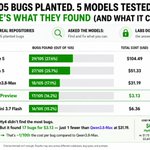
A $3 model found 17 of 105 planted bugs.
Hy4 Preview was tested on 2 real repositories with 105 hard-planted bugs, then asked to find and fix what it could.
The results:
Fable 5: 29/105 — $104.49
Opus 5: 27/105 — $51.33
Qwen3.8-Max: 18/105 — $31.19
Hy4 Preview: 17/105 — $3.13
Gemini 3.7 Flash: 16/105 — $6.36
Hy4 wasn't the strongest model in the test.
But it delivered a similar range of results to the other cheaper models at a fraction of the cost — roughly 33× cheaper than Fable 5 in this run.
That's the interesting part.
Capability isn't the only metric for agentic coding.
The better question is:
How much useful work do you get per dollar?
One test doesn't prove Hy4 is better. It shows why cheap models are getting harder to ignore.

1
94
A $3 model found 17 of 105 planted bugs.
I tested Tencent's Hy4 Preview on 2 real repositories with 105 planted bugs.
Here’s how the runs compared:
• Fable 5: 29/105 — $104.49
• Opus 5: 27/105 — $51.33
• Qwen3.8-Max: 18/105 — $31.19
• Hy4 Preview: 17/105 — $3.13
• Gemini 3.7 Flash: 16/105 — $6.36
Hy4 didn't find the most bugs.
It found nearly as many as Qwen3.8-Max at roughly 1/10th the cost.
That's the interesting result.
Frontier models still won on raw bug-finding in this test. But Hy4 shows why cost per useful result matters when you're running agents at scale.
Verdict: promising on cost-efficiency, not proof that Hy4 is the better model.
One benchmark isn't enough. I'd want to see this repeated across more repositories and bug types.
Would you trade some accuracy for dramatically lower inference cost?

100
An open-source research agent beat a Claude Opus 4.8 setup on MLE-Bench — at a fraction of the cost.
On 75 real ML engineering tasks:
→ PRAXIST: 49 gold medals / 65.3%
→ Claude Code + Opus 4.8: 34 gold medals
→ PRAXIST cost: $3,054
→ Claude setup: $38,370
The interesting part isn't just the numbers.
PRAXIST runs research peers in parallel. Their findings — including failed approaches — go into shared memory.
A PI-style panel then uses that accumulated evidence to decide what to test next.
So instead of:
try → keep the winner → forget the rest
it becomes:
try → record → compare → learn from failures → test again
That's a very different agent architecture.
Maybe the next leap in AI agents isn't just a bigger model. It's a better loop.
What matters more: model capability or the system built around it?

1
62
More AI agents ≠ better results.
Anthropic tested splitting one coding task across four agents:
Planner → Implementer → Tester → Reviewer
The surprising problem?
The agents spent more tokens coordinating than doing the actual work.
They called it the “telephone game” problem: every handoff can lose context.
And that's the part people underestimate about multi-agent systems.
Adding more agents isn't automatically better.
You have to design how context moves between them.
Sometimes the better architecture isn't more handoffs.
It's shared context.

1
1
30
More agents ≠ better agents.
Anthropic ran an experiment splitting one coding task across four agents:
Planner → Implementer → Tester → Reviewer
The result exposed a problem with multi-agent workflows:
coordination can become the bottleneck.
Every handoff creates a chance to lose context — the “telephone game” problem.
That leads to a bigger lesson:
Adding more agents isn't automatically better.
You need to design how context moves between them.
The real challenge in multi-agent systems isn't the number of agents.
It's keeping the right context intact.

2
45
Your AI coding agent doesn't always need one provider.
A setup for Codex is using multiple free Ox Alpha routes:
OpenCode → OpenRouter → Command Code → Hermes → Venice
When one route runs dry, it moves to another.
The useful idea here isn't “Codex for free.”
It's fallback routing: keep your coding workflow running when one provider hits its limit.
Just remember: free routes can have rate limits, quotas and changing availability.
Useful? Yes. Unlimited? No.

1
105
AI is getting too many models to choose from.
RouteLLM wants to make that choice automatic.
You send one prompt.
→ RouteLLM routes it
→ The right model handles it
→ You get the result
It claims support for 150+ models, custom routers and caching.
The interesting question:
Can automatic routing actually give you better results for less money?
That's what I'd want to test.

1
24
This open-source skill turns a codebase into an interactive architecture map.
Archify works with Claude Code, Codex, Cursor and OpenCode.
It can generate: → Architecture + data-flow diagrams
→ Searchable nodes
→ PNG / SVG / WebM exports
→ Shareable cards
The interesting part isn't the visualization.
It uses typed JSON IR + validation to avoid inventing connections.
That's the part worth testing.

1
69
AI agents are about to become reusable software.
Grok Bot is reportedly adding shareable templates:
→ Build a workflow once
→ Package the whole setup
→ Share a link
→ Someone else imports it with one click
That changes the game.
The real value isn't one powerful agent.
It's an ecosystem where useful agents can be built once and reused by everyone.
1
44
$50 → $5,273 in 48 hours with an autonomous AI agent.
Sounds insane.
But a profitable run isn't the same as a profitable system.
To verify the claim, I'd want:
→ Every trade
→ Fees + losses
→ Starting/ending balance
→ Human interventions
→ Whether the result can be reproduced
One winning run proves an outcome. It doesn't prove a strategy.

24
Grok Bot can reportedly run a full digital office 24/7 — even when your laptop is closed.
The setup:
→ Create a Chief
→ Give each agent a specific job
→ Show it the task once
→ Connect Telegram
→ Send goals, not step-by-step instructions
The agents break down the goal, delegate the work and deliver the result.
You only step in when a decision is needed.
But there's one claim I'd want to test:
How much of that “24/7 office” actually runs without human intervention?
That's the difference between an AI assistant and an autonomous AI workforce.

1
68