
A social impact organisation providing data access, insights and resourcing the data ecosystem. Data Journalism @dataphyte Data Collection @GolokaAnalytics
Nigeria
Joined October 2019
- Tweets2.4K
- Following126
- Followers1.8K
- Likes1.2K






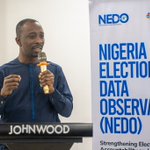
Dataphyte Foundation is inviting qualified applicants to serve as State Coordinators for the 2027 General Elections under the Nigeria Election Data Observatory (NEDO).
Selected coordinators will oversee election observation activities and manage field observers in their respective states during the Presidential and National Assembly Election.
Eligible applicants must be between 18 and 35 years old, hold at least a bachelor's degree and have experience in election observation and reporting. Strong communication, training and team management skills are also essential.
Applicants must reside in the state they are applying to coordinate and submit an updated CV (maximum two pages) alongside their highest educational certificate. Women are encouraged to apply.
Application Deadline: November 2, 2026
Apply here: bit.ly/StateCoordinators2027 or scan the QR code on the flyer.

Here are some moments from the launch of the Nigeria Election Data Observatory (NEDO) Consortium in Abuja, as partners and stakeholders came together to advance a more coordinated approach to election observation and credible electoral information ahead of 2027.
The Nigeria Election Data Observatory (NEDO) Consortium Launch has come to a close in Abuja after a day of discussions on how data, technology, citizen networks and independent observation can improve Nigeria’s electoral process ahead of 2027.
With the launch concluded, the work now moves to implementation, coordinating observer networks, improving access to credible election data and building the evidence needed for public accountability before, during and after the 2027 General Elections.
We sincerely appreciate all consortium partners, stakeholders, media organisations, civil society groups, researchers, technology partners, citizen observer networks and everyone who joined us for the launch.


1 /The Nigeria Election Data Observatory (NEDO) Consortium Launch also featured election-focused tools from consortium partners, showing how their existing platforms and networks will complement NEDO across the 2027 electoral cycle.
@thecjid presented its Press Attack Tracker for documenting verified attacks on journalists and Know Your Leader, a platform that helps citizens track candidates’ positions and policy statements.
@Yiaga presented its citizen-led election observation approach, including the Process and Results Verification for Transparency (PRVT) and its Election Results Analysis Dashboard - ERAD, which combines statistical observation, field reports and result verification...


2/ @BudgIT presented Civic Hive, an election results platform, which uses interactive maps and data visualisation to make election results easier for citizens and other stakeholders to follow, compare and analyse.
@DEANInitiative presented its Election EyeWitness Observation Mission, which uses grassroots observer networks and WhatsApp-based reporting to collect information before and during elections. The presentations showed how the different tools, networks and expertise will contribute to a broader pool of election information for verification, reporting and public accountability.


The Nigeria Election Data Observatory (NEDO) Consortium Launch featured a live walkthrough of the NEDO App, the election reporting tool that documents incidents during elections from verified election observers.
Olayinka Daniel, Digital Innovation Manager at Dataphyte Foundation, walked participants through how observers will submit reports on election activities, incidents and results from their assigned locations, with supporting evidence feeding into a shared dashboard for consortium partners.
He also explained how NEDO will allow partners to follow reports across states, LGAs, wards and polling units, verify information from the field, analyse election results and use the data for reporting and public communication.
The session gave participants a clearer view of how NEDO will connect field observation, data and technology to improve access to credible election information as the process unfolds.


The panel discussion at the NEDO Consortium Launch focused on the role of data and citizen networks in improving electoral accountability and integrity ahead of the 2027 General Elections.
Khadijah Kareem, Managing Editor at Dataphyte moderated the session. The session featured Amina Miango of CJID, Ibrahim Faruk of Yiaga Africa and a Agianpe Onyema, Program Manager Elections & Civic, @placng.
The panelists spoke about gaps in access to election information, noting that data is often scattered, difficult to use and does not always reach citizens in accessible formats or languages. They also discussed the role of citizen observers, media networks and technology in verifying election information and reporting incidents.
A key point from the discussion was that technology alone cannot guarantee credible elections. The panelists stressed the need for field observation, collaboration across organisations and multiple sources of information to verify reports and reduce the risk of misleading the public.


Dataphyte Foundation, @CJIDAfrica, @DEANinitiative, @BudgITng and @YIAGA officially launched the NEDO Consortium in Abuja.
@Abdek_SDGs, Programme Manager at Dataphyte Foundation, talked about how the partnership will work across the 2027 electoral cycle. He explained that NEDO will connect observer networks, data, technology and institutional expertise, while collaborating with other civil society organisations, media groups and researchers to contribute to and draw from the consortium’s shared election data.
With over 4,000 observers to be deployed during the 2027 elections, the approach is intended to widen coverage, reduce duplication and provide a stronger evidence base for verification, public reporting, research and electoral reform.


1/ At the ongoing Nigerian Election Data Observatory (NEDO) Consortium Launch in Abuja, representatives of Dataphyte Foundation, @CJIDAfrica, @DEANinitiative, @YIAGA Africa and @BudgITng delivered welcome addresses on the issues the consortium seeks to address ahead of the 2027 General Elections.
@JoshuaOlufemi, Founder of Dataphyte Foundation, called for a more coordinated approach to election observation, connecting media networks, technology, field observers, civic messaging and grassroots voices so civil society is not working from fragmented accounts of the same electoral process.
Bisan Habu, Deputy Director, Partnerships & Special Projects at @CJIDAfrica, drew attention to credible information, voter participation and the role of coordinated newsroom and civil society networks. Blessing Agu of DEAN Initiative spoke on citizen preparedness, transparent electoral processes, accountable institutions, election technology and result collation...


2/ Ibrahim Faruk, Programme Coordinator, Africa Division at Yiaga Africa, referenced the organisation’s citizen-led observation, election results analysis and voter research as part of efforts to improve electoral integrity.
Peace Chris Ubah, Programmes Officer at BudgIT/Civic Hive, called for accountability, timely communication and active participation from electoral institutions, civil society, the media, political parties and citizens.
The remarks showed how the partners’ different areas of expertise will contribute to NEDO’s work across the 2027 electoral cycle.


PRESS RELEASE!
Ahead of Nigeria’s 2027 General Elections, improving how election information is collected, managed, verified and communicated will be critical to electoral transparency and public trust.
Today in Abuja, Dataphyte Foundation, Yiaga Africa, BudgIT Foundation, CJID and DEAN Initiative officially launched the Nigeria Election Data Observatory (NEDO) Consortium.
NEDO will address gaps in election observation and civic data management by connecting the partners’ observer networks, data infrastructure, research, media and technology capacities within a common evidence framework.
Through the NEDO App and the consortium’s observer networks, electoral information will be documented, cross-checked and made available for analysis, reporting and public communication before, during and after the 2027 elections.
Read the full press release to learn more about the consortium and its plans for the 2027 electoral cycle.


The NEDO Consortium Launch has begun in Abuja, opening with a media press briefing featuring representatives of Dataphyte Foundation, CJID, DEAN Initiative, BudgIT Foundation and Yiaga Africa.
Delivering the press statement on behalf of the consortium, Oluseyi Olufemi, Country Director, Dataphyte Foundation, highlighted the fragmentation of election observation across separate civil society networks and the need for a shared system for collecting, comparing and verifying electoral information.
“We recognise that no single civil society organisation, regardless of its experience or resources, can adequately respond to these challenges at the national level. Our response is therefore to work together, pool our institutional capacities, and establish a common evidence system that strengthens what each organisation can achieve independently,” he said.
Representatives of CJID, DEAN Initiative, BudgIT Foundation and Yiaga Africa also delivered remarks on their respective roles, contributions and expectations for the consortium ahead of the 2027 General Elections.
The press briefing is setting the context for what NEDO seeks to address, how its shared information infrastructure will work and how the five partners will contribute across the electoral cycle.


Young people will not just be watching the 2027 elections. Their participation, choices and voices will matter in how the process unfolds.
In the next episode of Dataphyte’s Election Dialogue Series, we look at what youth civic participation could mean for 2027, the barriers young Nigerians still face, and what needs to change for their involvement to go beyond election-day voting.
Youths’ Civic Participation: What Will Change in 2027?
Coming soon!

The Nigeria Election Data Observatory (NEDO) Consortium will be officially launched tomorrow, October 27, 2026.
As Nigeria approaches the 2027 General Elections, the need for collaboration among civil society organisations has never been more important.
Election observation plays a critical role in safeguarding electoral integrity. However, when organisations work independently, their resources, observations, and evidence can remain fragmented and as such, limit their collective capacity to identify patterns, document electoral challenges, and provide strong evidence to inform electoral accountability.
The NEDO Consortium brings together five organisations, Dataphyte Foundation, the Centre for Journalism Innovation and Development (CJID), BudgIT, DEAN Initiative and YIAGA Africa to bridge this gap through a collaborative approach to election observation and electoral information dissemination.
The launch marks the beginning of a collective effort to strengthen independent election observation and promote electoral accountability through data and citizen networks.
Follow the launch across our platforms for key updates and highlights from the event.

Concerns about artificial intelligence replacing workers are growing as more businesses adopt the technology.
But AI's impact on employment goes beyond job losses. While some roles face greater risks, others could change as employers increasingly rely on AI to perform certain tasks.
For Nigeria, this raises important questions about job security, workforce readiness and the skills needed in a changing labour market.
At the just concluded Build 2026: Africa’s Shared Compute and AI Infrastructure Conference, our founder, Joshua Olufemi (@jayangbayi), joined other leaders in the African Data and AI space to speak on “Tech Justice and Algorithm Accountability: Designing Safeguards for Public and Private AI.”
During the session, Joshua shared insights on the importance of data sovereignty, responsible AI governance, local innovation and the need to build AI systems that understand Nigeria’s unique social, cultural and linguistic contexts.
Drawing from Dataphyte’s work on development data and elections, he highlighted emerging questions around the use of AI in electoral processes, the protection of citizens’ data, institutional capacity, synthetic media and the need for stronger ground-truthing system to support accountability.
He emphasised that as AI adoption grows, Nigeria must not only ask what AI can do, but also who controls the data, who benefits from it, and whether the systems being built truly serve the people and contexts they are designed for.
#Build2026 #DataphyteFoundation #AI #DataSovereignty #TechJustice #AlgorithmicAccountability


