

Nuclear energy company placing small modular reactors a mile underground. $FISN
Joined August 2025
- Tweets167
- Following135
- Followers835
- Likes31




Pinned Tweet
It's an exciting time for @DeepFission. ⚛️
What if the biggest barrier to expanding #nuclear energy isn't the reactor, but the way we deploy it?
In this overview video, our CEO and co-founder Liz Muller shares about our deployment-first approach and progress toward commercialization, leveraging proven technology in a new way to help meet urgent demand for reliable, affordable power.
Watch ⬇️
Nuclear power hasn’t had a technology problem. It’s had a cost and scale problem.
That’s the problem Deep Fission was built to solve, and it’s why @GoldmanSachs named our Co-Founder and CEO Liz Muller one of the Most Exceptional Entrepreneurs of 2026 at its Builders and Innovators Summit.
“This recognition reflects the ingenuity of our team and our shared conviction that nuclear power can be delivered more affordably and at greater scale,” said Liz.
Goldman Sachs Chairman and CEO David Solomon added that Deep Fission’s leaders “are not simply building a great enterprise; they are redefining what is possible in their industry.”
Congratulations, Liz, and thank you to Goldman Sachs for the recognition.
Full release in the comments. Thanks for following $FISN.


Deep Fission has signed a binding 25-year Master Energy Purchase Agreement with the Great Plains Development Authority in Parsons, Kansas, converting our December 2025 letter of intent into a definitive contract for a planned commercial project at the site of our U.S. Department of Energy pilot.
The initial phase is anticipated to be 150 MW, with a target commercial operation date of September 30, 2028. Later phases could grow the project to a total of 2,000 MW, pending further demand growth.
With Deep Fission’s Gravity™ Nuclear Reactor, we aim to provide reliable, carbon-free, 24/7 power.
Read the full release in the comments. Thanks for following $FISN.
#AdvancedNuclear #NuclearEnergy #CleanEnergy

Read the full release —> deepfission.com/newsroom/pre…

What comes up tells us what's below.
Before anything nuclear goes in the ground, we characterize the site. A key part of our safety case is the rock itself: keeping the reactor isolated from the surface and behaving predictably over the life of the plant.
In Parsons, Kansas, that work started with our first data acquisition well (G1), drilled to about 6,000 feet earlier this year.
Through geophysical logs, formation pressure testing and fluid sampling, we're learning:
• What the rock is made of and how it's structured
• Where groundwater sits relative to the reactor
• What temperature conditions look like at depth
Above ground, site-specific soil and seismic work completes the picture.
Every hole we drill teaches us something about drilling the next one, and that data feeds directly back into the reactor's design and safety case.
Thanks for following $FISN
Can you drill a well wide and deep enough to hold a nuclear reactor?
The answer goes back more than 60 years.
Swipe through the timeline, from the surge in large-diameter drilling in the 1960s, to the injection wells still being drilled today. Our Gravity™ Nuclear Reactor’s deployment plan builds on that record. Our commercial well plan calls for 64-inch casing to 600 feet, 54-inch to 2,300 feet and 44-inch to 6,000 feet, squarely within what the industry has already done.
We are not this hole’s first customer. We are its next one. Read the full white paper in the comments.
Thanks for following $FISN


The White House's National Security Science and Technology Strategy, released in August, calls for "improving energy resilience by establishing microgrids powered by advanced nuclear reactors."
Microgrids keep critical sites running independently of the broader grid. Deep Fission's Gravity™ Nuclear Reactor is designed for exactly this kind of distributed deployment: firm power from a mile underground, sited individually or clustered by the dozens to match a site's demand.
It's also designed to run on standard low-enriched uranium (LEU), the same fuel used in commercial reactors today, and to draw on drilling and manufacturing capabilities that have operated commercially for decades.
As policy prioritizes resilient, distributed power, we're building a deployment model to match.
Thanks for following $FISN

“We are excited to find ways for our students at USD 503 Parsons District Schools to learn more about the work Deep Fission is doing in the nuclear industry," shared Assistant Superintendent Jeff Pegues, a member of Deep Fission's Community Advisory Group.
"I’ve really enjoyed getting to know the Deep Fission team and the professionals working to bring this project to commercialization. I have been thoroughly impressed by everyone I’ve met with the organization—their knowledge, professionalism, and passion for their work are evident. I also appreciate the time and effort they have made to connect with our community and create meaningful opportunities for our students to learn more about the work they are doing.”
Our CAG helps provide a consistent forum for two-way communication between Deep Fission and local community representatives, focused on sharing information, listening to community perspectives, and building mutual understanding.
The group’s objective is to support informed, respectful dialogue on project progress, safety, environmental stewardship, construction activities, and operations.
Visit the link in comments to learn more.
Thanks for following $FISN


Learn more —> deepfission.com/sites/parson…

Want to take a deep dive on large diameter drilling? We published a white paper covering the 60+ year record of this capability, and how it supports our Gravity™ Nuclear Reactor's commercial deployment plan.
Some key facts:
—Between 1959 and 1968, contractors drilled about 500,000 linear feet of holes over 36 inches wide across North America
—In 1968, a 54-inch casing string weighing about 5 million pounds was run to 5,600 feet
—Our commercial well plan calls for 64-inch casing to 600 feet, 54-inch to 2,300 feet and 44-inch to 6,000 feet, squarely within the historical record
Visit the link in comments to read more. Thanks for following $FISN.
Gigawatt-scale power doesn't require gigawatt-scale reactors.
The Gravity™ Nuclear Reactor's modular design means total power scales by adding more boreholes, each with its own reactor, targeting up to ~15 MWe per unit.
A cluster of 100 boreholes could produce roughly 1.5 GWe. That's around the size of a single large reactor unit at a conventional nuclear plant. It's also roughly the scale of some of the largest AI data center campuses being built today, or, enough to meet the average electricity needs of over 1 million U.S. homes.
Our flexible approach lets us adjust the number of reactors to site-specific demand. That's how Deep Fission aims to deliver gigawatt-scale power to the grid.
Thanks for following $FISN

How can advanced nuclear developers partner with Washington to turn first-of-a-kind reactors into fleets?
Yesterday in D.C., Deep Fission met with officials from the White House, including the National Security Council, and the U.S. Department of Commerce.
CEO and Co-Founder Liz Muller, COO Michael Brasel and Senior Director of Government Relations Megan Williams led conversations on how federal financing can de-risk early deployments and help the industry reach nth-of-a-kind scale.
That evening, Deep Fission hosted a Nuclear Policy Dinner with STATION DC, where Liz moderated a panel on "Moving the Dial on U.S. Nuclear Commercialization." The discussion focused on what it takes to go beyond demonstrating and announcing nuclear projects to selling, financing and building them.
Conversations like these help bring more commercial-scale nuclear power to the grid and move the U.S. closer to @ENERGY goal of quadrupling nuclear capacity to 400 GW by 2050.
Thanks for following $FISN

𝐏𝐫𝐨𝐠𝐫𝐞𝐬𝐬 𝐟𝐫𝐨𝐦 𝐭𝐡𝐞 𝐟𝐢𝐞𝐥𝐝: We put our prototype reactor canister into a 34” borehole this morning.
Today a commercial drilling and rigging crew went to work with a full-size prototype of Deep Fission's reactor canister — the component that will eventually house Deep Fission's Gravity™ Nuclear Reactor core — in a wide borehole at a working drilling site.
The crew has finished, and our engineers are now reviewing the data. We wanted to share this update as it happened.
Next week we'll share the full result, our engineers' analysis, and what it means for Deep Fission's commercial momentum — along with a replay so you can see the operation for yourself.
Stay tuned!


"We aren't inventing new nuclear physics or new drilling technology," writes Deep Fission CEO and Co-Founder Liz Muller in her latest piece.
"We're prioritizing deployment innovation over reactor invention, integrating proven expertise, discipline by discipline, with a goal of delivering firm, commercial power from a mile underground."
Visit the link in comments to read the full article.

Today we announced a collaboration with Youngquist Brothers to advance and test methods for constructing large-diameter, deep boreholes for Deep Fission's underground deployment model.
Youngquist has been drilling large-diameter boreholes since 1971, to depths of more than 8,000 feet.
"Working with an established commercial driller lets us advance the drilling side of our approach using equipment and expertise that already exist in the field, rather than starting from scratch," said Liz Muller, CEO and Co-Founder of Deep Fission.
On September 3, our teams completed a related equipment demonstration in Fort Myers, Florida, lowering our 30-inch full-size prototype reactor canister into a 34-inch borehole to a depth of approximately 100 feet, then retrieving it. The demonstration focused on installation and retrieval mechanics, distinct from the full-depth drilling work intended to be covered by the collaboration.
"What Deep Fission requires for its nuclear application is the same discipline we've always applied," said Harvey Youngquist, CEO of Youngquist Brothers.
Visit the link in comments to learn more


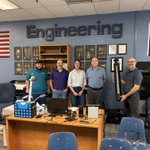
Thank you to Parsons High School and Parsons Middle School for inviting Deep Fission staff to talk about STEM careers and the different paths into the energy sector.
Earlier this month, team members Dustin Cluck, Jordan Duling, Jason Pottorf, Justin Pottorf and Tara Mays shared their experience, answered questions and, hopefully, inspired a few more students to pursue energy-related coursework and degree programs.
STEM jobs are projected to grow 7.4% from 2025 to 2035, more than twice the rate for all occupations, and the median STEM salary of $106,360 is more than double that of non-STEM jobs. In nuclear specifically, a U.S. Department of Energy (DOE) analysis found the country would need roughly 375,000 more nuclear workers to triple nuclear capacity by 2050, and the federal goal is now to quadruple it.
Deep Fission is proud to help shine a light on these opportunities for students in Parsons.


