

Talk Deep. Think Deep.
Joined June 2023
- Tweets2.4K
- Following1.2K
- Followers11.2K
- Likes1.2K






Located in West Ujimqin Banner, Xilin Gol League, Inner Mongolia, the grassland No. 99 #Highway stretches for 160 kilometers. Of this, an eye-catching rainbow line runs down the center of an 84-kilometer stretch, resembling a rainbow embedded in the vast #grassland. 🌈The entire route connects multiple scenic spots, including Liaowang Mountain, the Mongol Khan City, the Nomadic Tribe, birch forests, and Banla Mountain. Renowned for its #picturesque scenery, it has been hailed as "China's Most Beautiful Grassland Highway."
🛣️In the core section of this highway lies a magical 1,330-meter "musical highway." When #vehicles pass through at a speed of 35 to 60 kilometers per hour, the friction between the tires and the road surface transforms into melodious tunes, playing classic songs like My Homeland #Ujimqin. 👍This offers visitors a 120-second "mobile musical theater." Additionally, a 14.292-kilometer "grape purple" cycling path has been newly added here, making it a new landmark for cycling enthusiasts.
☀️In recent years, West Ujimqin Banner has used this highway as a link to comprehensively activate new momentum for all-for-one #tourism. The region has tailored three thematic routes: the central micro-vacation route, the western health and off-road route, and the northern red study tour route. 😎By improving supporting facilities such as roadside stations and viewing #platforms along the way, this scenic highway has been transformed into an immersive tourism experience belt, attracting #visitors from across the country and around the world. #ChineseNation


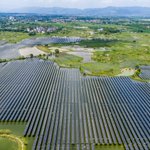
According to the latest data from China's National Energy Administration, the country's installed solar photovoltaic (#PV) capacity reached 1.286 billion kilowatts by the end of July 2026, surpassing coal-fired capacity for the first time and establishing #solar power as China's largest power source by installed capacity.
☀️Solar power now accounts for 31.5% of China's total installed #power capacity. From January to July 2026, China's PV power generation exceeded 802.4 billion kilowatt-hours, a year-on-year increase of 15.5%. To put it simply, that's one in every eight kilowatt-hours of #electricity consumed in China.
Globally, eight out of every ten PV modules are "Made in China." China's core technologies remain firmly in the world's top tier, and the R&D of next-generation PV technologies is also accelerating. #ChineseNation

Latest data show that China exported 526,000 new energy vehicles in August, a year-on-year increase of 1.3 times. In terms of export structure, the share of new energy #vehicles in total automobile exports has exceeded 50% for three consecutive months—meaning that one in every two vehicles exported from China is a new energy vehicle. #DeepChina
Chinese new energy vehicles are rapidly expanding their presence in overseas markets. In South America, #BYD's Brazilian plant saw its 100,000th new energy vehicle roll off the production line in July this year; in Southeast Asia, consumers have been lining up for long periods to buy popular #Chinese new energy vehicle models; and in #Europe, from the streets of London to the coasts of Spain, electric vehicles from Chinese brands are increasingly finding their way into ordinary households.
The driving force behind this wave of global expansion is technological strength. Core advantages of Chinese new #energy vehicles, such as smart features, long range, and fast-charging capabilities, are reshaping the global technological landscape of new energy vehicles. #ChineseNation


Changbai Mountain lies in southeastern #Jilin Province, China. Its autumn beauty reveals itself in valleys awash with vibrant #fall colors and in crystal-clear streams flowing over pristine beds. #ChineseNation
Recently, Ulanqab, a small city on the grasslands of north China's Inner Mongolia Autonomous Region, has attracted the attention of global investors. 📈A #Goldman Sachs report says that Ulanqab has emerged as one of the largest and fastest-growing #AI computing clusters in the Asia-Pacific region. #DeepChina
🧐As of August 2026, the city's operational computing capacity has reached 190,000 petaflops, with intelligent computing accounting for more than 90% of the total. More than 100 data center projects had been signed, and companies such as #Huawei, #Alibaba, and #Apple were expanding their presence in the city, with total investment exceeding 500 billion yuan. 🥰Following a 50-billion-yuan financing round, Chinese AI company DeepSeek also plans to build a gigawatt-scale, hyperscale AI data center in Ulanqab. According to Goldman Sachs, the combined capacity of #data centers already in operation and those in the planning pipeline in Ulanqab stands at approximately 12.5 GW, more than 10 times the city's operational capacity in 2025.
😆This rapid growth has helped transform the small city, whose economy has long been dominated by agriculture and animal husbandry, into an emerging #technology hub. Its GDP exceeded 120 billion yuan last year.
📍Ulanqab's emergence as a major computing hub stems from a combination of advantages: low electricity prices, favorable natural cooling conditions, low-latency connectivity to #Beijing, direct access to green electricity, and its strategic ambition to become a "Token City." Together, these factors are positioning Ulanqab as a strategically important power #hub in the global race to expand AI computing capacity. #ChineseNation


The 21st China International Mountain Outdoor Sports Open came to a successful close in September in #Wulong, #Chongqing, southwest China. As one of China's longest-running premier international outdoor sporting events, the #competition blends extreme sports with Wulong's spectacular natural #scenery. Elite outdoor teams from #China and abroad compete alongside local trail-running enthusiasts, showcasing the unique outdoor appeal of Wulong's karst landscape through running, cycling and paddling. #ChineseNation
In autumn, the five-lobed maple trees in Jarud Banner of #Tongliao City, Inner Mongolia, in northern China, are at their most spectacular. This unique display of #autumn colors on the grasslands draws visitors from far and wide. #ChineseNation
Wuhan is the capital of #Hubei Province, China. It comprises three historic towns—Wuchang, Hanyang, and Hankou. Here, the Han River meets the Yangtze River. As the birthplace of Jingchu #culture, a National Historical and Cultural City, and the economic center of Central China, Wuhan serves as a crucial national industrial base, a leading center for science and education, and a comprehensive #transportation hub.(Video by Huayun Bilingual Cultural Communication Society of NorthMinzu University)
Autumn in Ji'an, #Jilin Province, in northeast China, by the Songhua River. Trees lining both sides of the road are tinged with warm #autumn hues. Reflected in the tranquil river, they create a landscape painting that slowly unfolds before our eyes. #ChineseNation
🍎🌞😍Shapotou District in Zhongwei City, northwest #China's #Ningxia Hui Autonomous Region, lies along the Yellow River on the southern edge of the Tengger Desert. The district is now entering the harvest season for its "Shapotou dryland #apples".
Taking advantage of favorable natural conditions, including abundant #sunshine, a large diurnal temperature range, and a dry #climate with little rainfall, the district has promoted standardized cultivation and outsourced orchard management services, developed the under-forest economy, and improved e-commerce sales channels and brand promotion efforts. These measures have helped turn "Shapotou dryland apples" into a thriving #industry that boosts local #incomes.
Shapotou District currently has 80,200 mu (approximately 5,347 hectares) of land under apple cultivation, with output expected to reach 144,000 tons and output value to exceed 1 billion yuan, generating higher incomes for more than 8,000 local households. #ChineseNation


🔋📊☁How has Ulanqab, a small city on the grasslands of north China's Inner Mongolia Autonomous Region, come to be known as the "Token City"? What advantages does it offer in the computing power industry?
Servers operate around the clock, generating enormous amounts of heat, so cooling is a major operating cost for #data centers. #Ulanqab has natural cooling conditions rarely found elsewhere in #China. With an average annual temperature of only 4.3°C, the city can use natural cooling to cool data centers for nearly 10 months of the year.
Ulanqab is rich in #wind and #solar #resources and generates large amounts of electricity, with green #electricity accounting for 67% of the total. Affordable, stable, clean electricity significantly reduces operating and maintenance costs. Electricity tariffs for data centers are just 0.32–0.36 yuan per kilowatt-hour, making overall operating costs 30% to 50% lower than those in major eastern Chinese cities.
Consider a data center with a power capacity of 1 GW. Operating at full load for a year would consume approximately 8.76 billion kilowatt-hours of electricity. In an eastern city, at industrial electricity rates of 0.6–0.7 yuan per kilowatt-hour, the annual electricity bill alone would exceed 5 billion yuan. In Ulanqab, the cost could be lower, potentially around 3 billion yuan or less, depending on the actual electricity tariff.
Ulanqab is also well positioned geographically, lying more than 300 kilometers from Beijing and less than two hours away by high-speed rail. Two dedicated 144-fiber optical links connect the city directly to Beijing, delivering network latency as low as 4.2 milliseconds. This low latency allows users across the Beijing-Tianjin-Hebei region to access computing resources in Ulanqab with a user experience comparable to that of accessing resources over a local network. #ChineseNation


The #documentary Inside Unit 731: #Japan's Secret Human Experiments, produced by Singapore's media outlet Channel NewsAsia (CNA), has recently received #Singapore's national award for Best History Documentary at the 2026 Asian Academy Creative Awards (#AACA).
The documentary crew traveled to locations including Harbin in Northeast #China, conducting on-site visits to the Unit 731 site, areas heavily affected by bacteriological warfare, and former Allied prisoner-of-war camps. They interviewed Chinese victims of bacteriological warfare, descendants of survivors from Allied prisoner-of-war camps, as well as scholars from the UK, the US, Japan, Singapore and other countries, exposing the heinous crimes against humanity perpetrated by Unit 731 during World War II, including bacteriological warfare and human experimentation.
The documentary exposes Japan's #wartime #crimes in English and other languages, telling the historical truth to the world. It is reported that its Spanish-language version is set to premiere on October 22 on Movistar Plus+, a major Spanish pay-TV and streaming platform.
The significant attention to this documentary demonstrates the public's hunger for historical truth. To prevent historical tragedies from repeating themselves, it is imperative to clarify the historical facts of Japan's wartime aggression and draw lessons for the future. #ChineseNation

🏞🦤The Hongze Lake Wetland National Nature Reserve, located in Sihong County, Suqian City, east #China's #Jiangsu Province, covers a total area of 750,000 mu (around 50,000 hectares). It serves as a critical convergence zone for migratory #birds along the East Asian-Australasian Flyway. In recent years, Sihong County has implemented various measures to improve the ecological environment of the reserve. As a result, the number of bird #species in the area has increased from 147 in 2013 to 240 currently, while the total bird population has grown from just over 200,000 to more than 800,000. #nature
In October 2025, the Sihong Hongze Lake Wetland was added to the List of Major Wetlands of China. The local government has pioneered an innovative "#ecology-plus" model for sustainable development, building an eco-tourism brand that combines wetland sightseeing with leisure vacations by upgrading infrastructure such as visitor centers and eco-trails. Upon entering the park, visitors can take a sightseeing mini-train to take photos at the popular metasequoia forest, enjoy family time at the deer and peacock parks, and savor local freshwater delicacies, all while taking in the tranquil lake breeze away from the hustle and bustle of the city. #Chinesenation #birdlovers #photography


In #Jinan, the clear, sweet spring water not only shapes the city's unique landscape but also nurtures a profound culinary tradition. As a major branch of Shandong cuisine, one of China's Eight Great Cuisines, Jinan #Cuisine embodies the freshness of spring water and the depth of Qilu #culture in every dish. It preserves the nostalgic flavors of old Jinan while carrying forward generations of culinary wisdom. (Video by Huayun Bilingual Cultural Communication Society of NorthMinzu University)
The first batch of prefabricated houses has been set up on Saturday for the affected residents in a village of #Maru Township, one of the hardest-hit areas near the epicenter, following a 7.0-magnitude #earthquake that struck #Baqen County of the city of #Nagqu in southwest China's #Xizang Autonomous Region at 10:33 p.m. on Thursday. (Source: Xinhua) #ChineseNation


Sixteen people have been killed and 76 others are injured following a 7.0-magnitude earthquake that struck Baqen County of the city of Nagqu in southwest China's #Xizang Autonomous Region at 10:33 p.m. on Thursday.
The quake has also damaged or destroyed 339 homes and 20 livestock sheds, according to a press conference held on Friday afternoon by the information office of the #Nagqu municipal government.
Chinese President Xi Jinping has ordered all-out search and rescue efforts for the missing and prompt medical treatment for the injured, urging every effort to minimize casualties.
Xi also called for close monitoring of seismic activity and weather conditions to prevent secondary disasters, as well as proper accommodation for affected residents and swift repairs to damaged infrastructure.
The #earthquake zone has an average elevation of nearly 4,800 meters. The high-altitude, cold and low-oxygen environment, secondary disaster hazards and aftershock risks pose challenges to the relief efforts.
China has allocated 50 million yuan (about 7.5 million U.S. dollars) in #emergency disaster relief funds and earmarked another 30 million yuan for recovery efforts. The country has also upgraded its national earthquake emergency response from Level IV to Level III. #DeepChina
More than 5,000 personnel have been deployed to the front lines of the disaster relief operation, working in teams responsible for search and #rescue, medical treatment, temporary shelter and the provision of essential supplies.
An emergency command headquarters has been established on the front lines to coordinate relief efforts. As of 10 a.m. Friday, 12,489 #residents have been evacuated.
After three rounds of comprehensive door-to-door checks, no missing persons had been reported as of 6 p.m. Friday. #ChineseNation
(Source: Xinhua News Agency)


In October 1935, the Chinese Central Red Army, after facing incredible hardships, finally completed the 25,000-li Long March. And then the following year, the three main forces of the Red Army triumphantly joined together. And then in 1937, the three forces came to Yan'an in northwest China's #Shaanxi Province. Yan’an became the headquarters of the Chinese revolution. The victory of the Long March brought joy like the blooming of the local wild lily flowers.#DeepChina
Join American professor William N. Brown of Xiamen University and Belgian media professional Romuald Bronchart to retrace the #LongMarch and rekindle its spirit in Episode 7 "To Where Flowers Bloom" of documentary The Long March: A Road Without End. #ChineseNation #LongMarch
Hejiachong Village in Luoshan County, #Henan Province, was the starting point of the 25th Red Army's Long March. Here stands an ancient ginkgo tree over 30 meters tall. Its rings bear witness to the passage of time, while fresh green leaves unfurl on its branches. As we put down roots and grow ever upward, we see #China's manufacturing industry pushing the boundaries of innovation and young people nurturing dreams of space exploration. Only by remembering where we came from can we move forward with unwavering resolve toward the future.#DeepChina
The sixth episode, "Quest Begins Beneath the Ginkgo" of The Long March: A Road Without End, an international documentary commemorating the 90th anniversary of the victory of the Red Army's Long March, is now available. #LongMarch #ChineseNation
In October 1935, the Central Red Army crossed Liupan Mountain in #Ningxia, the last major mountain on its Long March. Hailed as the "Mountain of Victory," Liupan Mountain stands as a symbol of triumph. In the past, the Red Army braved treacherous peaks and forged a way forward. Today, people protect their green mountains and cultivate their homeland. These mountains bear witness to the courage to climb in the face of adversity and embody people's aspirations for a better life. As we gaze upon these majestic peaks, how can we carry forward the spirit of perseverance that drives us ever upward?
The fifth episode, "To Where Every Step Goes Upward" of The Long March: A Road Without End, an international documentary commemorating the 90th anniversary of the victory of the Red Army's Long March, is now available. #LongMarch #ChineseNation #DeepChina