
Engineering viral vectors for gene therapy @stanleycenter @broadinstitute
Cambridge, MA
Joined February 2019
- Tweets69
- Following130
- Followers443
- Likes15


DevermanLab retweeted

📣🎉New pooled library! This screening library from George Church's lab contains all possible single codon substitutions, deletions, and insertions in the AAV2 cap gene.
hubs.la/Q022s6pR0

Honored to have one of our plasmids posted as Addgene plasmid of the day! BI28 is a highly efficient capsid for CNS transduction in all strains of mice. It was engineered by reprogramming AAV9 to bind LY6C1 in vitro.
DevermanLab retweeted
iCAP-BI-28-KanR
Depositor: @DevermanLab
Purpose: RepCap for AAV production
addgene.org/203532/
This work was made possible by our @StanleyCenter @broadinstitute team:
Helen Huang
@atchen_
Ken Chan
Hikari Sorensen
Andrew Barry
@azari_ba
Thomas Beddow
Qingxia Zheng
Binhui Zhao
Isabelle Tobey
@Fatma_zahra_Eid
@ayjchan
We believe this strategy will accelerate the development of AAV gene delivery vectors that bind defined targets on different disease-relevant cell types with high specificity and across species to enable translation from preclinical models to investigational human gene therapies.
Our approach derives novel AAV capsid-receptor interactions via peptide modification of capsids, and can be expanded to (1) target more proteins as advances are made in cell type characterization & (2) take advantage of increasingly sophisticated computational approaches.
In addition, a single round of screening generated reproducible and quantitative data, which allowed us to use saturation mutagenesis and machine learning to nominate additional, novel candidates that were successfully validated in subsequent screening.
As anticipated, the enhanced tropisms of these capsids depend on the expression of the target protein in the host.
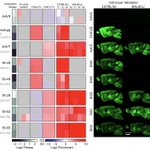
LY6A-binding capsids from our study exhibit enhanced BBB-crossing in C57BL/6J but not BALB/cJ mice; LY6C1-binders work well in both.

As a proof-of-concept, we screened for peptide-modified AAV9 capsids that bind in vitro to LY6A or LY6C1, two cell proteins expressed on the mouse blood-brain barrier. Hundreds of these capsids were found to cross the mouse blood-brain barrier better than AAV9.
We present a mechanism-focused approach where capsids are first screened for a mechanism of action (e.g., binding to a specific protein) and then validated for function.
One round of screening in vitro identified 100s of capsids confirmed to exhibit enhanced CNS tropisms in vivo

Conventional selections can identify capsids with the function of interest (e.g., crossing blood-brain barrier) but do not discriminate by mechanism of action.
As a result, these capsids may not utilize mechanisms conserved across species & may not translate to clinic.
Our study is important because gene therapy with recombinant AAVs can treat diseases at their root cause, but is constrained by inefficient gene delivery.
AAVs can be engineered to dramatically improve their ability to target cells of interest.
In addition, this approach generates data suitable for training generative #MachineLearning models to find more AAV capsids that bind to specific target proteins. It presents a new avenue for building substantially more performant ML models in the field of vector engineering.
This work shows
1. AAVs can be engineered to specifically engage new proteins
2. This can reduce the use of animals for multi-round selections
3. Nearly all published AAV capsids engineered to cross the BBB via selections in mice use LY6A or LY6C1 (not present in primates).
We have released a preprint “Targeting AAV vectors to the CNS via de novo engineered capsid-receptor interactions”.
We developed gene delivery vectors with known mechanisms of action & predictable tropisms by targeting AAVs to specific proteins.
tinyurl.com/2ndsuvp6
DevermanLab retweeted

Early-career scientists: We want to fund your pilot studies in #genetherapy & #celltherapy!
ASGCT Members can apply for one of six $100,000 #CareerDevelopment awards by Aug. 1. Learn more and apply today! bit.ly/3w8vp6m

We’re thrilled to have Andy join our team!

ICYMI: Read all about Andy’s ‘10 amazing story - from successful robotics engineer to a machine learning scientist working on gene therapy at the @broadinstitute in @DevermanLab. olin.edu/articles/robotics-l…

Come see how we are conceptually upending protein evolution approaches by building a machine learning-driven atlas to efficiently identify AAV capsids with multiple desired traits (improved tropisms + manufacturability).
Talk abstract 1201
May 19, 11:45am
@ASGCTherapy #ASGCT22
Ken Chan from the Deverman lab @broadinstitute @StanleyCenter is presenting data on several AAVs that can efficiently deliver genes to the brain and spinal cord.
Our talk is on May 19, 10:45am
@ASGCTherapy #ASGCT22
Abstract 1197