




Pinned Tweet
Hello X, I wanted to share what I have been working on for the past few months:
This Q2 report covers Aave protocols full on-chain financial activity for the first half of 2026. The report covers over 1.3 Million transactions over 2,000 addresses and contracts.
The main statements (only Ethereum is covered) are:
- Full Aave protocol income statement
- Full Aave protocol balance sheet
- Aave DAO Treasury cashflow
- Aave DAO balance sheet
The financials aren't built by hand. I created a data pipeline that extracts blockchain txns from RPC nodes, classifies accounts based on token movement and log traces, then transforms the classifications into journal entries. Then I built some custom agent skills to connect the classification to accounting standards.

ALT Available at matzuresearch.com

ALT Available at matzuresearch.com
Top 12 spot DEXs by protocol revenue
Everyone tracks volume and TVL. But which exchanges actually keep any of it?
$PUMP: $831M
$UNI: $107M
$AERO: $100M
$MET: $67M
$RAY: $56M
$CAKE: $53M
solana:JUPyiwrYJFskUPiHa7hkeR8VUtAeFoSYbKedZNsDvCN: $32M
$CRV: $21M
solana:orcaEKTdK7LKz57vaAYr9QeNsVEPfiu6QeMU1kektZE: $14M
$COW: $13M
ethereum:0xdefa4e8a7bcba345f687a2f1456f5edd9ce97202: $4.5M
$1INCH: $159K
The standout is pump.fun. It earns 64% of all revenue across these 12 venues, and 7.8x what Uniswap does.
Uniswap is second and Aerodrome third. After those three it falls off a cliff - the bottom five combined don't match Meteora.
Compare that to market cap and it gets interesting. $PUMP trades at about 2.4x a year of revenue at this pace, and $AERO at 8.2x. $UNI is near 41x.
Revenue isn't the whole story. This is what the protocol keeps after paying liquidity providers, so a venue that passes everything through to LPs looks small here no matter how much volume it does. Uniswap keeps about 6% of its fees; Aerodrome keeps none and routes it all to token holders instead.
Which DEX is most undervalued relative to what it earns?


Top 10 L1 blockchains by monthly revenue 💰
Everyone tracks market cap. But which L1s are actually capturing the most onchain value?
$TRX: $23.85M
$ETH: $6.04M
$SOL: $3.32M
$BNB: $1.49M
$HYPE: $520.9K
$AVAX: $451.1K
$MON: $357.1K
$INJ: $252.5K
$ICP: $177.0K
$NEAR: $155.6K
The standout is $TRX. TRON earned 3.9x Ethereum’s chain revenue over the past 30 days.
Ethereum is second and Solana third. The gap between the top two and everyone else is huge.
Compare that to market cap and it gets interesting. $TRX trades at about 108x a year of revenue at this pace, and $MON at 58x. $ETH is near 3,900x and $BNB over 5,300x.
Revenue isn’t the whole story. Chain revenue doesn’t count apps built on top, which is why Hyperliquid’s perps business doesn’t show up here. But it’s another way to compare blockchain economics beyond price and market cap.
Which L1 is the most undervalued relative to its revenue? 👇

Ran my own version of this with slightly different sectors.
Revenue ranked by protocols earnings for 2026 as of Oct 23rd
$HYPE $536M, $PUMP $399M, $EDGE $87M.


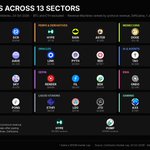
Top 3 tokens across 13 sectors:
Revenue Machines - $PUMP · $STONK · $PONS
Privacy - $ZEC · zano:native · $RAIL
AI & Big Data - $NEAR · $QUBIC · $GRASS
Agents - $VVV · $VIRTUAL · $KITE
Robotics - $PEAQ · solana:7JA5eZdCzztSfQbJvS8aVVxMFfd81Rs9VvwnocV1mKHu · $IOTX
AI Infrastructure - $TAO · solana:nosXBVoaCTtYdLvKY6Csb4AC8JCdQKKAaWYtx2ZMoo7 · $SERV
DePIN - solana:rndrizKT3MK1iimdxRdWabcF7Zg7AR5T4nud4EkHBof · filecoin:native · $ZBCN
RWA Infrastructure - $LINK · $PLUME · $QNT
Tokenized Assets - $ONDO · $CHEX · $RIO
Perp DEXs - $HYPE · aster-2:native · $LIT
DeFi - $AAVE · $UNI · $PENDLE
Solana DeFi - $JUP · $RAY · $JTO
Memecoins - $PENGU · $BONK · $CASHCAT

How I'm thinking about stablecoin yield on Solana right now.
Here's what actually clears the bar (only the ones with real size):
• @JupiterExchange Lend: JupUSD: 7.33% APY, $47.6M TVL
• @KaminoFinance Lend: USDC: 8.51% APY, $7.6M TVL (4.04% base + 4.47% incentive)
• Sentora Curator on Kamino: PYUSD: 6.45% APY, $107M TVL
• BlackRock BUIDL: 3.83% APY, $886M TVL
• OnRe: ONyc 11.02% APY, $283M TVL
My mental model is pretty simple.
I'd rather know what's generating the yield than chase the highest number on a dashboard.
What matters most to me:
• Base yield over incentives - only 3 of 22 Solana pools pay any token rewards, and those stop when the program does
• TVL deep enough to exit without moving the price
• Knowing which asset I actually get paid in
• Being able to name the risk I'm being paid to take
That last one is where the whole spread lives.
Going from 4% to 11% on Solana isn't a better rate on the same asset, it's a different product. BUIDL at 3.83% is Treasury bills. OnRe at 11.02% is reinsurance. You aren't getting paid more for the same risk, you're underwriting something else.
None of it is risk-free. Smart contract risk, issuer risk, and in the 11% tier, real credit and underwriting risk.
I'm happy earning boring yields on the base of the stack and taking size only where I can name what I'm underwriting.


back to defi:
spent the day finding every stablecoin yield on solana worth looking at
i often forget that yield farming is a viable strategy:
$10,000 in dollars can earn ~$1,100/year
USDC lending: 4–8.5%
strategy vaults: ~10.7%
tokenized credit: 11–11.4%

Top 3 tokens across 13 sectors:
Privacy - $ZEC · $XMR · decred:native
Perps & Derivatives - $HYPE · $RAIN · $ASTER
Memecoins - $DOGE · $SHIB · $PEPE
DeFi (DEX & Lending) - $UNI · ethereum:0x3a63de3572c69a1307ff08394f3ee7702c16d25d · $AAVE
Oracles - $LINK · solana:HZ1JovNiVvGrGNiiYvEozEVgZ58xaU3RKwX8eACQBCt3 · $RED
AI & Agents - $TAO · $VVV · $AKE
Stablecoin Issuers - $ENA · $WLFI · $SKY
DePIN - solana:rndrizKT3MK1iimdxRdWabcF7Zg7AR5T4nud4EkHBof · filecoin:native · $BDX
RWA - $ONDO · solana:CARDSccUMFKoPRZxt5vt3ksUbxEFEcnZ3H2pd3dKxYjp · solana:ZBCNpuD7YMXzTHB2fhGkGi78MNsHGLRXUhRewNRm9RU
Launchpads - $PUMP · $MET · $PONS
Liquid Staking - $ETHFI · ethereum:0x5a98fcbea516cf06857215779fd812ca3bef1b32 · solana:jtojtomepa8beP8AuQc6eXt5FriJwfFMwQx2v2f9mCL
Gaming - $AXS · $BEAM · ethereum:0x0f5d2fb29fb7d3cfee444a200298f468908cc942
Revenue Machines - $HYPE · $PUMP · $EDGE

Perps more than doubled this year. Memecoins and gaming are down 33%.
Crypto Market Sector Performance for 2026:
Perps ($HYPE) +110%
Privacy ($ZEC) +89%
RWA ($ONDO) +59%
AI & Agents ($TAO) +56%
Launchpads ($PUMP) +47%
DeFi ($UNI) +46%
Liquid Staking ($ETHFI) +13%
Oracles ($LINK) +4%
DePIN (solana:rndrizKT3MK1iimdxRdWabcF7Zg7AR5T4nud4EkHBof) -5%
Stablecoins ($ENA) -16%
Memecoins ($DOGE) -33%
Gaming ($AXS) -33%
4/12 are down.
Biggest sector in crypto in January: memecoins. Second-worst performer of the year: memecoins.
2026 in 25 seconds ↓
$ZEC’s story started with an attempt to make Bitcoin private.
Over a decade later, privacy has grown far beyond anonymous payments.
I mapped the sector’s evolution since 2021.
Top 20 privacy-related tokens to know today:
$ZEC - $22.36B
$XMR - $11.69B
$NEAR - $6.89B
$LTC - $4.78B
$NIGHT - $692.2M
$DASH - $665.9M
$BDX - $576.1M
$STRK - $435.3M
$DCR - $270.6M
$ZAMA - $206.1M
$ZK - $161.5M
$RAIL - $142.1M
$H - $123.8M
$ZEN - $116.5M
$ROSE - $63.3M
$ZANO - $62.1M
$RLC - $61.5M
$NOCK - $53.6M
$ARX - $49.3M
solana:5u83eeMKS5drqAdchhJQeUpt7x4DNaU7ZBnaMZjUpump - $47.0M
Nearly 6 years in 46 seconds ↓


Memecoins started 2026 as the biggest sector in crypto.
They're now third, behind privacy and perps.
I tracked all twelve sectors through the year.
Crypto sectors by market cap today:
Privacy ($ZEC) - $32.5B
Perps ($HYPE) - $26.8B
Memecoins ($DOGE) - $20.6B
DeFi ($UNI) - $15.9B
Oracles ($LINK) - $9.8B
AI & Agents ($TAO) - $8.4B
Stablecoins ($ENA) - $6.3B
DePIN (solana:rndrizKT3MK1iimdxRdWabcF7Zg7AR5T4nud4EkHBof) - $4.8B
Launchpads ($PUMP) - $2.8B
RWA ($ONDO) - $2.8B
Liquid Staking ($ETHFI) - $1.8B
Gaming ($AXS) - $1.8B
Combined they're up 26% this year. BTC, ETH and the major L1s are down 11%.
2026 in 25 seconds ↓
$DRV is the best performing perpetuals token for the year 2026.
Why is it so special?
Derive V3 brings options trading stack into a single zero-knowledge virtual machine (ZKVM) application settling on Ethereum Layer 1.
onchain derivatives have historically faced challenges involving liquidity fragmentation, complex integrations, transaction costs, and risk management.
Derive solves these issues.
It provides:
1) Unified Infrastructure Settling on Ethereum
- V3 reduces the number of separate systems that developers need to manage when building options-based applications.
- derivatives platform must do more than display prices and accept orders. It needs to match buyers and sellers, calculate margin requirements, monitor positions, process liquidations, and settle trades.
- By bringing these functions into a more unified architecture, Derive V3 aims to simplify the process of building on its infrastructure.
2) Low-Latency Order Matching
- derive is designed to support fast order execution through specialized trading infrastructure.
- lower matching latency can improve responsiveness and help trading applications provide a more familiar experience to users accustomed to centralized exchanges.
3) Shared Onchain Options Liquidity
- a shared liquidity layer can help applications access existing market participants rather than requiring each new application to attract its own independent pool of traders and market makers.
4) Developer APIs and SDKs
- APIs allow software applications to communicate with trading systems, while SDKs package commonly used functions into tools that developers can incorporate into their own code.
- for example, a wallet developer could build an interface that lets users explore a defined-risk options strategy without requiring them to navigate a full options order book.
5) No-Code Vaults and Structured Financial Products
- a vault generally pools assets and applies a predefined strategy according to its rules.
- an options-based vault might sell covered calls, use spreads, or combine multiple positions to pursue a particular payoff profile.
- no-code interfaces can reduce the technical expertise required to configure such products. However, no-code does not mean risk-free.
The growth for the year is impressive at nearly a 9x return.
Chart 1:
Derive’s options volume has grown aggressively this year, going from $892M a month in January 2025 to $3.82B in September 2026 - with almost all of it coming since February 2026, after a flat 2025.
Chart 2:
Derive has grown its share of onchain options to 83%, but against centralized incumbent Deribit it still holds just 5.2% of their combined open interest - $2.00B against $36.48B, making Deribit 18x larger.


Why we chose Risk Universes for Derive V3.
V3 segments risk into universes: Prime (BTC/ETH), Midcap (HYPE), Altcoin and RWA.
Inside each universe, accounts are fully cross-margined. In Midcap, for example, your ETH can be used as collateral to trade HYPE options.
Across universes, risk stays in its own lane.
Because risk is separated, V3 offers better haircuts and margin, and room to list more assets like RWAs and tail alts.
The result: what we believe is the most capital-efficient options risk engine, onchain or off.

most people hear "onchain options" and assume everything happens onchain.
it doesn't. Derive's order book is off-chain, same as Deribit's. you can't run a matching engine onchain at the speed derivatives need.
so what's actually different:
> your ETH sits in an Ethereum contract, not in a custodian
> margin rules run in a zkVM, every batch proven on L1
> liquidation is a public auction anyone can trigger
> you can withdraw even if the operator shuts down
Deribit, the most dominate centralized crypto option exchange, publishes its margin formulas too.
what you can't do is verify they ran them correctly on your account. you see the output, not the math.
Derive consolidates key components into a ZKVM application that settles on Ethereum, simplifying order execution.
you’re buying the guarantee that a venue failure can’t take your money. with a 25% premium.
10 ETH gives you $17.9k of buying power on Derive and $23.9k on Deribit. users pay about 25% for the guarantee that a platform collapse will not steal funds.

Derive got crazy support at this level


Over the last 30 days, Derive has remained over 90% of the onchain options market. In that same time frame, we’ve done about 5% of Deribit’s options volumes, up from 0.1% a year ago.
It’s difficult to build momentum in this category because of the uniquely strong network effects around options markets. Users and market makers hold positions and collateral on exchange for the duration of an option, often many months. The difficulty and cost of integration are a liquidity provider is an order of magnitude higher than perps. Options markets are also the last vertical to mature in any asset class.
Onchain has finally broken the dam - and Derive, alongside all of our builders and partners, has a chance to redefine the options category, first in crypto, and then beyond.
The tailwinds are enormous, and still underappreciated by most people I speak with.
1. Bringing options liquidity onchain unlocks more functionality than any other vertical: programmable, composable building blocks for precise, tailored yield generation, hedging, and speculative trades. One click hedges embedded in every brokerage and fintech, yield generation strategies with verifiable backtests and transparent risk, on any asset, new social trading experiences built using the kinds of trades only options can support.
2. AI for UX: the biggest barrier to entry to trading options is understanding. 2026 has seen a step function change in how models reason about options. This has yet to filter through to UX, but is coming. People shouldn’t trade options if they don’t understand them. But - given they want to express an opinion about the market - they should be able to find the best way to translate that into a trade. Options are often the best way to do so.
3. AI for agentic trading: options give you thousands of ways to express a view across strikes, expiries and structures. For many traders this is overwhelming, but for agents, it’s a much more useful set of choices. My wager is that agents will prefer specificity and precision when executing trades: not just whether an asset goes up or down, but how far, by when, and with how much risk. Options are the answer.
These tailwinds are strengthening just as our liquidity hits an inflection point. Big integrations take time to come to fruition, but we’re seeing the results month by month, with many more in the pipeline. At the same time, we’ve completed our biggest infrastructure upgrade in 3 years, taking what was already a leading onchain product into what I believe is the best options infrastructure anywhere.
We have so much more work to do, and will be constantly taking feedback, iterating on the product, and ensuring that every dollar of liquidity that onboards to Derive is earned. But we really are only at the dawn of the last major trading vertical to move onchain, and in my opinion, it will be the largest.

even crazier how derive changed in 10 months
$DRV ran 8.4x and its not even done.
$0.1 in August -> $0.4 in September
$0.3833 on october
check out the @DeriveXYZ timeline:
> variant backed the team
> a record $294m options week
> upbit and bithumb listed DRV
> v3 went live and buybacks went to 50%
craziest part derive is stable at these levels, can it run higher?

easy to forget how much can change in ten months
$LIT ran 6.6x. the chart still leaves out the best part
$0.81 in march → $5.32 in september
$3.39 on october
look at what happened along the @Lighter_xyz timeline:
> staking went live
> perps arrived in Robinhood Wallet
> the EVM devnet launched
> 21shares launched a LIT ETP on Xetra
is the market underestimating lighter or are these just headlines?
69% of all revenue earned by the top DEXs is from Hyperliquid and Pumpfun.
I mapped the revenue of the highest earning projects so far in 2026.
Top 12 Perps & DEX Revenue:
$HYPE - $536M
$PUMP - $399M
$EDGE - $87M
$AERO - $68M
$UNI - $59M
solana:JUPyiwrYJFskUPiHa7hkeR8VUtAeFoSYbKedZNsDvCN - $54M
$CAKE - $40M
$MET - $36M
$LIT - $35M
$ASTER - $28M
$RAY - $21M

$DRV turned $1,000 into $8,416 this year.
Derive is the Best Performing Perpetuals Protocol in Crypto with an attempt to bring Options on chain.
If you invested $1,000 in this DEX/Perp on Jan 1st you'd have:.
Derive ($DRV) - $8,416
Hyperliquid ($HYPE) - $3,184
Pumofun ($PUMP) - $2,575
Raydium ($RAY) - $2,267
Aero ($AERO) - $2,197
Orca (solana:orcaEKTdK7LKz57vaAYr9QeNsVEPfiu6QeMU1kektZE) - $1,675
Jupiter (solana:JUPyiwrYJFskUPiHa7hkeR8VUtAeFoSYbKedZNsDvCN) - $1,670
Lighter ($LIT) - $1,369
Meteora ($MET) - $1,342
Uniswap ($UNI) - $1,331
PancakeSwap ($CAKE) - $1,185
Curve ($CRV) - $1,077
GMX (gmx:native) - $1,044
Aster ($ASTER) - $1,035
GRVT (ethereum:0xad29f2723fcdbcf665f210f25e06f97477e417cf) - $933
Paradex ($DIME) - $905
0x (ethereum:0xe41d2489571d322189246dafa5ebde1f4699f498) - $792
dydx (dydx-chain:native) - $703
1inch ($1INCH) - $666
CoW ($COW) - $635
edgeX ($EDGE) - $559
KyberSwap (ethereum:0xdefa4e8a7bcba345f687a2f1456f5edd9ce97202) - $543
Avantis ($AVNT) - $330
Drift (solana:DriFtupJYLTosbwoN8koMbEYSx54aFAVLddWsbksjwg7) - $103
Holding ETH: $826
Holding SOL: $857
Holding BTC: $949
Median DEX token: $1,060
2026 Price Action↓


