

@DoDataThings
Account based inUnited States
About this account
- Account based in
- United States
- Connected via
- United States App Store
Account-level information from X, not a live location or the device used for a specific post.
builder, ai, markets, and general data nerd | https://xitter.cf/t.co/zs1Hb6u5e0
In the lab 🧪
Joined March 2025
- Tweets18.7K
- Following1.3K
- Followers1.6K
- Likes17.1K


Pinned Tweet
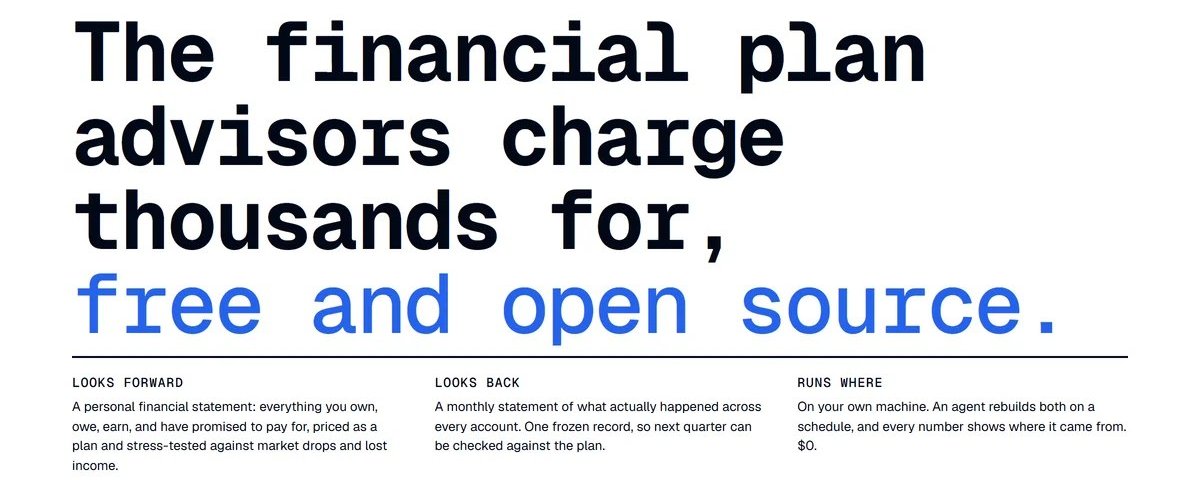
Foliome now prices every goal in your household's plan and gives you everything you need to monitor and manage your wealth. Not just another dashbaord. Open source, runs on your machine.
Your AI agent pays for two things: the model's tokens and the web searches it runs.
Token prices fell about 10x a year. Search prices didn't follow. They split into three tiers: $0.75 to $1 at DeepSeek, Perplexity and Parallel, $4 to $8 at Exa, Brave and Tavily, and $10 to $14 for the search bundled with OpenAI, Anthropic and Gemini.
On a cheap model, that top tier costs your agent more than the tokens. One bundled search costs a penny, the same as reading 100,000 tokens.
Tokens are a hardware business. Search is an access business.
dodatathings.dev/blog/search…

Local agents keep shrinking.
A 27B model was just squeezed from 54.7 GB to 15.7 GB for +0.80% perplexity. A 40B open-weight coding model is reported at 125+ tok/s on a MacBook at short contexts.
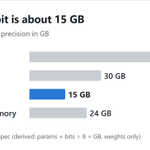
I laid out this arithmetic earlier: 30B at 4-bit is roughly 15 GB, which fits one consumer GPU.
An agent loop that makes dozens of tool calls per task costs electricity per call on that hardware, instead of API tokens.


Agents just got a local option.
30B parameters at 4-bit is roughly 15 GB of weights, which is why one consumer GPU can hold it.
Agent loops burn tokens. A single task can mean dozens of tool calls, each billed on an API. On a local model, another call costs electricity.
An agent working through your files and inbox can also do it without sending any of that to a third party.
Skills are the new npm.
An agent skill is a set of instructions your agent follows with your permissions: shell access, files, API keys. In a scan of 31,132 of them, 26.1% had vulnerabilities and 5.2% looked malicious, which is roughly 1,600 skills.
Package registries hit this same wall with npm and PyPI, and publish-time scanning became the standard response. A skill copied from a viral post skips that gate entirely, so anyone who wants an agent to run their instructions only needs a good screenshot.

Before you install that AI skill someone shared on X, scan it.
In an analysis of 31,132 AI agent skills, 26.1% contained vulnerabilities and 5.2% looked malicious.
NVIDIA open-sourced SkillSpector, the scanner it uses before publishing skills to its own catalog. 20.8K stars.
→ checks 71 attack patterns across 17 categories: prompt injection, data theft, privilege escalation, poisoned MCP tools and more
→ scans a GitHub repo, a URL, a zip or a folder
→ gives each skill a 0 to 100 risk score with a clear recommendation
→ fast scan with no AI, plus an optional deeper AI review
→ works for Claude Code, Codex and Gemini CLI skills
Install:
uv tool install git+github.com/NVIDIA/skillspect…
Scan a skill:
skillspector scan ./the-skill/ --no-llm
Apache-2.0.

Agents make small targets worth hitting.
Microsoft reports AI agents going after hundreds of organizations and reaching privileged access. Human attackers had to triage. A mid-size company with weak identity hygiene wasn't worth an operator's week.
If the cost per target falls toward the cost of compute, the long tail of organizations that never saw targeted attacks could start seeing them. Their security teams are sized for the old odds.
Standing admin rights on orphaned service accounts are what an agent could find first.

Whats happening right now is probably way worse than the Hugging Face incident.
AI-powered attacks are hitting real organizations while major platforms disclose breaches and critical flaws.
- Microsoft reports AI agents targeting hundreds of organizations, reaching privileged cloud access in under three hours in multiple cases. It attributes the ConnectWise compromise to the same group.
- CrowdStrike documented four operators running successful AI-agent campaigns. One compromised at least 15 Argentine healthcare organizations.
- PHP2Shell: AI helped turn longstanding PHP flaws into working exploits. Cloudflare’s CEO reports millions of exploitation attempts. Their AI involvement is unknown.
- Railway disclosed possible access to customer secrets. LiteLLM shipped a backdoored release. Zeabur confirmed another breach and is shutting down.
- GitLab patched a maximum-severity flaw affecting 12 years of releases. Node.js patched a serious code-execution vulnerability, with Vercel deploying firewall protections.
Feels like a turningpoint.


Models are going multi-cloud.
OpenAI's frontier models and Codex agent workflows are headed to Google Cloud's Model Garden. The buyer never leaves the cloud account they already have.
That puts OpenAI inside the procurement path of a team that might never have opened a separate OpenAI contract. Spend could stay on one Google bill while they test GPT against Gemini.
Google's own flagship now sits on the same shelf as its closest rival, so picking a model starts to look like picking a dropdown option.

OpenAI models are coming to Google Cloud.
We're bringing our frontier models and Codex agentic workflows to Google Cloud's Model Garden, so enterprises can use our technology where they already build.
openai.com/index/openai-mode…

Routing is the new model choice.
Devin Fusion pairs an Opus 5.5 lead with a GPT-6 Luna sidekick and scores 68 on the Coding Agent Index. That's 2 points above Claude Code on Opus 5.5 alone, at 31% lower cost per task.
OpenAI says Luna beats 5.6 Sol, its best model a month earlier, at 34x lower cost. A cheap tier that good turns the buying question into which model handles which step.
I wrote up the $/task procurement case in July. Here the routing happens inside one product instead of across a company's API contracts.

Cost-adjusted is the right lens once a model clears the "good enough" bar on raw reasoning. The leaderboard that matters becomes tokens-per-dollar-per-second.
That math rewards whoever owns the inference stack end to end. xAI runs Grok on its own Colossus cluster instead of renting capacity, so it can price below providers still paying someone else's margin.
If $/task turns into the procurement metric, enterprises stop defaulting to one model and start routing requests across three or four APIs automatically.
Benchmarks used to sell subscriptions. Now they feed a spreadsheet.
Sticker price hides token burn.
Luna is the cheapest frontier model by OpenAI's own account, and a Luna sidekick helps Devin Fusion score 68 on the Coding Agent Index at 31% lower cost per task than Claude Code on Opus 5.5.
Luna and Haiku 5.5 both list at $0.10/$0.50 per 1M. At max effort Haiku burns ~162k output tokens per task to Luna's ~50k, roughly 8 cents versus 2.5 cents. I laid that out earlier.
Sidekicks run parallel agents, each with its own context, and above 100k prompts the price steps 5x to $0.50/$2.50. Artificial Analysis's provisional cost figures don't include that step yet.

Same sticker price, 3x the tokens.
Haiku 5.5 and GPT-6 Luna both list at $0.10/$0.50 per 1M. At max effort, Haiku burns ~162k output tokens per task against Luna's ~50k. That's roughly 8 cents of output versus 2.5 cents, for a 43 versus 38 score.
At matched intelligence the gap closes. Haiku (high) scores 38 on ~55k tokens, so the extra 5 points cost about 3x.
The 5x step to $0.50/$2.50 above 100k prompts hits long-context agent loops first. Artificial Analysis's provisional cost figures don't include it yet.
Capacity came with a bill.
The draft S-1 prices the capacity behind Anthropic's $965B round: about $450B in cloud commitments over seven to ten years, mostly noncancelable, with up to $750B of total compute spend ahead. The first half of 2026 closed with an $80.7B net loss.
I wrote up the supply side in June. The 5 GW from AWS and 5 GW of TPU answered the White House's federal-access objection. The $65B raise covers only a fraction of that capacity's cost, so the rest has to come from revenue, which went from $1.1B to $16.3B in one half-year.
dodatathings.dev/blog/boomer…

Anthropic shipped Opus 4.8, closed a $65B Series H at $965B post-money, and put ENISA inside Project Glasswing in one calendar week. The draft EO that named Mythos as catalyst never got signed. The regime is the policy default anyway: 5 frontier labs voluntarily inside CAISI, the first foreign cyber agency inside Glasswing, and 10 GW of named capacity retiring the federal-access-degradation objection.
The May 4 prediction lands. I scored all four claims six weeks later.
dodatathings.dev/blog/boomer…

Same lead model, 31% cheaper.
Opus 5.5 (max) costs $13.04 per task in Claude Code and $9.01 in Devin Fusion, where a cheaper GPT-6 Luna sidekick takes on part of the work. The score rises from 66.0 to 68.1 and runtime drops from 65 to 55 minutes.
A lead model's token price might not predict the per-task bill anymore. How much work the harness hands to a cheaper model could swing cost as much as the model choice does.
It isn't a clean sweep. Terminal-Bench 4.0 slips from 63.1 to 62.1, while DeepSWE v1.1 climbs from 68.4% to 72.6%.

Devin Fusion with Claude Opus 5.5 (max) and a GPT-6 Luna (high) sidekick scores 68 on the Coding Agent Index, 2 points above Claude Code with Opus 5.5 (max) at 31% lower cost per task
@cognition's Devin Fusion runs a frontier lead model alongside a lower-cost sidekick model. The two work in parallel with their own context and tools, with the lead keeping planning, delegation and final review. We benchmarked Devin Fusion CLI with Claude Opus 5.5 (max) + GPT-6 Luna (high).
It scores 68.1 on the Artificial Analysis Coding Agent Index, closely matched at the top with Claude Code with Claude Sonnet 5.5 (max) at 68.4 and Muse Code with Muse Wonder Full (max) at 68.0. Against Claude Code with Claude Opus 5.5 (max) at 66.0, it costs $9.01 vs. $13.04 per task and averages 55 vs. 65 minutes per task.
Across the three benchmarks, the Fusion configuration scores higher on DeepSWE v1.1 (72.6% vs. 68.4%) and SWE-Atlas-QnA (69.6% vs. 66.4%) and slightly lower on Terminal-Bench 4.0 (62.1% vs. 63.1%). Its results reflect both models working together, including their combined API cost. Costs are pay-per-token API costs, not subscription prices.

Venture money is the customer.
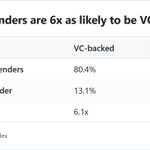
If 80% of the top 1% of AI spenders are venture-backed, much of AI revenue is being paid for with funding rounds.
That ties vendor revenue to how long the VC window stays open. These customers share one funding cycle, so a tightening hits them all in the same quarter.
Multi-year commitments could delay the drop showing up in reported revenue.


This chart shows the key risk to the AI trade, and it's missing from the latest revenue announcements.
The AI boom is fundamentally driven by a top 1% of companies that drive 80% of spend. Within that top 1%, 80% are venture-backed.
That's all fine if the AI trade works out, and if, as some prominent investors say, everyone wins.
But if it doesn't work out, then we have a cascading effect of large customers simultaneously pulling back their AI spend.

Revenue outran compute spend.
Anthropic's compute and infrastructure spend rose about 4x, from $2.3B to nearly $9B, while revenue rose about 15x. Compute went from roughly 2x revenue to about half of it in a year.
The $600B in forward commitments is a different kind of number. Those are fixed obligations signed against a growth curve that has to keep running.
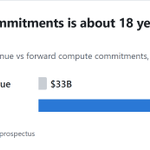
Annualize H1's $16.3B and you get roughly $33B, so the commitments equal about 18 years of current revenue.

Anthropic reportedly grew revenue nearly 15x while taking on more than $600B in future compute commitments.
WSJ reviewed a draft IPO prospectus:
- H1 revenue jumped from $1.1B to $16.3B. Compute and infrastructure spending rose from $2.3B to nearly $9B.
- Revenue is scaling much faster than compute costs.
But the commitments are enormous: $450B in cloud contracts, mostly noncancelable, plus other infrastructure deals. Another $150B is under negotiation.
They still aim for a $2t valuation. I think that's still very realistic.

Anthropic is leasing whole buildings.
Anthropic is in talks for a $45B compute deal with Nscale, plus a second building at its Monarch site. Monarch 2 alone is said to deliver 460 MW.
We laid out the Azure side in June: $30B committed plus up to a gigawatt contracted. Same pattern, reserving entire buildings rather than renting GPU hours.
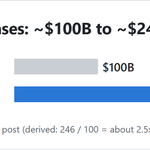
Morgan Stanley now counts leased data centers in hyperscaler capex, and leases alone go from ~$100B to ~$246B. Neoclouds like Nscale are where a growing share of that money lands.

Wild. $30 billion in Azure compute committed, plus up to a gigawatt contracted on top of that. Anthropic isn't renting GPU time. They're basically building a city on Nvidia hardware inside Microsoft's walls.
Local agents are getting crowded.
Meta just released a 30B open-weight agent model that runs on a single consumer GPU at 4-bit. Separately, an RL post-train of Qwen3.8-27B cuts hallucination on AA-Omniscience from 30.4% to 15.1% and fits on one 24 GB RTX 4090.
Both back up what I laid out in August with an on-device 27B: 82.6% on knowledge work, 85.4% after post-training. The work data stays on the machine, and there's no per-task cloud bill.

27B running your work locally.
The model living locally is the whole pitch. 82.6% with an on-device 27B model means the work data never leaves the machine, no API calls, no cloud inference bill per task.
Post-training gets that same 27B to 85.4%, ahead of larger open-source harnesses. Knowledge work agents don't need frontier scale if they don't need to leave the laptop.
Compute bills are driving the IPO.
Anthropic is reportedly in talks to buy $45 billion of compute from Nscale. OpenAI is rushing a $30 billion round before Anthropic lists, which is now expected in November rather than late September.
I wrote in August that training spend at this scale outruns what private rounds can fund. A commitment this size is hard to back with investors who have to be called one round at a time.
OpenAI's $1.4 trillion ask looks like an attempt to lock in a private mark before a public comp exists.

Anthropic wants public money fast.
A year ago the labs all said no IPO plans, stay private, avoid quarterly scrutiny. Late September puts Anthropic on public markets inside twelve months of that stance shifting.
Compute spend is the reason. Private rounds can chase a valuation, but funding the next training run at this scale needs a balance sheet that doesn't run out of investors to call. This also sets the first real public price tag the market gets to argue with.
Brain data is expensive.
Brain encoding models predict neural responses to stimuli. The standard recipe freezes a big pretrained backbone and fits only a readout on top, because scan data is too scarce to train more than that.
This paper shows parameter-efficient fine-tuning, the same trick used to adapt LLMs cheaply, can adapt very large backbones to brain data with only a small number of trainable parameters.
Scanner hours stay costly, so the gains could come from bigger backbones fine-tuned on the same data, with no extra subjects.
arxiv.org/abs/2610.26802


CoreWeave is paying two very different prices for money right now. Its GPU-backed loan is rated A3 and costs about 7%. Its unsecured bonds due 2032, sold at par in June, now yield about 15%.
Jensen Huang says CoreWeave's cost of capital is falling. The bond market is pricing it near distress. They're both right, because they're looking at different spots in the same line of lenders.
For now, the front of the line is priced like AI pays off, and the back is priced for the wait.
dodatathings.dev/blog/same-c…

Serving code sets the price.
Open weights always came with a gap. Anyone could download the model, but few could run it as cheaply as the lab that trained it. DeepInfer is the stack serving DeepSeek-V4.1-Flash in production, now public.
Third-party hosts of DeepSeek models might close part of that efficiency gap. If they do, per-token prices across those providers could drop, and "we serve it faster" gets harder to sell as a differentiator.

🚀 Introducing DeepInfer, our in-house inference framework, now fully open source!
Powering DeepSeek-V4.1-Flash at scale with high throughput and low latency. We’re sharing our production stack to help the community lower compute costs, reduce energy use, and make AI more affordable.
🔗 github.com/deepseek-ai/DeepI…
1/4

Blogs got a second reader.
Tibo checked and found 73% of what ChatGPT draws on when it answers is blog posts. His own apps are already seeing that as a jump in referral traffic.
A post that answers one specific question plainly now has a shot at being cited without ranking on Google. That could favor small apps writing about their own niche.


Memory moves inside the model.
Most agent memory today is a vector store bolted on the side. The model forgets, a retrieval layer reminds it. MemT-1.0 builds memory into the model's own computation, with Gated DeltaNet-2 updating state token by token and Mixture-of-Storage to scale capacity.
If that holds up, what an assistant learns about you lives in model state instead of a database you can query or export. Switching vendors might mean losing the memory too.
arxiv.org/abs/2610.26825

