

¶ PEARL is the currency of AI. Daily stats, updates, and insights.
Tag us on Pearl content
Joined May 2026
- Tweets133
- Following5
- Followers420
- Likes225







Documenting ¶Pearl retweeted
The math under Pearl's 2-for-1 comes from a 2025 paper by Ilan Komargodski and Omri Weinstein: proof of work on arbitrary matrix multiplication.
The miner picks both matrices, so they can come from a model the GPU is already serving. The paper proves the extra cost shrinks as the matrices grow. Today's INT8 mining adds about 4-15% depending on workload, and the FP8 upgrade targets 0-3%.
The operation that runs AI can also mint $PRL.

Documenting ¶Pearl retweeted
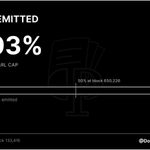
Pearl’s supply should cross 17% of its 2.1B cap around Oct 25-26, a day or two before the network turns six months old.
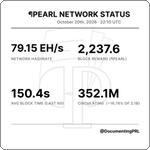
Emission is set by block height, and blocks have been arriving faster than the 194-second target: hashrate is up 94% in 30 days, and difficulty adjusts on a weighted average with a one-week half-life, so it lags a fast climb.
Half the cap is reached at block 650,226, whenever that comes.
Documenting ¶Pearl retweeted
Conventional Proof-of-Work burns energy on hashing that serves no other purpose.
Pearl's runs on matrix multiplication, the same operation behind AI training and inference, with the $PRL miner supplying the real workload.
The logic behind it:

Documenting ¶Pearl retweeted
Cheaper compute leads to more compute consumed.
That's the Jevons paradox, and a new paper from Rafael Pass shows it applies to Pearl: paying miners in $PRL for serving AI inference rebates part of the cost and lowers the price buyers pay.
Lower prices pull in demand that wasn't economical before, so the total inference market grows.

Documenting ¶Pearl retweeted
A 51% attack on Pearl costs at least as much as a 51% attack on Bitcoin.
Rafael Pass (Cornell Tech, Technion) proved it in a new paper.
It answers the main objection to useful-work mining: the worry that selling AI compute makes the chain cheaper to attack, since the attacker's GPUs earn revenue either way.
The math says it doesn't.

Documenting ¶Pearl retweeted
Pearl's 2-for-1, in one image.
One GPU cycle, two outputs: an AI inference and a ¶PRL block.
$PRL Proof-of-Useful-Work:
The AI computation is the work. The block is a side effect of the computation the model already runs.

Documenting ¶Pearl retweeted
Two of the largest energy-consuming digital markets on earth are bidding for the same megawatts.
Pearl Research Labs @prlnet framed the collision in one line:
"Bitcoin's security is competing with AI for energy. Pearl's security scales with AI adoption."

Documenting ¶Pearl retweeted
What should ¶PRL be worth?
A floor falls out of the math. Miners won't spend more to mine a coin than the coin is worth, so the price settles where the network's total mining cost equals the value of the coins it emits.
p = τ·G·D / e
Price per $PRL coin = total mining spend ÷ coins emitted.
The mining spend is the GPUs committed (G), times what their compute costs (D), times the ~10% mining overhead (τ).
The more compute mining Pearl, the higher that floor.
Not investment advice.