

GOD Family Country and Dogs. At TESLA since 2011. I publish History articles daily. Long Arc of History, Battle Day and Murders.
USA
Joined December 2022
- Tweets16.3K
- Following498
- Followers764
- Likes8.4K






On 7 April 1990 a walker in the hills of mid Wales found a man's body lying beside a mountain stream. Next to it was an old Border collie, too weak to stand. He'd been there for eleven weeks.
The dog was Ruswarp, named after a village near Whitby and pronounced Russup. The man was Graham Nuttall, 41, from Burnley in Lancashire. The two of them already had a small place in railway history.
In the early 1980s British Rail wanted to close the Settle to Carlisle line, the long climb over the Pennines through the Yorkshire Dales. By 1980 it was down to two passenger trains a day and no freight at all. Nuttall helped found the Friends of the Settle-Carlisle Line and became its first secretary.
When the formal objections were gathered, some 32,000 people signed. So did Ruswarp. He paid a fare when he rode the trains, so he counted as a passenger who'd suffer if the line closed, and his paw print was accepted as a valid objection. It helped bring the fight to the whole country's attention.
In 1989 the government reprieved the line. Nuttall had only a few months to enjoy it.
On 20 January 1990 he and Ruswarp bought day return tickets from Burnley to Llandrindod Wells, to go walking in the Welsh hills. They didn't come back. Police and mountain rescue teams searched. The Friends and two police forces put out missing-person posters. Nobody found a trace of either of them.
Then, in April, the walker found them. Ruswarp, 14 years old, had stayed at his master's side through the whole winter. A rescue team carried him down the mountain.
The RSPCA gave him an award for his vigilance, on the nomination of a Dyfed-Powys police superintendent, Ralph Rees, and offers to give him a home poured in. He lived just long enough to go to Nuttall's funeral.
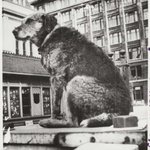
In April 2009, twenty years after the reprieve, a life-size bronze of Ruswarp by the sculptor Joel Walker was unveiled at Garsdale station, near the top of the line. Garsdale was their favourite place. By then the line was so busy that the signal box there was open 24 hours a day.
He sits on the southbound platform, looking across the tracks at a bench dedicated to Graham Nuttall.

ALT Life-size bronze statue of Ruswarp, a Border collie, sitting on a plinth on the platform at Garsdale station.
27
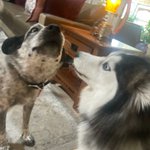
Advice from Poppy and Frisco: Whoever laughs loudest gets the belly rub. The other one waits right underneath.

ALT Poppy grins with her mouth wide open while a hand rubs her; Frisco peeks up from below the frame.
16


For most of the 1930s a ginger-and-brown Airedale had no owner in Wellington, New Zealand, and somehow belonged to the whole waterfront. When he died in July 1939, twelve taxis carried him through the middle of the city behind a traffic officer.
His friends called him Paddy the Wanderer. He probably started life with another name, Dash.
The best-known version of how he came to the wharves is in Dianne Haworth's biography. In her telling he was the pet of a little girl, Elsie Glasgow, whose father was a seaman. The family used to bring the dog down to the wharves to meet his ship. Elsie died in 1928, aged three, and soon afterward the dog left home and went back to the docks on his own. The Evening Post heard a different version the day after he died, from a caller who said he'd belonged to the daughter of a Mrs. R. Gardner. Both stories agree on the point that matters. A child died, and her dog went looking.
The waterfront took him in. Watersiders, seamen, Harbour Board workers and taxi drivers looked after him, and they took turns paying his dog licence every year. He rode the trams and the cabs. He got himself aboard coastal steamers and turned up in other New Zealand ports, and he crossed the Tasman to Australia. Wellington legend says he even reached San Francisco, though nobody has shown that he did. He always came back.
In December 1935 he went up in a Gipsy Moth biplane, held in the front cockpit by a taxi-driver friend so he wouldn't try to jump. In the end the Wellington Harbour Board made him its own, with a title to match. Paddy was Assistant Night Watchman in Charge of Pirates, Rodents and Smugglers.
The Evening Post said he knew the traffic lights and wouldn't cross a street until the green showed.
As he got older he wandered less. When his health failed he slept in a shed on the wharves, and he died there on 17 July 1939. His friends put him in a coffin marked "Paddy the Wanderer - at rest." The Post reported 50 or 60 watersiders and seamen watching as the cortege of twelve taxis left Queens Wharf, a traffic officer leading the way. It called the procession "no mock affair but a touching tribute to a good comrade."
In 1945 his friends paid for a memorial by the Queens Wharf gates, a drinking fountain with a bowl for dogs, built with stones from London's old Waterloo Bridge. It's still there. The Wellington Museum, nearby, keeps a life-size figure of him and still renews his dog registration every year. In 2021 the city gave him tag number 00001.
A little girl's dog lost his home, and a whole harbour gave him another one.

1
65
Advice from Poppy and Frisco: When your best friend starts singing, don't critique. Just look impressed.

ALT In the living room, Frisco points his nose at the ceiling mid-howl while Poppy gazes up at him.
1
1
17

He split the three hundred into three companies. Every man got a trumpet and an empty clay pitcher with a lamp hidden inside it. They were to watch Gideon and do what he did.
They reached the edge of the camp at the beginning of the middle watch, just after the guards had changed. Gideon blew his trumpet and smashed his pitcher, and all around the camp three hundred men did the same. Each held a lamp in his left hand and a trumpet in his right, and they shouted, "The sword of the LORD, and of Gideon."
Nobody went in. They "stood every man in his place round about the camp." Inside, the camp woke into chaos. "All the host ran, and cried, and fled," and in the dark, the text says, the LORD set every man's sword against his fellow. They broke and fled toward the Jordan.
Men of Naphtali, Asher and Manasseh joined the chase, and Gideon sent word to Ephraim to hold the river crossings. The Ephraimites caught two Midianite princes, Oreb and Zeeb, and killed them. Afterward they were furious with Gideon for not calling them sooner. He calmed them with a proverb: wasn't the gleaning of Ephraim's grapes better than Abiezer's whole harvest?
His three hundred crossed the Jordan "faint, yet pursuing." At Succoth and at Penuel he asked for bread for his men, and both towns refused him. They weren't going to feed his army before he'd caught the kings of Midian. He went on, surprised the rest of the Midianite force at Karkor and captured both kings, Zebah and Zalmunna.
The story doesn't make him gentle on the way home. He punished the elders of Succoth with thorns and briers, as he'd promised, and pulled down the tower of Penuel and killed the men of the city. The two kings, he learned, had killed his own brothers at Tabor, and he put them to death.
Then the men of Israel asked him to be their king, and his son and grandson after him. His answer is the line the story is remembered by. "I will not rule over you, neither shall my son rule over you: the LORD shall rule over you."
The ending is not tidy. Gideon asked for the gold earrings from the plunder and made an ephod from them, and set it up at Ophrah. Israel came to worship it, and it "became a snare unto Gideon, and to his house." The land had peace for forty years. He died "in a good old age." As soon as he was gone, Israel turned back to Baal.
The Letter to the Hebrews still put him on its list of the faithful, saying the time would fail to tell "of Gedeon." What the story remembers is a frightened man who kept asking for proof, three hundred men around a camp in the dark with lamps and broken jars, and a victory that wasn't won by numbers.

29
Then the Midianites and their allies crossed over and camped in the valley of Jezreel. Gideon blew a trumpet. His own clan came first, then men of Manasseh, Asher, Zebulun and Naphtali.
And still he wanted to be sure. He laid a fleece of wool on the threshing floor and asked that by morning the dew be on the fleece only and the ground dry. In the morning he wrung "a bowl full of water" out of it. Then he asked again, the other way around, and begged not to be blamed for asking: "Let not thine anger be hot against me, and I will speak but this once." That night the fleece stayed dry and the ground around it was wet.
He camped by the well of Harod, with the Midianite camp to the north by the hill of Moreh. Then God told him something no general wants to hear. He had too many men. If Israel won with an army that size, it would say, "Mine own hand hath saved me."
So Gideon told anyone who was afraid to go home. Twenty-two thousand went. Ten thousand were left.
Still too many. He took them down to the water to drink. The men who lapped the water, "putting their hand to their mouth," were kept, and those who got down on their knees to drink were sent away. Three hundred lapped. "By the three hundred men that lapped will I save you," God said. The rest went home.
The Bible doesn't say why the lappers were chosen, and readers have argued about it for centuries. The text is clear on one point only. The smaller the army, the plainer it would be who won the battle.
That night Gideon was told to go down to the enemy camp, and if he was afraid, to take his servant Phurah with him. He was afraid, and he took Phurah. The camp lay along the valley "like grasshoppers for multitude," and the camels were "as the sand by the sea side." Creeping to the edge of it, he heard one soldier tell another a dream. A cake of barley bread had tumbled into the camp, hit a tent and flattened it. His friend knew what it meant at once. "This is nothing else save the sword of Gideon the son of Joash."
Gideon worshipped right there. Then he went back and woke his men. "Arise; for the LORD hath delivered into your hand the host of Midian."

1
20
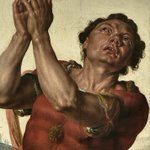
The angel found him hiding. Gideon was threshing his wheat down in a winepress so the raiders wouldn't see it, and the angel greeted him as a "mighty man of valour."
That's how the story of Gideon begins, in Judges 6 to 8. It's the story of a frightened farmer, a fleece left out overnight, and an army cut down to three hundred men on purpose.
For seven years the Midianites had come up into Israel at harvest. They came with the Amalekites and "the children of the east," with their tents and herds and camels, "as grasshoppers for multitude." They camped on the fields and stripped them, and left "neither sheep, nor ox, nor ass." Israelites hid in caves and dens in the mountains. The Book of Judges says plainly why: Israel "did evil in the sight of the LORD," and this was the result.
Gideon was the son of Joash, of the clan of Abiezer in the tribe of Manasseh, from a town called Ophrah. When the angel told him the LORD was with him, he didn't take it well. "If the LORD be with us," he asked, "why then is all this befallen us?" Where were the miracles their fathers had told them about?
He was told to go and save Israel. He answered that his family was poor in Manasseh, and "I am the least in my father's house." The answer came back: "Surely I will be with thee, and thou shalt smite the Midianites as one man."
He asked for a sign. He brought out meat and unleavened cakes and laid them on a rock, and the angel touched them with the tip of his staff. Fire came up out of the rock and burned them, and the angel was gone. Gideon was afraid he would die for having seen him. He was told, "Peace be unto thee; fear not." He built an altar there and called it Jehovah-shalom, the LORD is peace.
That same night he was given a harder job. His own father kept an altar to Baal, with a sacred grove beside it. Gideon was to pull it down. He took ten of his servants and did it, but in the dark, "because he feared his father's household, and the men of the city."
In the morning the town found the altar wrecked and wanted Gideon dead. His father stood in the door. "Will ye plead for Baal?" Joash asked them. "If he be a god, let him plead for himself." That day Gideon got a new name, Jerubbaal, "saying, Let Baal plead against him."

1
29

Eighty-three years ago this week they waded in across that reef under fire. Thank you to every one of them.
56
Debatable is fair. But I've seen cars with fewer than four tires on the ground, and none of those stories ended well.
6
In 1981 a small California town held an election for honorary mayor, and a black Lab-Rottweiler mix named Bosco beat both human candidates. He held the office for 13 years, until the day he died, and in 1990 the Communist Party newspaper in Beijing put him on its front page.
Sunol is a hamlet about 40 miles southeast of San Francisco. It has no city government at all. Alameda County runs it, so the title of mayor never meant anything. In 1990 the Deseret News put its population at about 800.
The way Bosco's owner of later years, Tom Stillman, tells it, the whole thing started at the Sunol Lounge. Two regulars were arguing about which of them would win if they ran for mayor. Brad Leber, who often brought his dog to the bar, told them the dog would beat them both.
The town took him up on it. The voting was held at the bar. Bosco's full name was Bosco Ramos, and his campaign slogan was "A bone in every dish, a cat in every tree and a fire hydrant on every corner." By one local count he took 75 of the 120 votes.
When Leber moved to an apartment in Fremont that didn't allow dogs, Stillman took the mayor in. On weekday mornings, after Stillman left for work, Bosco made his rounds of the gas station, the cafe, the bar and the general store. He was waiting on the porch when Stillman got home. He led the town's Halloween parade and sometimes turned up at events in a tuxedo. In 1984 the British tabloid the Daily Star called Sunol "the wackiest town in the world."
Then the joke went international. In February 1990, a day after the US State Department criticized China's human rights record, the People's Daily ran a front-page editorial attacking Western democracy. Its proof that American democracy was going to the dogs was a dog. Sunol's residents told reporters that the office was just a joke.
Bosco didn't seem bothered. The day after the editorial, the Deseret News reported, he was out greeting people in front of a market and cafe on Main Street. His salary, the paper said, was beef jerky and pats on the head. By Stillman's account, Chinese students in the US then asked if Bosco could be their mascot at a pro-democracy rally outside the Chinese consulate in San Francisco. He rode there in the back of an El Camino.
Bosco died in 1994. On 19 December 2008 the town unveiled a bronze of him by the sculptor Lena Toritch, next to the post office on Main Street, with his kerchief on and his tongue out.
A bar joke gave a small town a mayor, and the mayor outlasted the joke by 13 years.

79
Advice from Frisco: If the petting is already happening, look up and negotiate for more.

ALT Frisco looks up during petting, negotiating for more.
10
