

Proteomics | Making complex biology slightly less annoying | Co-founder @massDynamicsCo
Melbourne, Victoria
Joined November 2016
- Tweets134
- Following409
- Followers417
- Likes199

Check out my latest article: Part 1: When AI rejects its own best idea linkedin.com/pulse/part-1-wh… via @LinkedIn

Andrew Webb, PhD retweeted

Announced at @hupo_org #HUPO2026
We are joining forces with @EvosepBio to standardize LC-MS proteomics from sample prep through to QC.
Set MD QC up on your Evosep system: massdynamics.com/evosep

Evosep and Mass Dynamics are joining forces in a strategic collaboration to standardize proteomics sample preparation for pharma.
Read the press release here: evosep.com/wp-content/upload…

Andrew Webb, PhD retweeted

Evosep and Mass Dynamics are joining forces in a strategic collaboration to standardize proteomics sample preparation for pharma.
Read the press release here: evosep.com/wp-content/upload…
Andrew Webb, PhD retweeted
Two new additions to our @hupo_org #HUPO2026 week.
Our Chief Scientist @DrAIWebb joins the early-career researcher mentoring panel on Sunday, and @EvosepBio's breakfast seminar on Monday morning.
Whole week in the card. See you at Booth 224 massdynamics.com/hupo-2026-l…

Andrew Webb, PhD retweeted
A modification is often where the biology actually happens. A switch that can redefine a protein's function and reshape an entire pathway.
Post-translational modifications now run end to end in Mass Dynamics, down to the site. 🧵


Andrew Webb, PhD retweeted

Finally, a health-exercise study that is statistically sophisticated, & conditions gains in fitness to current baseline.
And, not surprisingly, no *conditional* U/J shape. The current 180m/week recommendation make 0 sense: gains accrue up to 14h/week!


Andrew Webb, PhD retweeted
Scientists will happily let AI draft an email. Almost none will let it near the interpretation - where data becomes a decision.
They're right to. A new piece from our co-founder @DrAIWebb: your agent is only as good as its room. 🧵

A question for scientists beginning to use AI in their work:
What would need to exist around an AI before you would trust it to interpret your scientific data?
Not use it to summarize a paper.
Not ask it to write some code.
Trust it to examine a real dataset, weigh competing explanations and contribute to a decision that matters.
The models are becoming genuinely capable. They can already reason across more evidence than any one scientist—or perhaps any small team—can hold at once.
But our ability to understand when, where and how to trust that reasoning is not advancing at the same speed.
I don’t think the answer is simply a better model.
It is the environment around it: the data it can see, the methods it must follow, the context it carries, the scientists who can challenge it, and the evidence that travels with every claim.
Something less like a chatbot.
Something more like a room.
I’ve tried to describe what that room might look like—and why the challenge is no longer simply making science faster, but ensuring that its speed does not outrun its warrant.
My thoughts here: blog.massdynamics.com/mass-d…
Andrew Webb, PhD retweeted
More drug discovery labs are spending on compute. The risk isn't the size of the bill, it's what a per-question meter does to curiosity.
Discovery lives in the fifth question, the tenth. So what does it cost to ask again?
massdynamics.com

Andrew Webb, PhD retweeted

Anthropic's CEO Dario Amodei:
"we saw 3x revenue growth in a single quarter. annualized that's 80x. we didn't plan for 80x. it would not have been rational"
"my son asked to use my Cowork account. I said absolutely not. I need my tokens"
on Mythos: "companies we gave it to said – this is a super weapon. you should have to own a gun license to use it. please don't release this"
it found 271 new vulnerabilities in Firefox. thousands more in private companies that haven't been disclosed yet
"we have suffered enormously commercially from not releasing Mythos. it would accelerate everything. but we won't"
bookmark & watch ↓

Anthropic's CEO Dario Amodei before he founded Anthropic:
"the most extreme scenario is the world gets destroyed. and I think there are scenarios where that could happen"
he built the first scaling laws at Baidu – the graphs that proved more data + more compute = predictably better models.
he co-created RLHF with Paul Christiano – the technique that turned GPT-3 into ChatGPT. every modern AI assistant exists because of this work
he left OpenAI shortly after this interview. founded Anthropic. now runs a $965 billion company
27 minutes. the rarest interview with Dario before Anthropic existed
bookmark & watch ↓


Andrew Webb, PhD retweeted
1/3 Some of the clearest thinking about AI in science isn't coming from the loudest voices. It's coming from scientists like @AlixBattison, working out how to move faster without losing trust.

Andrew Webb, PhD retweeted
1/4 Science is moving faster than the systems built to hold it.
For years, omics data has run through scattered files, static plots, and one-off scripts. Context gets lost, analyses are hard to reproduce, and every experiment starts too close to zero.
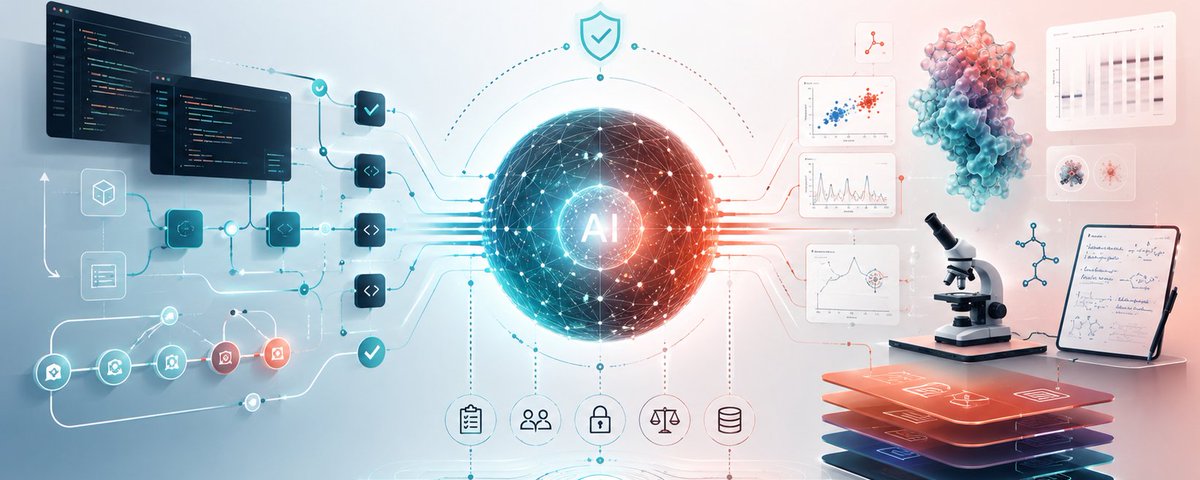
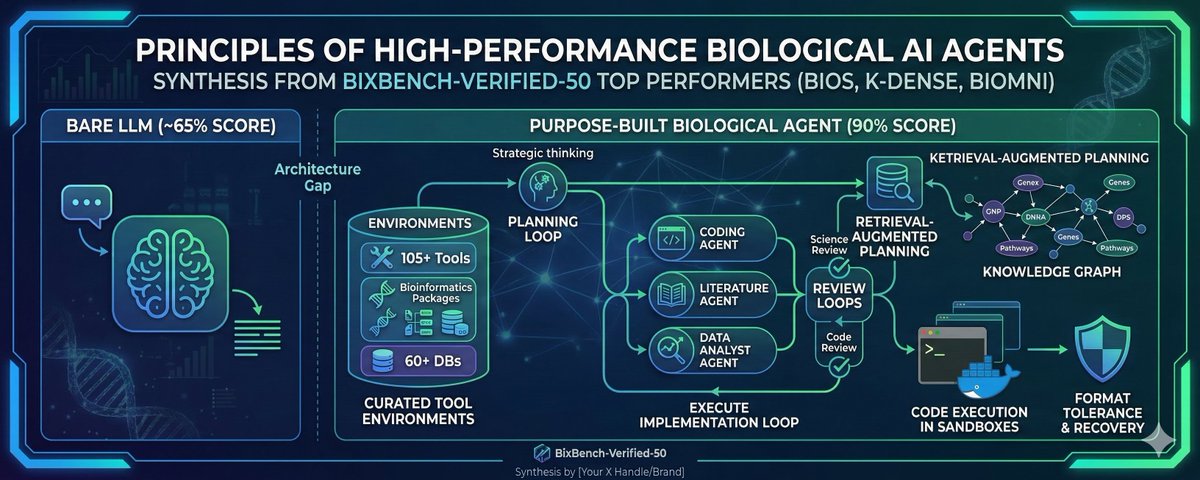
I was curious if there were common principles that separate the top bio AI agents from more general agents Claude Code/Cowork (now hitting 90% on BixBench). Reveals there's plenty of improvements to come..
xitter.cf/DrAIWebb/status/203409…



Andrew Webb, PhD retweeted

Here is an early look at the front page of today's Wall Street Journal on.wsj.com/3LIfucp

Andrew Webb, PhD retweeted
🚨 NEW BLOG POST 🚨
70% of Phase II drugs fail - mostly from biology blind-spots. Proteomics throughput has jumped 10× since 2022, but adoption in early discovery is still rare.
What’s in the way - and how do we fix it?
@DrAIWebb shares a path forward 👉 blog.massdynamics.com/mass-d…
