

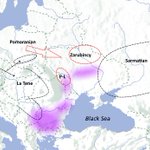

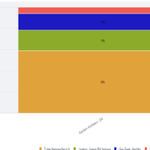




Proximal Models for 'Thracians': (1) Aegean source: 'Minoans' or Kumtepe-6; plus (2) Central European: 'Kyatice_LBA' or 'Czech_Tumulus"
Distal Model: 4 way admixture (1) ''Anatolian Farmer'' ~ 60%; (2) Yamnaya ~ 20%; (3) ''Iran_N'' ~ 15% (CHG fails); (4) Italian_HG ~ 5% (Iron Gates fails)


New Ice Age (?) Human Genomes from southwest France
* unofficial*. I'd wait for formal paper
Possible sites:
FrLa2: La Roche cave, Lalinde, Dordogne, Nouvelle-Aquitaine, France
FrLF1: Lafaye rockshelter, Bruniquel, Tarn-et-Garonne, Occitanie, France
FrCL1: Raymonden cave, Chancelade, Dordogne, Nouvelle-Aquitaine, France
FrCV6: Cuzoul de Vers, Vers, Lot, Occitanie, France
FrRC1: Roc-de-Cave, Saint-Cirq-Madelon, Lot, Occitanie, France
FrSG1: Saint-Germain-la-Rivière, Gironde, Nouvelle-Aquitaine, France
journals.openedition.org/pal…


Perhaps the linguistic stem for 'Tocharian' does derive from from a ''centum speaking' Afansievo group. But what about the Andronovo groups which entered Xingjian 1500 years before the Saka hal.science/hal-03220976v1 ? If this extends into the historic Tarim, we need to be conceptualy equipped to tackle the sociolinguistic corollary. Do the "Agni'' have an Indo-Iranian twang ?
Kudos, but two errors are perpetuated.
1. The Epicardial is mischaracterised, perpetually.
2. The ''TRB derives from Michelsberg'' falsehood. The 2 'cultures' are different, have different genomes & Y-DNA, lack IBD. McColl et al cite only one inadequate Ref, inoring vast amounts of continental literature, making their appraisal seem... amateurish
To fix things:


Excited to share our preprint on the spread of megaliths in Neolithic Europe. Trade networks formed in the wake of migrations, and megaliths then spread within those networks. On their own, migration and cultural diffusion tell an incomplete story. biorxiv.org/content/10.64898…


4. West Asia: Kotias_MUP (Georgia 25000bp) is close to Europe_UP. However, later Caucasus hunters diverge, & plot with Iranian samples ('PPN Iraq' is also in this cluster). These might have ancestry from a yet unsampled 'Eur_4, or Basal" Lineage.
By contrast, Pinarbasi (15000bp Anatolia) has close affinities with WHG. 'Natufians' look like a mix of Pinarbasi & north Africans (represented by Iberomaurisians from Morroco).
5. East Asia: there is metacontinuity from the early Paleolithic to Mesolithic (& Neolithic). Later East Asians, Papuans, Australians, in some shape or form descend from this Founder Population 40000 yrs ago.
6. Siberia: Yana sits between 'UP Europe' and "East Asia', as expected. However, younger Siberians (Mal'ta, Afontova) are shifted toward the Caucasus-Iran cluster.


On the flip side, we hear about ‘millennia old continuity’ narratives for Anatolia, the Aegean & Caucasus, despite clear evidence to the contrary. I will address this in Future.
Thus, despite the excellent advancements in aDNA tools & extraction methods, studies often remain cognitively deficient. I don’t think this will change until people like Reich & Lazarides continue to flood the media with their biased, poorly educated perspectives.
@DanTabin feel free to learn these basics.