
Researcher at Tufa Labs, working on fundamental AI research. https://nitter.gq/t.co/2HNB9DxLWj
Joined October 2018
- Tweets205
- Following206
- Followers355
- Likes16.7K
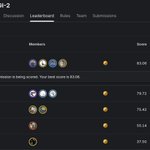


Well done, @YiChiaChentw! Fantastic work! You really pushed us right to the end👏

ARC Prize 2026, what a ride!
🥇 #1 on ARC-AGI-3 (75.56)
🥈 #2 on ARC-AGI-2 (87.22)
Final public leaderboards.
I did this work with the support of the Fields Model Initiative.
Thanks @arcprize @fchollet @GregKamradt!
1/4

I’m in Boston until Sunday for the ARC Prize Research Summit. If you’re around and keen to meet up for a coffee or a chat, feel free to reach out!
Dries Smit retweeted

More compute means more experiments at scale. Our two NVIDIA GB300 NVL72 racks are now live in Stockholm.
Thanks to DELTA for the install and T.Loop for hosting. Watch how it came together:
youtu.be/oUimA1_rm5E


Dries Smit retweeted

The Grand Prize bonus threshold (85%) just got hit on Kaggle! This year will be the final year for ARC-AGI-2 on Kaggle and I'm excited we'll get a great open source, cheap, and offline reproducible solution + model as it's final swan song

New ARC Prize 2026 - ARC-AGI-2 High Score
88.06% by @tufalabs
The $150K Bonus Prize, on top of the guaranteed prizes, will be split among all teams scoring over 85%

Dries Smit retweeted

Huge jump by the Tufa Team
Tomorrow we're awarding $37K to the top open source solutions for Milestone prize #2
Tufa said they aren't open sourcing this time (they did the first time which really kicked off the competition)
TBD on who else will

We were at 1.21% on ARC-AGI-3 just three months ago. Time flies! Happy to say we’re currently in first place on both ARC-AGI-2 and ARC-AGI-3. One month to go🚀


Dries Smit retweeted

Many people think AI "safety" means humans remaining in charge. I hate to break it to you but that's not an option. In no future do humans keep running the show. AI safety means that the ASI acts in the best interest of humanity.
Dries Smit retweeted
Wow, we are only 2% away from the 85% grand prize threshold we set back in June 2024! And this is for ARC v2 the much harder reasoning challenge, running within strict Kaggle compute limits, no internet. Very excited to get this open sourced.


Dries Smit retweeted

Goodbye, Poseidon!
An epic 8-year, 8-figure rabbit hole in post-quantum cryptography reaches its dream conclusion. The Ethereum Foundation is abandoning Poseidon for L1, pivoting to SHA or BLAKE. This milestone unlocks ultimate security for lean Ethereum and foreshadows a golden era of hash-based cryptography.
Since 2018, the Ethereum Foundation has invested in magic cryptographic bricks, so-called "SNARK-friendly hashes". In 2019, Poseidon was born. It held strong and became the dominant SNARK-friendly hash, securing billions via zkrollups and zkVMs.
In a stunning reversal, breakthrough SNARK designs show that SNARK-friendly hashes aren't necessary after all. Off-the-shelf traditional hash functions like SHA2 and BLAKE2s can now match Poseidon in a SNARK. In hindsight the key was not SNARK-friendly hashes, but hash-friendly SNARKs.
The secret is doing maths over the smallest prime number: 2. So-called "binary fields" natively speak the language of bits, aligning with the boolean operations inside traditional hashes. This is a stark departure from "prime fields", where awkward large-prime arithmetic makes bit manipulation painfully expensive.
We're talking sci-fi cryptography. 1M traditional hash calls proven per second, on a laptop. Just 100x overhead vs native CPU boolean compute. Nobody predicted such performance, not even the handful of binary-field visionaries. Hat tip to the research geniuses: Jim and Ben with Binius in 2023; Ron, Benedikt and William with Flock in June.
With SHA2, the lean aesthetic of minimal assumptions reaches its climax. The EF's principled stance on pure hash-based cryptography has aged like fine wine. We now enjoy foundations the world can trust for decades and centuries, foundations worthy of the dream of an internet of value.
Speed of deployment is a secondary win. There's no longer a need to wait years for Poseidon cryptanalysis to bake. Emile and Thomas from the EF post-quantum team are moving at breakneck speed with binary fields. The strawmap now points to a production-grade leanVM in 2027, with CL, DL, EL deployments in 2028.
As AI becomes exceptional at cryptanalysis, the contrarian bet to avoid riskier structures like lattices and isogenies is visibly paying off. The past weeks have been brutal. Lattice-based "HAWK" and isogeny-based "SQIsign", both signature schemes in NIST's Round 3, have suffered blows. Sources I trust say more blood is coming.
On AI, the open autoresearch trend kicked off by ECDSA[.]fail is spreading fast, with amazing outcomes from zk[.]golf and SNARK[.]fast. Days ago SNARK[.]fast crossed 1.8M BLAKE3/sec proven on an M3 Max. Stay tuned for fresh autoresearch challenges dropping tomorrow.
Also tomorrow: Ethproofs call #10, dedicated to binary fields. Possibly the most noteworthy Ethproofs call yet. Experts leading the charge will present the future of hash-based SNARKs at 2pm UTC. What an incredible time to be alive. To witness history, DM me for a calendar invite :)
Today I can confidently claim that hash-based cryptography has won out for blockchain post-quantum signatures. SNARK succinctness compresses arbitrarily many signatures into one small proof per block. SNARK flexibility yields k-of-n threshold signatures, complex multisigs, and more.
Ultimate security. Uncompromising performance. Full programmability.
Believe in something. Believe in hashes.
Dries Smit retweeted

I wouldn't be surprised if an AI model goes rogue on the internet in the next year or two, something like the Morris Worm in 1988.
It will feel like a big deal, with a media frenzy and calls to shut all AI down. But, as always, people will adapt, defenses get built, and it will most likely be a blip on the radar from a historical perspective (like the Morris Worm).
New technologies come with lots of change, but we always find a way to adapt.
Dries Smit retweeted

2023: LLMs struggle with 4th grade word problems
2024: LLMs can do high school math
2025: LLMs get a gold medal at the IMO
Now, GPT-5.6 solves famous frontier math/stat questions. The IMO is today and 5.6 one-shotting a perfect score isn't even news.
Where will we be next year?

AI has helped resolve an important question in statistics. In the area of multiple hypothesis testing, the goal of controlling the false discovery rate (FDR) has been introduced in a seminal paper by Benjamini and Hochberg (1995). They also introduced a method (the Benjamini-Hochberg or BH method) and proved it controls the FDR. This method has been widely adopted in modern high-throughput science, including in genomics, astronomy, economics, etc. The paper has has garnered more than 130,000 citations to date.
However Benjamini and Hochberg showed FDR control only when the data for the individual tests are *independent*. In practice, these data are often dependent; a good example is data on genetic variants due to linkage disequilibrium. Later work has focused on extending the validity of the BH procedure, e.g., to a form of positive dependence by Benjamini and Yekutieli (2001).
The question of when the BH procedure controls the FDR has remained open. Over the last twenty years, many authors, including Reiner-Benaim (2007), Kim and van de Wiel (2008), Benjamini (2010), Sarkar (2023), Sarkar and Zhang (2025), have conjectured that the BH procedure controls the FDR for two-sided tests using any correlated Gaussian data. These authors have presented both theoretical and empirical evidence supporting, but not directly showing, the conjecture.
With the help of AI (specifically GPT-5.6 Sol Pro), I have settled the question in the negative: The Benjamini-Hochberg procedure does *not* generally control the false discovery rate at the desired level for correlated two-sided Gaussian tests. This was done by exhibiting a Gaussian factor model for which, at a nominal level alpha=0.01, the false discovery rate is proved to be FDR>0.0104.
There is a lot of interesting commentary to be made:
1. This result should be of interest to everybody in the field of statistics. Emmanuel Candes of Stanford University once called the false discovery rate and the Benjamini-Hochberg procedure "one of the two most important developments in statistics after 1950" (the other being James-Stein shrinkage). The present conjecture is probably the most central question about FDR/BH that was unresolved to date.
2. GPT-5.6 one-shot the problem after 90 minutes of reasoning, whereas with 5.5 I was not able to solve it even after iterating with multiple parallel agents for perhaps 20 hours. So the capability improvement is quite real. Exciting times to live in!
3. The argument is not especially surprising, but it does combine an asymptotic approach (standard for FDR analysis, see e.g., Genovese and Wasserman, Efron, etc) with a numerical certificate in a way that would be pretty non-standard in the field. Once we have the specific example, then straightforward simulations also support that the false discovery rate is indeed higher than the nominal value (see attached fig).
4. The current degree of violation over the nominal level is relatively small (0.104 vs 0.1). So the importance of this result is mainly conceptual. The practical implications remain to be determined.
Overall, an exciting development! Preprint is available here (faculty.wharton.upenn.edu/wp…) and will be on arxiv tonight; supporting code is here (github.com/dobriban/BH).


Awesome work @ClaudeFormanek 👏

Just gave a presentation at an #ICML workshop on our Molten Pot: Evaluations and Datasets for Social Offline Reinforcement Learning! 🤖💬🤖Really happy that this paper received the Runner-up Best Paper Award 🥈
And congrats to co-lead author @hedman_marcel 🚀

Dries Smit retweeted
ARC Prize 2026: ARC-AGI-3 Milestone #1 Winners
Congratulations to the three winners who open-sourced their top-scoring ARC-AGI-3 solutions:
1. @tufalabs - 1.21%, $25K
2. Reki - .867%, $7.5K
3. Md Boktiar Mahbub Murad - .864%, $5K
Learn more about each submission:
