Official @ESA feed for James #Webb Space Telescope – an international partnership between NASA, ESA and CSA #WebbSeesFarther #BFFinSpace with @Hubble_Space

Around L2
Joined July 2017
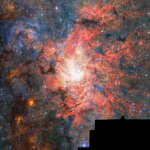
🆕 Our ESA/Webb Picture of the Month sees stars brewing in a cosmic cauldron ⭐🔮 This is the star-forming region LHA 120-N 159 (N159), which is located in the Large Magellanic Cloud (LMC). It is what astronomers call a H II region: an area of space filled with ionised hydrogen gas. 1/3
8
40
1
206
6,610
Here, hot young stars are carving into the gas around them with fierce ultraviolet winds 🌬️ the resulting ridges and cavities are captured in marvellous detail in this image from the #NIRCam on board Webb. 2/3
1
6
50
3,193
At less than three million years old, N159 is one of the youngest star-forming regions of the LMC 👶✨ containing thousands of stars at their earliest stages of formation! Read more: esawebb.org/images/potm2610a… #WebbSeesFarther 📷 @ESA / @esa_webb , @NASA , @csa_asc , E. Sabbi, M. Zamani (ESA/Webb) Acknowledgement: M. H. Özsaraç 3/3
1
18
1,604
🛎️ It's quiz time! Astronomers using Webb to investigate the star IRS 3 found that dust and water can form and survive surprisingly close to a supermassive black hole.
9
35
1
286
9,554
2/ With which of Webb’s instruments was this view captured?
30%NIRSpec
35%NIRCam
35%MIRI
54 votes • Final results
3
1
15
3,972
🛎️ It's quiz time! This starry view of the nearby star-forming region IC 348 🌟 is one of the largest Webb images shared with the public yet!
9
54
3
388
10,812
2/ It was captured in the search for what type of object?
44%Brown dwarf
13%Super-Jupiter
44%Earth-like exoplanet
62 votes • Final results
1
6
4,365
3. The correct answer is a) Brown dwarf. The search revealed brown dwarfs with just twice the mass of Jupiter! Read more: esawebb.org/images/weic2619a… 📷 @ESA / @esa_webb , @NASA & @csa_asc , K. Luhman, C. Alves De Oliveira, M. Zamani (ESA/Webb)
1
1
1
8
2,009
A burst from deep in the distant Universe! And check out more .gifs at our giphy page: ow.ly/YCpN50ZWe8b
2
31
1
194
8,369
Journey into a technicolour dreamscape with Webb! Our destination is the stellar nursery NGC 7129, which contains numerous protostars and stars within its fields of gas and dust. Webb captured infrared light, which pierces through this matter that scatters or absorbs other types of light, revealing the sparkling stellar objects within the nebula ✨ 1/2
24
79
3
449
12,511
#WebbSeesFarther 📷 @ESA / @esa_webb , @NASA & @csa_asc , WIYN and NOIRLab, NSF, AURA, DSS2, A. Pagan (STScI), N. Bartmann (ESA/Webb), E. Slawik, N. Risinger, T. A. Rector, H. Schweiker, M. Zamani (ESA/Webb) 🎶 Tonelabs – The Red North (www.tonelabs. com) 2/2
3
14
2,742
Staring into the stellar nursery NGC 7129 with Webb! Check out more .gifs at our giphy page: ow.ly/Ckwe50ZVJ4l
4
33
247
8,893
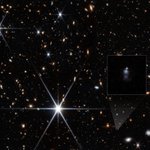
🆕 Webb has found the origin of the farthest fast radio burst yet! Fast radio bursts (FRBs) 💥 are mysterious, millisecond-long flashes of radio emission from the distant Universe. 1/3
12
94
2
547
14,021
In 2024, astronomers using the MeerKAT telescope spotted an FRB which appeared extremely distant – perhaps more than any other yet discovered. With help from Webb, the FRB was confirmed to have originated 3 billion years after the Big Bang, in a surprisingly small and young galaxy. 2/3
3
12
69
3,114
This has implications for the origin of FRBs. They are unlikely to come from the merger of neutron stars (associated with older galaxies) as one theory suggested. They may, however, come from a type of neutron star known as a magnetar 🧲⭐ which can form in younger galaxies. Read more: esawebb.org/news/weic2621/ #WebbSeesFarther 📷 @NASA , @ESA , @csa_asc , STScI, T. Nanayakkara (USYD). Image Processing: J. DePasquale (STScI) 3/3
8
60
2,653
🛎️ It's quiz time! Webb caught the Lion Nebula 🦁 roaring to life in this #NIRCam and #MIRI image.
7
40
2
301
11,294
2/ What type of star is at the centre of the nebula?
18%Protostar
37%White dwarf
45%Neutron star
117 votes • Final results
1
3
15
4,026
3. The correct answer is b) White dwarf. This is ‘cooking’ everything from the inside out, producing a bubble of ionised gas as it does (the lion’s face). Read more: esawebb.org/news/weic2616/ 📷 @NASA , @ESA , @csa_asc , STScI. Image Processing: A. Pagan (STScI).
2
15
2,047
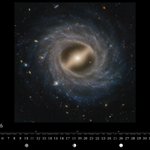
In the 2026 ESA/Hubble and ESA/Webb calendar, the month of October features the flocculent spiral galaxy NGC 5335. It has patchy streamers of star formation across its disc 🌟 and a bar structure slicing across its centre! Ready to print .pdf here: esahubble.org/products/calen… 📷 @NASA , @ESA , STScl
5
29
181
7,359