

Reformed crypto degenerate turned horse racing maximalist. Solving difficult problems using statistics since 1998.
The industrial North
Joined October 2023
- Tweets11.9K
- Following1.9K
- Followers1.6K
- Likes6.1K




Pinned Tweet
Another productive day in software land. New release about to be pushed live.
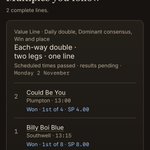
And a profitable day at the races.
Keep those bug reports, suggestions and requests coming. They’re priceless and very much appreciated.
If your reported issue hasn’t been implemented yet, don’t worry, it’s sitting in queue in priority order 👍
Great post

HOW BETTING SYNDICATES THINK: THE TONY BLOOM CASE
Tony Bloom, known as The Lizard, is one of the most successful professional sports bettors in the world. Through Starlizard, he built a betting operation that approaches football betting more like financial trading than traditional gambling.
More recently, a 2025 High Court case brought claims that his betting operation generated approximately £600 million in annual winnings.
But perhaps the most interesting part of his story is how he thinks.
In his early days, Bloom admitted that he wasn't particularly good at betting.
"Early on I was a hopeless gambler really. I liked to think that I understood the form and had a strategy but I was just guessing really."
That admission tells us a lot. Understanding football and knowing how to beat betting markets are two completely different things.
Bloom eventually realised that discipline, mathematics and a structured approach were essential.
As he once explained:
"I wanted to gamble because I enjoyed it and, therefore, I needed to do it properly in order to win."
That philosophy became the foundation of his approach.
SO, HOW DOES HE LOOK AT THE BETTING MARKET?
One of his most interesting observations concerns injuries:
"A lot of otherwise good gamblers may read too much into injuries. Sometimes the odds can get too skewed because one or two players are out. When I analyse situations, I don't want to go overboard on one side."
This is a particularly important point.
The market doesn't always react proportionally to new information. Sometimes a piece of news creates an overreaction, and that's where opportunities can emerge.
Bloom also believes in calculated aggression:
"I believe in betting aggressively. And, occasionally, to win big, you have to risk losing."
This isn't about blindly taking bigger risks. It's about being prepared to commit when the numbers justify it.
Another important part of the Starlizard philosophy is the search for value across different football markets.
Rather than focusing exclusively on the biggest competitions, the operation has historically analysed leagues around the world, including markets where bookmakers may have less information and pricing may be less efficient.
Its approach is built around developing independent odds, comparing them with the market and identifying discrepancies worth acting on.
And perhaps the most important distinction is this:
Bloom doesn't judge a bet by whether it wins or loses.
He judges whether the decision was right based on the information and probabilities available at the time.
THE BIGGEST LESSON FROM TONY BLOOM?
"At university I made myself a promise that I would become fiercely disciplined."
That discipline, combined with a willingness to question market prices, is what separates professional betting operations from ordinary punting.
The real business isn't predicting football.
It's understanding probabilities, identifying mistakes in the market and having the discipline to act when the price is right.
That's how betting syndicates think


Well you can’t win ‘em all.
But…
- Independent self-improving loops.
And…
- a genetic algorithm performing evolutionary search
Guarantees performance improvements over time.


I’m fixing and rerunning the pipeline. Chelmsford location data was missing and the weather report triggered a failure which led to the entire downstream pipeline failing for Chelmsford.
Full predictions will be live soon.


I never for a moment imagined that evolutionary search using a genetic algorithm would be this much fun.
She’s 100% correct.
Token minimising > tokenmaxxing

The days of tokenmaxxing might be over, y’all
Instead of using AI to build the kind of code we talk about in this video, token-heavy agentic loops are still the most broadly talked about area right now.
An article came out a few months ago about token minimization, but it seemed to be more about cutting employees off from their ability to use AI at all. Plus, let’s look at a very relevant case study indicating that token minimization isn’t really happening yet: Anthropic’s recent S1 filing.
About 80% of Anthropic’s revenue is billed per token rather than as flat monthly subscriptions, which includes developers building on the API and companies whose employees use Claude’s own apps, like Claude Code, on usage-based plans. Revenue thus grows with how long and how often agents run. The S1 filing shows that the top 5% of Claude Enterprise users who also use Claude Code spend about 20x more than those who don’t, net revenue retention is about 900%, and quarterly revenue went from $376M to $11.6B in six quarters.
And yes, many people have been doing this for a while - certainly software engineers who are used to building software & automations. I made coding guides on how to fine-tune open models for this exact thing over 3 years ago! But this hasn’t become *mainstream* yet - I advise companies, and I see it in tech-forward startups and among the most technically advanced people in larger corporations. Again, token-heavy agentic loops are still the most broadly talked about area right now. I think this knowledge of building actual software & systems that selectively use AI will become much more mainstream — after years of encouraging people to do it!

If @RupertLowe10 makes one more positive move for racing and dogs, I swear I’ll join the party and run for York Central constituency.