

The fastest AI inference in the world powering leading companies like NVIDIA, Meta, Intel, AMD and Perplexity.
Joined September 2025
- Tweets31
- Following9
- Followers15.1K
- Likes44




Pinned Tweet
EAGLE-4 is here.
From EAGLE-1 to EAGLE-3, we’ve kept making inference faster.
EAGLE-4 is our fastest yet.
961.6 tokens/s on @Alibaba_Qwen’s Qwen3.8-27B with TokenSpeed (BF16, 4× @NVIDIA B300, TP4, one request, T=0).
Github: github.com/eagle-hq/EAGLE-4
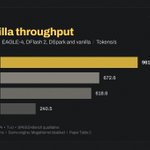
One request on @Alibaba_Qwen’s Qwen3.8-27B: 4× vanilla throughput.
EAGLE-4: 961.6 tokens/s
DFlash 2: 672.6
DSpark: 618.6
Vanilla: 240.5
SPEED-Bench qualitative, 4× @NVIDIA B300, TP4, concurrency 1, T=0. MegaKernel disabled, TokenSpeed.

Thank you to our partners @NVIDIA, @AMD, @vllm_project , @sgl_project, @lightseekorg, @fal, @FireworksAI_HQ, @gmi_cloud and others.
And to the researchers, engineers and everyone else who helped bring EAGLE-4 to developers.

Everything you need to get started with EAGLE-4.
Blog: blog.eagle.ai/blog/introduci…
GitHub: github.com/eagle-hq/EAGLE-4
Paper: github.com/eagle-hq/EAGLE-4/…
Website: eagle.ai
Integrations:
vLLM: github.com/eagle-hq/vllm
SGLang: github.com/eagle-hq/sglang
TokenSpeed: github.com/eagle-hq/tokenspe…
Model weights on Hugging Face:
Qwen3.8-27B -
huggingface.co/EAGLE-Corp/Qw…
Nemotron 3.5 Super VL -
huggingface.co/EAGLE-Corp/Ne…


What does this mean for developers?
At the measured decoding rates, generating 4,096 tokens would take approximately:
Vanilla: ~17.9s
EAGLE-4: ~6.6s
These are illustrative decoding-time estimates, excluding prefill and application overhead.
Benchmark setup: 4xB300, TP4, batch 1, SGLang 0.5.20, temperature 0.

5/ Thanks to @NVIDIA’s Nemotron team for early access.
Methodology: blog.eagle.ai/blog/eagle-4-n…
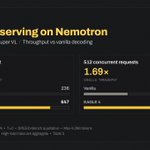
Building with Nemotron 3.5 Super VL?
Explore @NVIDIA’s launch announcement, technical blog and research report:
Announcement: blogs.nvidia.com/blog/nemotr…
Technical blog: developer.nvidia.com/blog/nv…
Technical report: research.nvidia.com/labs/nem…

This is a great step forward for open-source models. The cost advantage makes it possible to scale inference and verification in ways that would be expensive with closed models.
The tradeoff is latency. Verification can require dozens of inference passes per task. While most can run in parallel, some must run sequentially, making end-to-end latency multiple times longer than a single generation.
With EAGLE, we can accelerate those inference passes and bring the end-to-end time faster than a single standard generation, while keeping the benefits of self-verification.

Scaling self-verification with DeepSeek V4 Flash beats Claude Fable 5 on Terminal-Bench 2.1, while being 11x cheaper 💰
As open-source models become more capable, they can now generate large numbers of high-quality candidate solutions and verify their own outputs at very low cost.
For example, we find that sampling just 5 solutions with DeepSeek V4 Flash and ranking them using the same model with LLM-as-a-Verifier can lead to a significant boost in accuracy (79% → 88%), outperforming closed frontier models on Terminal-Bench.
Try it out today: github.com/llm-as-a-verifier…
More on verification scaling in my previous post.

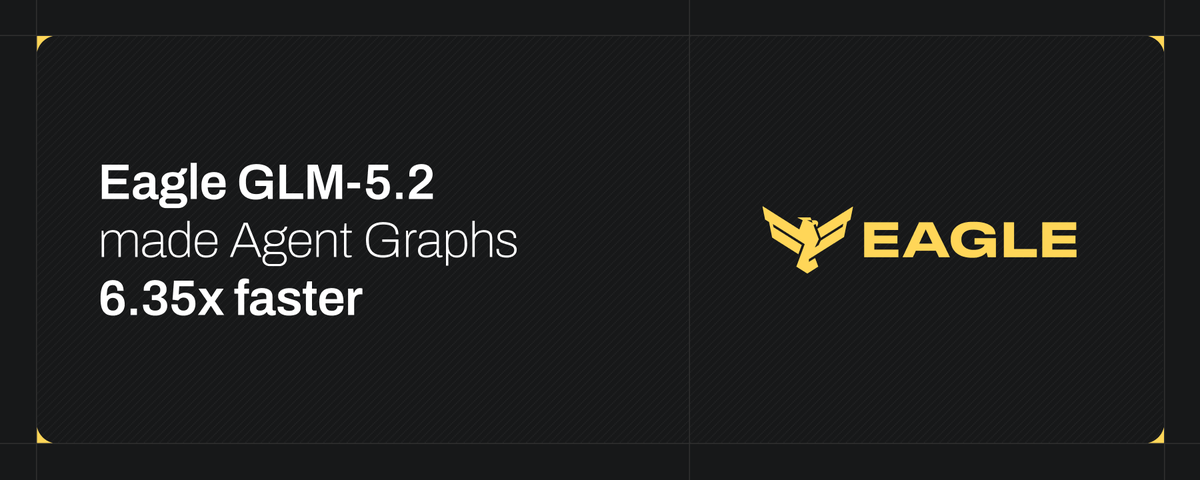
AI hardware has advanced rapidly over the past few years, delivering unprecedented compute for training and inference. As AI systems continue to scale, achieving higher performance increasingly depends on both more capable hardware and more efficient software.
Speculative decoding is a prime example. Rather than requiring new hardware, it unlocks more performance from existing accelerators by fundamentally changing how inference is executed. A lightweight draft model predicts multiple future tokens, which are then verified in parallel by the target model. By reducing sequential decoding steps and improving hardware utilization, speculative decoding enables substantially higher throughput from the same underlying compute.
This reflects a broader shift in AI infrastructure. Software is redefining AI performance by unlocking more from increasingly powerful hardware. As accelerators continue to evolve, advances in inference algorithms will be just as critical as advances in the hardware itself, together defining the next generation of AI systems.

EAGLE 3.1 has been merged into @nvidia TensorRT-LLM.
The integration brings EAGLE's latest speculative decoding architecture to one of the most widely used inference frameworks for NVIDIA GPUs.
EAGLE 3.1 introduces architectural improvements that increase drafter robustness, improve acceptance length across multiple model families, and deliver more consistent performance under real-world deployment conditions.
Making these improvements available in TensorRT-LLM simplifies adoption for developers building high-performance inference pipelines on NVIDIA infrastructure.

Learn more about EAGLE 3.1 support in TensorRT-LLM: github.com/NVIDIA/TensorRT-L…
