





Mohamad El Boudi retweeted

Claude writes better code when it can verify its work. Checks that used to be expensive, like tests, benchmarks, and end-to-end runs, are now cheap.
Here’s how the Claude Code team thinks about verification:
claude.dev/blog/how-the-clau…



Mohamad El Boudi retweeted

Any AI SDLC workflow which involves taking a spec and turning it into a backlog of issues or tickets is a dead end.
There is only the spec. Any materialization of the spec into discrete units of work can only introduce drift. It is waste.
Mohamad El Boudi retweeted

一个亿万富翁,花了 42 分钟,
把全球经济的底层逻辑讲透了!
钱是怎么流动的?
债务是怎么运转的?
经济危机又是怎么发生的?
全程没有晦涩的金融术语,
讲得比很多 MBA 课程还直白。
这 42 分钟,真的值得反复看。
Mohamad El Boudi retweeted

this harness engineering paper is f*cking insane
it's the exact setup anthropic used to keep a single AI agent coding for hours without forgetting what it was doing.
2 agents, 4 files, one prompt that runs every session, all on one page.
set it up tonight and your agent keeps building feature after feature while you sleep, instead of quitting halfway.
the crazy part is everyone blames the model when their agent gives up after 20 minutes, while the fix is a json file and a text log.
full breakdown in the harness guide below.


Mohamad El Boudi retweeted
表达能力差,真的会让你错失很多机会。
2019 年,MIT 教授帕特里克·温斯顿用一场 1 小时的演讲,
讲透了如何清晰表达、抓住听众注意力。
时隔多年再看,依然值得认真学一遍。
Mohamad El Boudi retweeted

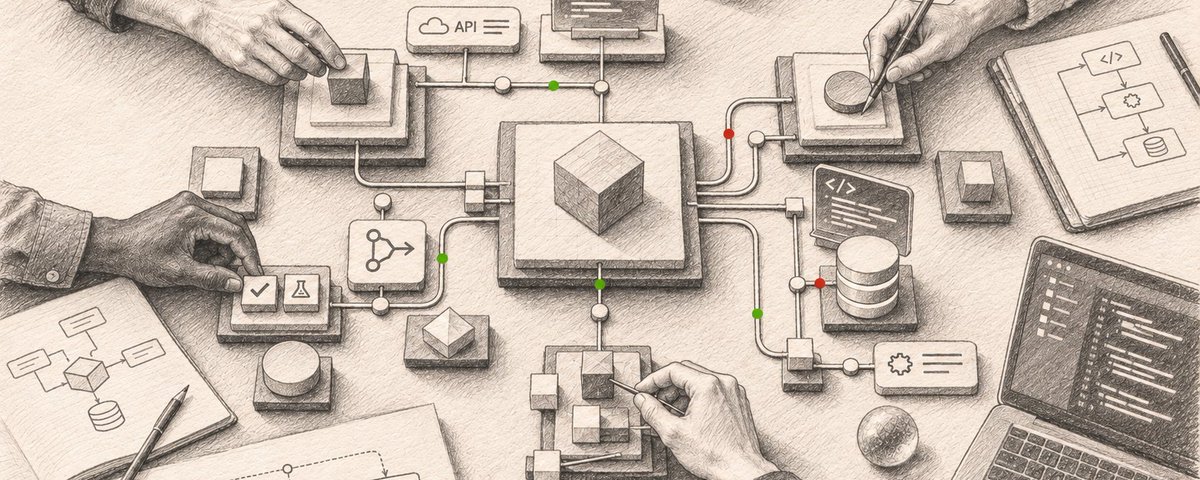
The 𝗦𝗼𝗳𝘁𝘄𝗮𝗿𝗲 𝗙𝗮𝗰𝘁𝗼𝗿𝘆 𝗘𝗻𝗴𝗶𝗻𝗲𝗲𝗿.
An emerging engineering role for the transition from AI-assisted development to L4 Autonomous Software Factories.
Feel free to copy, adapt (, and challenge it)!
Mohamad El Boudi retweeted

An incremental path to a software factory:
Level 0: You notice AI is making mistakes or doing things you dislike, so you implement strong automated guardrails.
Level 1: You notice you’re repeating prompts, so you create some skills.
Level 2: You notice you’re calling skills in the same order, so you create a skill that calls the skills you use, in order.
Level 3: You notice that some skills should only be called in some circumstances, so you enhance “parent” skills to call “child” skills only when it makes sense.
Level 4: You notice you’re manually prompting the agent when the ticket is ready, so you configure your agent to monitor tickets and start automatically.
Level 5: You notice you’re manually watching your open PRs for comments, so you configure your agent to watch PRs and auto-respond.
Level 6: You notice you’re manually triggering releases, so you configure your release pipeline to release code upon merge. Features are deployed in phases for safety, so only a subset of users see the changes at first.
Level 7: You notice you’re manually watching the logs for issues after releases, so you configure your agent to open a bug and implement the corresponding bug fix when it sees an error.
Level 8: You notice the system sometimes fails, so you configure it to learn from mistakes and improve over-time.
Mohamad El Boudi retweeted

i’m not convinced that “context” is the real bottleneck here.
for lots of orgs, all the meetings are captured in granola. all async comms are in slack. all docs are in notion. I’ve even seen teams check their agent logs into shared repos.
all of these have ample MCPs and CLIs that all agents can access. the context is there, everything is legible, and yet—
the problem is that it is stored, retrieved, and acted on non-deterministically. it’s unstructured and out of date and there’s way too much of it. it’s an unreliable mess. the agents (and humans) can only do so much with that, and the result isn’t at all what people imagine when they design agentic systems, because nobody can trust it.

Databricks CEO Ali Ghodsi says if frontier models stopped advancing, it wouldn't matter for most orgs because enterprise AI is bottlenecked on context, not intelligence:
"There's no agentic work that's automated the whole enterprise. That has just not happened. Why is that? The real reason is the models are smart enough, but they just don't have the context that exists inside of any organization."
"They have not been in every meeting. They don't know what's in everybody's heads. They don't know all the processes. There's always a couple of employees who know everything in every organization. You go tap on their shoulder, and everybody's like, 'Oh my God, what would happen if he or she quits?'"
"If you just fused that and gave that context into the AI models, just the frontier today, I think there's so much productivity gains you could get for any organization on the planet."
"For that, we actually don't need smarter models... If the frontier doesn't advance, it doesn't actually matter for the vast majority of organizations on the planet. They're just so far behind in the adoption curve of actually automating things and getting value out of this stuff."
@alighodsi
Read the latest Profiles of the Future by @bhorowitz and @mikemcg0 on Databricks & the Future of the Firm: a16z.news/p/databricks-and-t…

Mohamad El Boudi retweeted

I write the speeches of the President of the French Republic, Emmanuel Macron.
I write them at the Château, which is what those of us inside still call the Élysée, as though 1789 were a rumour we had decided not to dignify. There are three of us. Three people, elected by no one, who decide a few times a year what sixty-eight million French men and women will be told they feel. Tonight, at eight o’clock, they will be told they feel solemn. The communiqué says the President will speak solennellement. I am the solennellement.
It is ten past seven. There are twenty chouquettes in the box.
La Rochefoucauld wrote that gravity is a mystery of the body, invented to hide the defects of the mind. He intended it as an insult. I have it framed above my desk, as a job description. Talleyrand, who served every regime and believed none of them, told his young diplomats: surtout, pas trop de zèle. Above all, not too much zeal. That one I keep in my wallet.
The house suits the work. It was built for a count, bought in 1753 by Madame de Pompadour, mistress to the King, and passed through a revolution, two empires and five republics without anyone ever taking the hint. The President of the Republic addresses the nation from a royal favourite’s drawing room, a few doors from the salon where Napoleon signed his second abdication. The French believe they abolished the monarchy. They abolished the King, and kept the court, and the court kept me.
We keep the archive of past addresses in a cabinet, as a family keeps its photographs. Like every family, we have the uncle no one mentions at Christmas: the tenth of December 2018, the gilets jaunes address, the evening we lost our nerve and paid. Ten billion euros to send the roundabouts home. Bercy still speaks of it the way the old nobility spoke of the night of the fourth of August. The transcript sleeps in the bottom drawer. We do not pay twice. We are not a charity. We are a Republic.
Every trade has its ancestors. Bossuet had princesses, and a court dissolving at Madame se meurt, Madame est morte. Malraux had Jean Moulin, and four words at the Panthéon, Entre ici, Jean Moulin, that still send senators fumbling for their handkerchiefs. I have casseurs. I have had casseurs since 2018, and I shall have them until I retire, which under the reform will be at an age my grandfather regarded as posthumous.
Allow me to explain how it actually works. The world imagines la plume as a poet in a garret. I am nearer to a sommelier. I do not make the wine. I tell you what you are tasting, in a confident voice, and you would be embarrassed to disagree. Our raw material is the élément de langage: language delivered flat-packed, with a diagram and one screw missing, which the minister is expected to assemble on live radio.
Certain elements are compulsory. “Casseurs” must arrive early, before the viewer has found the remote. “Ordre républicain” follows, as night follows day. “Forces de l’ordre” must be followed within one sentence by “gratitude,” gratitude being the only form of remuneration that requires no vote in the Assembly. “Vie chère” appears once, softly, as a physician mentions the shadow on the scan to a patient he has no intention of treating.
Certain words never appear at all. “Budget.” “49.3.” “Banlieue.” “OQTF.” “Immigration.” And, under no circumstances whatever, “Céline.”
We shall return to Céline.
Over all of it presides the President’s single conjunction, en même temps. Tonight it will do its customary work: firmness and compassion, order and listening, the casseurs and the cause, all at the same time, which is to say each for about four seconds. Should anyone insist on the cause, a second word waits in the drawer beside the uncle: pédagogie. We will have lacked pédagogie. In France the government is never mistaken. It has merely explained itself too slowly to a people who had already stopped listening.
Molière’s Monsieur Jourdain discovered he had been speaking prose for more than forty years without knowing it. The French have been governed by prose for nearly as long, and have noticed even less. That is my contribution to the national literature.
Half past seven. Fourteen chouquettes.
The figures came in all morning. Eight hundred thousand marched yesterday, according to the organisers; five hundred and fifty thousand, according to the Interior Ministry. I write for the smaller number. It has the police. Some two thousand arrests. More than six hundred officers injured, whom the President will thank tonight in a voice of real emotion, and whose salaries the budget froze last month in a voice of no emotion whatsoever. A tourist office burned in Lyon. The town halls of Marseille and Lille forced and ransacked. A police compound in Bordeaux. And Limoges.
None of it surprises anyone in this building. We have a template, and the template has a pedigree. Clichy-sous-Bois, 2005. The Arc de Triomphe, 2018, when they smashed the face of Marianne and we restored her nose at public expense. Nahel, 2023, when a burning car was driven into a mayor’s house with his wife and children inside. Every three or four years France sets fire to itself with the punctuality of a Swiss train, and every time I write the same speech with fresher adjectives. One does not change the menu at a great restaurant. One changes the garnish.
At half past five the President received the Prime Minister and the ministers concerned. Plumes are never in the room. We sit in the room next to the room, where power in France has always preferred to live. When it ended, someone opened our door, regarded us for a moment, and said: “Bon.” In a palace, bon is a complete sentence; on occasion it has been a constitution. It means: the meeting went as expected, nothing will change, write something that sounds as though it will.
And here, figurez-vous, is the detail I treasure. The Château published the agenda of that meeting in advance. Three headings. Économie-commerce. Assurance. Suivi judiciaire. The shops, the insurers and the courts: three chairs at the table for the three things in France capable of filing a claim.
There was no fourth heading. Nobody crossed it out. Nobody needed to. The country had spent Saturday in the streets over the price of fuel, frozen benefits, shuttered services, missing teachers, and a democracy in which, as one of them put it, you vote every five years and hold your tongue in between. On that last point they are entirely correct; I have built a career on it. Valéry defined politics as the art of preventing people from meddling in what concerns them. He wrote it as a lament. In this building it is read as a training manual. The agenda accomplishes in three nouns what once required a censor, a prefect and a regiment. I did not have to leave the cause out of the speech. The cause was simply never invited.
Now, Limoges.
The hôtel de ville of Limoges was inaugurated in 1883 and listed as a historic monument in 1975. Its architecture borrowed from the Hôtel de Ville in Paris, the one the Communards burned in May 1871 and the Republic rebuilt in stone so that everyone would remember who had won. On Saturday, towards five in the afternoon, a crowd of French people broke into a copy of the building a crowd of French people had burned the last time, and burned the copy. Marx, who wrote his best book about us, said history repeats itself, first as tragedy and then as farce. He underestimated us. In France history repeats itself as heritage, and is listed by the Monuments historiques. The bell tower held until half past eight, then came down on live television, which in this country is the only place anything is permitted to happen.
The mayor, Guillaume Guérin, said that night that a monument was burning but the Republic was not. It was a fine line, and I confess to a pang of professional envy. He was also correct: the Republic is fireproof by design. Only buildings burn. By Sunday he was threatening to resign unless Paris paid for the roof. Someone on the radio compared it to Notre-Dame, and I felt the entire Ministry of Finance lean forward in its chair. Bercy remembers Notre-Dame: hundreds of millions pledged before the embers had cooled, by gentlemen who had never cared for the Gothic until it became deductible. A roof is a cause. A roof has a silhouette. A roof can be floodlit, and a president in his final spring thinks only in stone.
Here is what will not be floodlit.
Three thousand two hundred and fifty-six teaching posts were removed from the state schools at this year’s rentrée. The ministry blamed a chute démographique vertigineuse, a dizzying fall in the birth rate, which is perfectly true: the French have stopped having children, and so, with impeccable logic, we stopped teaching the ones they have. The budget that did it passed under article 49.3, invoked three times, that most elegant of devices by which the Republic consults the Assembly in order to dispense with it. Next year the education budget rises by 1.2 billion, and the minister assured the AFP, while the lycéens were in the street, that the priority on education had been “objectivement préservée.” When a French minister reaches for objectivement, the matter is already lost, and he knows it, and he would like you to know that he knows.
The lycéens have been out since September. We had suspended the stun grenades for them, out of delicacy. For Saturday we authorised them again, the children now being accompanied by adults. I invent nothing. The State has far more imagination than I have. What it lacks is shame, and I made my peace with that long ago, because shame is fatal to prose.
Eight minutes to eight. Six chouquettes.
Then there is the word I am paid never to write.
Immigration is the subject this house discusses most over dinner and least at eight o’clock. In January 2024 we passed an immigration law, and the Conseil constitutionnel struck out more than a third of it. Ministers wept on camera and opened champagne in private. A law one can brandish and never apply: in my trade, that is a masterpiece. Each year we issue more than a hundred thousand orders to leave French territory and carry out fewer than one in ten. The paperwork departs. The people remain. The word itself passes from minister to minister like a grenade whose pin someone has politely replaced. Half the country will be listening for it tonight. They will listen in vain. To say it would be to concede that the State has governed neither its border, nor its suburbs, nor its schools for twenty years. The whole architecture of the address rests on the premise that the State governs everything, beautifully, from a drawing room.
I considered, briefly, a sentence about the mille-feuille: commune, intercommunalité, département, région, État, Europe, each leaf golden, flaky and impeccably glazed, and at the very bottom, pressed flat beneath all of it, a child waiting for a mathematics teacher. It is a beautiful image. It is also unusable. The plume who hands the President a metaphor implying the whole pastry was baked to protect itself from the people eating it has drafted his own letter of resignation, and signed it in the President’s voice.
So I wrote the line about standing together against the sowers of chaos. Semeurs de chaos. He tried it on X last night, and it had a superb séquence. I am rather proud of it. A nation that has not mastered its own streets in twenty years is informed that chaos is something sown by strangers, on a Saturday, from outside. The nation, which adores a good sentence more than a true one, will repeat it at dinner. I wrote the line about the gendarmes and the CRS who held. I wrote the line promising that what burned will be rebuilt, which is true, because it is insured, and listed, and photographed. I did not write the line about the child at the bottom of the mille-feuille. That line does not exist in the system. It has never been issued a stamp.
A marcher died yesterday on the boulevard Magenta. Strangers carried him to the fire station at Château-d’Eau, and he died at its door. The prefecture’s word is malaise. In our language a malaise is a fainting fit, and also what a whole country suffers when it can no longer say aloud what is wrong with it. Bossuet would have given him an oration. The Republic will give him a pensée, one sentence, placed after the police and before the insurers, which is precisely where the Republic files its citizens.
And now, Céline.
On Friday evening, the night before all this, the President and his wife were at Céline Dion’s concert, the penultimate night of her Paris run. The press has been unkind. The press lacks a sense of tradition. In 2023, while the suburbs burned, it was Elton John. Stendhal said that politics in a novel is a pistol shot in the middle of a concert. The President has perfected the inverse: a concert in the middle of politics, at the very hour the pistols are going off. She is Québécoise, of course, which is to say French without the inconvenience of being governed by us. The song she opens with is called “On ne change pas.” One does not change. I left it out. A fact becomes cruel only by its placement, and I place facts for a living.
People suppose my trade is lying. Lying is for amateurs and ministers. My trade is to describe a fire so exquisitely that no one thinks to ask who stacked the wood, who sold the matches, or who has lived in the house for twenty years assuring the neighbours that the wiring was fine. Every sentence the President pronounces at eight o’clock will be true. The town hall burned. The violence was unacceptable. The casseurs will be pursued and punished. The Justice Minister wants an extremely firm judicial response, and he shall have one, for firmness is the last thing this State can reliably deliver on a weekend, provided the weekend is short and the prisons are not already full. The speech is true from its first word to its last. It begins at five o’clock on Saturday afternoon and declines, with immense dignity, to remember anything before.
The President will finish. The networks will cut to their analysts, who will find it measured. The bell tower will be rebuilt in finer stone, with a plaque bearing the name of whichever minister is still in post. By Wednesday the burned cars will have been towed beyond the périphérique, where no one of consequence need look at them. The country will perform the one authentic monument it has left, the haussement d’épaules, and agree that ça aurait pu être pire. It will be worse. It is always worse the next time, and the next time is already in the drawer beside the uncle, awaiting fresh adjectives.
Two minutes to eight. The box is empty.
My wife texts while I am still at the desk. Tu as mangé? Then: Il reste du fromage.
The General asked how anyone could govern a country with two hundred and forty-six cheeses. Sixty years on, we have the answer. Nobody does. One simply reminds it, at eight o’clock, before the flags, that there is still cheese.
Beaumarchais gave his slanderer a rule: calomniez, calomniez, il en restera toujours quelque chose. Ours is the same rule, read backwards. Omit, omit. Something always remains. The façade. The cheese. The President, until May.
We do not rebuild what was starved. We rebuild what burned on camera.
Bon courage.
Mohamad El Boudi retweeted

“Increasingly, organizational systems bottleneck AI gains not individual workers”
Yup. At this point, in most every company that does ‘knowledge work’ - there are pockets of folks who are AI-pilled and know how to use these tools effectively. With the right nudges and processes, these folks could lead the charge forward. But In most orgs, they are gated by organizational inertia.
It’s much easier for orgs to do what they’ve always done, because inertia is hard to overcome. Incentives are a thing, and so are engrained organizational dynamics. This is yet another manifestation of the “No one ever got fired for buying IBM." idea.
This is why I’ve always believed what Mollick has written from the beginning. The only way to make this work effectively is to have a both bottoms up and top down approach. You definitely need folks at the top who understand that to make this thing work, it’s not just a technical problem. Those leaders need to know that lots of priors have to be re-thought, and lots of things their org takes for granted (processes, org structures, how folks work together, who needs to be on the ship) - had to be burnt down.
Innovators dilemma on steroids

Mohamad El Boudi retweeted

everything i know about managing agents i learned from the amazing programmers and computer scientists that came before
constraints in your codebase are freeing for both humans and agents! this has always been true, but if you were a small dev team you likely never had to think that deeply because you could trust your fellow programmers to write code and review well
but large companies have had to solve this problem since even before agents. because before you had agent slop, you had human slop. lots of engineers wrote bad code out of necessity (eg backend engineer forced to write frontend or reverse). the solution to this was constraints: lint rules, smarter compilers and diagnostics, high quality tests, investments into observability, and so on
the arrival of agents just means that big company problems are now everyone's problems. the good news is that none of this is really that novel: it's just good engineering
youtube.com/watch?v=GqmsQeSz…


Mohamad El Boudi retweeted

Fascinated by the idea of giving agents consequences for their actions at runtime. Feels like an underexplored approach.
For example:
- If it calls tool A, it can no longer call tool B.
- If it reads a sensitive document, network access is revoked to prevent exfiltration.
- If it takes a privileged action, subsequent actions require approval.
- If it enters a high-risk part of the system, its available tools shrink.
Each action narrows or changes the agent’s future action space. Such a cool concept.
Mohamad El Boudi retweeted

The best FDE work has an expiration date.
The solution to a hard customer problem should eventually disappear into the product, so the next customer gets it by default.
If the same problem keeps requiring an FDE, the product didn’t learn.

Every company says they have Forward-Deployed Engineers now.
ElevenLabs CEO and former Palantir Deployment Strategist @mati gives one of the best explanations of what an FDE is—and says companies are missing the key piece of what actually makes FDEs valuable:
“In our case, FDEs are part of the product team. They are not part of the go-to-market team. They are deeply embedded in understanding what the roadmap of the product is.”
“You want all the FDEs to actually solve the customer problem and stretch your product in that direction. But the second thing you want them to do is bring any of that knowledge back to the product, so the product becomes better for the next generation of companies building on top of it. I feel like the second part is frequently missed.”
“The beauty of that is—everybody benefits because you work with one customer, learn, and you bring that into the product experience. Both of those customers benefited from having their product optimized for better work.”
“The domain expertise they have is still theirs. They can win based on their domain expertise. But the product experience of how you build based on that domain expertise can be abstracted, and can be reusable.”
Mohamad El Boudi retweeted

AI coding agents need guardrails before they touch a mature codebase.
AI-SDLC is a declarative governance framework for teams running spec-driven AI development workflows.
It helps you move a well-specified task toward a reviewed pull request by using a Definition-of-Ready gate, dependency-aware orchestration, and review checks around the change.
Key features:
• Definition-of-Ready gate – stops tasks with unresolved operator decisions from being dispatched
• Dependency-aware orchestration – walks a task dependency graph before admitting work into the pipeline
• Cross-harness review – supports independent reviewer subagents across different execution harnesses
• DSSE attestations – records signed evidence around changes and review steps
• Declarative resource model – defines resources such as Pipeline, Decision, AgentRole, QualityGate, and AutonomyPolicy with JSON Schema
It’s open-source (Apache License 2.0 license).
Link in the reply 👇

Mohamad El Boudi retweeted

if you haven't read this essay, you really should.
one of my all time favorites

Mohamad El Boudi retweeted

The biggest cheese banks in Italy store 300,000+ wheels of Parmesan.
Dairy farmers use cheese as collateral and get loans up to 80% of market value. At ~$1,000 per wheel, that’s $200m+ in loans (banks seize and sell cheese if farmer can’t pay back).
Best part: banks use automated machines that brush and turn the cheese wheels everyday to keep them fresh.
***
Vid link: youtu.be/QqqVnxw1GZk?si=tefH…

Mohamad El Boudi retweeted

CANCEL your weekend plans.
You NEED to:
• Build a RAG system that cites sources with page numbers
• Implement hybrid search (dense + sparse) for better retrieval
• Add reranking with cross-encoders for top-10 accuracy
• Set up chunking strategies (500 tokens, 50 overlap minimum)
• Build query expansion for better recall
• Add metadata filtering for scoped retrieval
• Implement citation grounding to prevent hallucinations
• Create an eval harness with 50+ golden test cases
• Track retrieval metrics: hit rate, MRR, NDCG
• Add fallback to web search when confidence is low
• Build query rewriting for ambiguous questions
• Implement parent document retrieval for context
• Add embedding caching to reduce latency 80%
• Use colbert or late interaction for better accuracy
• Build a RAG dashboard showing retrieval quality
• Test with adversarial queries that should return nothing
• Document your chunking strategy and why it works
• Benchmark against naive RAG and show improvement
You have way too much to do.
Bookmark & Repost.