

Clear electronics/RF guides, videos & downloads by Ian Poole | Resource hub for engineers & hobbyists | Shop: https://xitter.cf/t.co/ClrsfjiAbA
South East, England
Joined November 2016
- Tweets28.5K
- Following269
- Followers17.4K
- Likes2.5K





And also check out my video:
Inside the Reed Switch: How a Tiny Magnet Changes Everything
youtu.be/uCYTTKwsM0g
👉 Want to dive deeper into the history, construction materials (like rhodium and ruthenium coatings), and circuit design considerations? Check out the full guide here: electronics-notes.com/articl…
Reed Relays are a Surprisingly Good Switching Solution.
Ever wonder how electronic circuits achieve fast, reliable, and isolated switching without the bulk of traditional electromechanical relays?
Meet the reed relay - a compact component that bridges the gap between traditional mechanical relays and solid-state alternatives.
What is a Reed Relay?
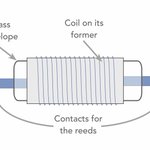
At its core, a reed relay consists of a reed switch - two overlapping nickel-iron blades hermetically sealed inside a glass envelope filled with inert gas (like nitrogen)—wrapped inside an electromagnetic actuating coil.
When current passes through the coil, it creates a magnetic field that magnetizes the blades. They attract each other, snap shut, and close the circuit. Remove the current, the field drops, and the spring-loaded contacts snap back apart.
Why Engineers Choose Reed Relays:
* Speed: Because the gap between contacts is tiny (0.05 to 1 mm), they boast incredibly fast switching speeds—often between 0.5 to a few milliseconds.
* Reliability & Longevity: Sealed inside glass, the contacts are entirely protected from moisture, oxidation, and contaminants.
* Complete Isolation: They offer absolute physical isolation between the control circuit (coil) and the switched circuit.
* Compact Size: They are small enough to fit into standard SIL or DIL integrated circuit packages, saving precious PCB real estate.
Design precautions:
While they are highly reliable, reed relays aren't always a "set-and-forget" component. When designing them into your circuits, remember:
1. Contact Bounce: The contacts collide with high energy, causing minor "bounces." If switching capacitive or inductive loads, this can cause arcing and reduce contact life.
2. Magnetic Interaction: Unscreened reed relays can experience magnetic coupling. If placed too close together on a PCB, their fields can oppose one another, requiring a higher coil voltage to close.
Pro tip: Always look for reed relays with built-in ferrous metal screens to optimize efficiency and enable tight stacking!
3. Current Constraints: They are typically built for low-to-medium signal switching, not heavy-duty power applications.
From test and measurement matrix switches to automated telecommunication exchanges, the reed relay remains an elegant, trusted solution for modern hardware engineering.
More information- check the link in the comment.
#ElectronicsEngineering #HardwareDesign #CircuitDesign #ElectronicComponents #ElectricalEngineering #electronicsnotes

For a deeper look at transformers check out my website: electronics-notes.com/articl…
Why the transformer is still an essential component for modern electronics
While digital technology gets all the headlines, the "analogue" transformer remains a really key electronic component for many circuit designs. But it is probably the least understood of the basic electronics components.
From the power grid to the many domestic devices, transformers are performing key roles behind the scenes.
On my Electronics Notes website, I took a deep dive into how these components function beyond just changing voltage.
Key takeaways include:
🔹 More than Voltage: While we often think of them for step-up/step-down tasks, transformers are vital for galvanic isolation, keeping users safe from high-voltage mains.
🔹 Impedance Matching: In RF and audio design, transformers are essential for maximizing power transfer between different stages of a circuit.
🔹 Diverse Applications: Whether it’s pulse transformers for digital signals or resonant transformers for frequency selectivity, the variety of types (toroidal, ferrite, air-core) is vast.
Even as circuit designs evolve, understanding the magnetic coupling and theory behind these components is a must for any engineer.
Check out the full breakdown in the link in the comments.
#ElectronicsEngineering #ElectricalEngineering #CircuitDesign #TechEducation #electronicsnotes #electroniccomponents

24 OCTOBER 2026
Fact of the day:
It was on this day in 2003 that the last commercial Concorde flights landed at Heathrow.
Three aircraft landed in sequence having been given special permission to fly low over London before they came in to land at just after 4 pm local time at approximately two minute intervals.
It was sad to see the last flights of this amazing aircraft.
In case you missed my first post - the 2N3055 is an iconic power transistor.
Even though there are more up-to-date devices that can work better, there are still many circuits in which the ‘3055 can be used to great effect.
It’s over 60 years since 2N3055 was first launched, so it has survived well and it’s still being manufactured by many companies.
Find out everything, watch my video now: youtu.be/AlKwDjhUxj8
#2N3055 #transistor #semiconductor #electroniccomponents #electronicsnotes

More information can be found in my website: electronics-notes.com/articl…
Understanding Varactor Diodes: what they are; how they work; where they are used
Have you ever wondered how your car radio "tunes" to a station or how your smartphone manages to jump between different frequency bands without a single moving part inside?
The secret lies in a component that combines the worlds of semiconductors and capacitors: The Varactor Diode (also known as the Varicap).
Based on insights from Electronics Notes, here is a look into how this "variable reactor" works and why it’s the key electronic component for modern wireless communication.
What is a Varactor Diode?
At its core, a Varactor is a semiconductor diode designed to take advantage of a phenomenon that most engineers try to minimize: Junction Capacitance.
While a standard diode is meant to conduct or block current, the Varactor is almost always operated in reverse bias. In this state, it doesn't conduct electricity; instead, it acts as a voltage-controlled capacitor.
How It Works:
To understand the Varactor, think of a traditional capacitor (two conductive plates separated by an insulator).
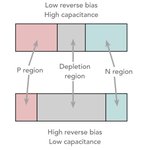
* The Depletion Region: When you reverse-bias a diode, an area empty of charge carriers (the depletion region) forms at the junction. This acts as our insulator.
* The P and N Layers: The conductive semiconductor material on either side acts as the capacitor plates.
* Capacitance Changes: As you increase the reverse voltage, the depletion region widens. In capacitor terms, this is like moving the plates further apart—which decreases the capacitance.
By simply changing the voltage, you change the capacitance. No knobs, no motors, just solid-state physics.
Abrupt vs. Hyperabrupt: The Doping Secret
Not all Varactors are created equal. The way the semiconductor is "doped" during manufacturing changes how it responds to voltage:
* Abrupt Varactors: Have a constant doping level. They offer a linear relationship and a high "Q" (quality factor), making them great for high-frequency precision.
* Hyperabrupt Varactors: Have a non-uniform doping profile that creates a much larger change in capacitance for a small change in voltage. These are the workhorses of wide-band tuning.
Where Do We Use Them?
Without the Varactor, our modern "connected" world would look very different. They are essential for:
✅ Voltage Controlled Oscillators (VCOs): The heart of frequency synthesizers and Phase Locked Loops (PLLs).
✅ RF Filters: Allowing devices to "track" a signal and filter out interference dynamically.
✅ Frequency Modulators: Directly shifting the frequency of a signal to carry information (FM radio).
Pro Tip for Designers
When using a Varactor, the "Capacitance Ratio" is your most important metric. It tells you the range between the minimum and maximum capacitance the diode can achieve. If you need a wide tuning range, go Hyperabrupt; if you need low loss at high frequencies, stick with Abrupt.
Have you ever had to troubleshoot a VCO or a tuning circuit? What’s your go-to Varactor for RF projects?👇
I’ve dropped the link to the full technical guide from Electronics Notes in the comments
#Electronics #RFEngineering #WirelessTechnology #CircuitDesign #RFdesign #HardwareEngineering #Varactor #Semiconductors #electroniccomponents
