

Curriculum Assistant, Masters Team for FBL at The Open University, Member of The Geological Society and undergraduate with The OU studying BSc Geology
Marston Moretaine, England
Joined October 2010
- Tweets1.9K
- Following375
- Followers195
- Likes3.2K



Emma Boland retweeted

#Jupiter with Io and the GRS on October 1st. damianpeach.com/barbados22/2… Excellent seeing. Io is alongside with the GRS just appearing at right. C14HD with Uranus-C camera.

Emma Boland retweeted

Friday I captured around 200k images of our sun. I asked my friend @TheVastReaches for help working all the data so we could create an incredibly detailed image of our star, and we're nearly done. Take a look at this close crop of the final 140 MP pic we'll be sharing tomorrow:

Emma Boland retweeted
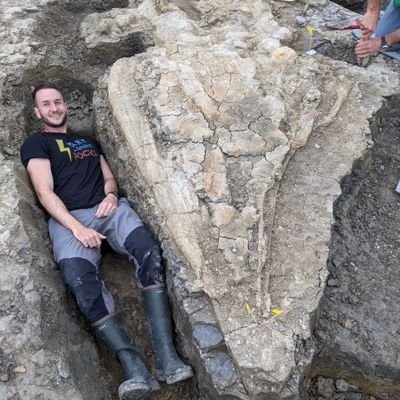
One of the best belemnite fossils I’ve ever seen. Perfect for #MolluscMonday
Most belemnite fossils are just the hard part, called the guard or rostrum. This one includes the ink sac and arms with hooks! It’s a real beauty. Well, as far as squid-like Jurassic critters go. 🦑

Emma Boland retweeted

A beautiful eruption of plasma was just observed off the southwest limb. Image by GOES-16 SUVI.
SolarHam.com

Emma Boland retweeted
A large filament just lifted off in the southwest quadrant and will likely fling some plasma into space. Trajectory should be mostly south of the Sun-Earth line, however coronagraph imagery will be needed to confirm this. Full update via SolarHam.com
Emma Boland retweeted

Stars gas Clouds N M78 by steven Mohr tumblr.com/spacewonder19/676… – at Madrid, Spain

Emma Boland retweeted

Recent volcanic activity has been observed on Venus for the first time.
Scientists made the discovery by poring over archival radar images of Earth’s twin taken in the '90s by our Magellan mission. Our VERITAS mission is set to investigate: go.nasa.gov/3mP5f9O

ALT A computer-generated 3D image shows the entirety of Venus in a bright yellow color. There are patches of darker yellows that illustrate differences in the surface. The large circular planet has a black square to the middle-right section marking where volcanic activity was spotted in archival radar images from NASA's Magellan mission.


Emma Boland retweeted

How far can the human body go? 💪🏃♀️
@robinince and @profbriancox are joined by @russell_kane @SallyGunnell @Ben_garrod and Polly McGuigan to find out how good humans are at endurance.

Emma Boland retweeted

Amazing folding leaving Alice #geology #alicesprings Amadeus Basin, Australia 🇦🇺 – at Alice Springs, Northern Territory

Emma Boland retweeted

Evening , Rosette in 2 palettes , bi colour and Hubble palette. Captured under Norfolks pristine skies 💫🔭🌟night all , clear skies

ALT Rosette Nebula in Monoceros A Bicolour image , combined woth Ha ad Red, O3 as Blue and the Ha O3 blended to make a synthetic Green , and the second a 3 filter Hubble Ha O3 and S2

Emma Boland retweeted

🌍🔭🪐 From the middle to the end of June 2022, cast your eyes to the morning sky to see a spectacular parade of the planets.
👇 Here's what's happening and how you can watch from the UK. #AskUsAboutSpace spacecentre.co.uk/blog-post/…

Emma Boland retweeted

COMPETITION TIME!
This is your opportunity to name a Mars simulant designed in our labs! For competition details and to find out how @Amy_R_Dugdale will use it in her experiments, watch the video below.
Enter here: https://nitter.gq/t.co/Sa6kWU0zJ7
CLOSES: 28th June 23:59
Emma Boland retweeted
👨🏻🚀 #OnThisDay in 1961 Yuri Gagarin launched into space, completed one orbit and returned safely to Earth. He was the first human to travel to space.
🚀👩🏿🚀 Who is your favourite astronaut? #InternationalDayofHumanSpaceflight #YurisNight

Emma Boland retweeted

Great images coming back from @NASAPersevere showing fascinating detail on the slope of the delta... jumbled rock screes, jutting outcrops and Vienetta-like layers... Image Credit: NASA/JPL-Caltech/ASU/S Atkinson


Emma Boland retweeted

Terrestrial, rocky or telluric planets are composed primarily of silicate rocks or metals. In our Solar System are Mercury, Venus, Earth, Mars and some planetary-mass satellites. They have a solid planetary surface.
Images: The terrestrial planets sized to scale NASA/ESA

Emma Boland retweeted
🛰️🌍 Our brand new #HomePlanet gallery will open on 22 April #EarthDay and you're invited to come and explore!


Emma Boland retweeted
🚀 #OnThisDay in 1970, Apollo 13 launched. The astronauts on board were James Lovell, Fred Haise and Jack Swigert.
💥 Little did they know that 55 hours 52 mins into the mission, 322,000km from home, disaster would strike as an oxygen tank exploded.
