

Finding exceptional listed companies by comparing them with the whole market. Good is relative. 20 years in banking. Co-founder, Top Percentile.
Hong Kong
Joined February 2026
- Tweets3.8K
- Following410
- Followers2.6K
- Likes10.5K







Pinned Tweet
October turned the market on its head.
Our October Monthly Market Review is now live.
AI financing fears hit chips and speculative growth, while consumer and energy stocks found buyers. Even record memory profits couldn’t calm the tech sell-off, and the Fed paused with further hikes still in view.
Full report in the reply 👇

Intuit $INTU reports after markets close. One of the most consistently strong businesses in software is facing a problem: customer growth is slowing.
Stock: down 52.1% YTD | down 3.8% over 1 month | down 6.5% at last earnings
WHAT HAPPENED AT LAST EARNINGS
◆ Revenue grew 14% in FY26, but online paying customers increased just 3%. Management guided to slower growth of 9–10% for FY27 while investing to attract more customers.
WHAT HAPPENED LATELY
◆ Intuit introduced QuickBooks Free and expanded its AI-powered accounting tools as it pushes to attract more customers and deepen engagement.
WHAT MATTERS THIS EARNINGS
◆ Whether Intuit’s push to attract more customers can compensate for slower revenue per customer growth.
◆ How its expanding AI capabilities are influencing customer adoption and competitive positioning.

3
13
656


“From a business perspective, it’s business as usual.”
Colette Kress, $NVDA earnings call
KEY TAKEAWAYS FROM THE CALL
◆ FY28 growth outlook raised. Nvidia now expects 75% revenue growth, up from 70%, on a higher FY27 base. Demand still exceeds supply, but additional capacity supports the increased outlook.
◆ Vera Rubin’s record ramp. Nearly $20B in revenue during its first quarter of production shipments. Major hyperscalers are bringing systems into production in roughly half the time taken with Grace Blackwell.
◆ AI demand is broadening. Agentic AI is driving strong CPU demand. Nvidia expects Vera CPU revenue to more than double in FY28, alongside continued growth in enterprise and sovereign AI.
◆ Financial commitments are growing. Supply commitments reached $390B and guarantees $118B. Management emphasised greater selectivity in customer financing and future commitments.
◆ Leadership transition. The board confirmed a permanent CEO search covering internal and external candidates, ruled out reinstating Huang and established a National Security and Export Control Oversight Committee.
WHAT ANALYSTS ASKED
Joseph Moore, Morgan Stanley
Q: What supports the higher FY28 growth outlook, and does demand still exceed available supply?
A: Both demand and achievable supply have improved. Management remains confident in 75% growth despite the new export controls.
Vivek Arya, Bank of America
Q: Can Nvidia protect its competitive position and retain talent without Huang?
A: Kress highlighted employee commitment, strong technical leadership and customer and supplier support. The board will conduct a thorough CEO search without rushing the appointment.
Timothy Arcuri, UBS
Q: Can Nvidia protect pricing power and margins as customers develop custom AI chips?
A: Management reiterated its 72–73% FY28 gross-margin outlook, supported by pricing adjustments. It gave no longer-term margin target.
C.J. Muse, Cantor Fitzgerald
Q: Will Nvidia become more selective about financing neocloud customers?
A: Yes, future support will be assessed carefully, particularly financing for land, power and data-centre infrastructure. External financing partners will play an important role.
Stacy Rasgon, Bernstein
Q: Are the new financing conditions in neocloud agreements a change in policy?
A: No. Kress said the disclosure clarifies existing arrangements. Commitments depend on customers securing financing and getting infrastructure operational.
Ben Reitzes, Melius Research
Q: Could changing government policies cause an AI investment slowdown in 2028?
A: Management continues to see strong demand and remains engaged with government, but offered no specific assurances about future policy.
Joshua Buchalter, TD Cowen
Q: How does Nvidia allocate scarce supply among hyperscalers, AI labs and neoclouds?
A: Priority depends on data-centre readiness, available financing and credible customer demand. Management said pricing is consistent across customers.
Jim Schneider, Goldman Sachs
Q: How will Nvidia balance buybacks, supplier investment and customer financing?
A: Buybacks remain a priority, alongside financing additional supplier capacity. Customer guarantees will remain selective.
REMAINING QUESTION
◆ Can customer financing and data-centre construction keep pace with Nvidia’s expanded supply commitments and ambitious FY28 growth outlook?

$NVDA is up 2.5% after another huge earnings beat. Revenue growth remains extraordinary, with Vera Rubin ramping rapidly, although memory costs continue to pressure margins.
HEADLINE PRINT
🟢 Revenue: $115.8B vs $109.3B expected (+103% YoY)
🟢 Adj. EPS: $2.68 vs $2.47 expected
WHAT CHANGED
🟢 Data Center: $107.6B vs $101.9B expected (+110% YoY)
🟢 Q4 revenue guidance: $130B vs $124.4B expected
🟡 Q4 gross margin guidance: 71–72%, down from 74.9% in Q3
WHY THIS EARNINGS MATTERS
◆ AI demand remains exceptionally strong. Vera Rubin NVL72 has started shipping, and Nvidia is guiding for another substantial increase in revenue. The business continues to deliver extraordinary growth despite supply constraints and rising memory costs. The expected margin decline remains the main financial pressure.
REMAINING QUESTION
◆ Can Nvidia sustain the Vera Rubin ramp and its technology leadership through the transition away from Jensen Huang?
$NVDA is up 2.5% after another huge earnings beat. Revenue growth remains extraordinary, with Vera Rubin ramping rapidly, although memory costs continue to pressure margins.
HEADLINE PRINT
🟢 Revenue: $115.8B vs $109.3B expected (+103% YoY)
🟢 Adj. EPS: $2.68 vs $2.47 expected
WHAT CHANGED
🟢 Data Center: $107.6B vs $101.9B expected (+110% YoY)
🟢 Q4 revenue guidance: $130B vs $124.4B expected
🟡 Q4 gross margin guidance: 71–72%, down from 74.9% in Q3
WHY THIS EARNINGS MATTERS
◆ AI demand remains exceptionally strong. Vera Rubin NVL72 has started shipping, and Nvidia is guiding for another substantial increase in revenue. The business continues to deliver extraordinary growth despite supply constraints and rising memory costs. The expected margin decline remains the main financial pressure.
REMAINING QUESTION
◆ Can Nvidia sustain the Vera Rubin ramp and its technology leadership through the transition away from Jensen Huang?
Nvidia $NVDA reports after markets close. One of the strongest businesses in the market faces its first results in 33 years without Jensen Huang at the helm.
Stock: down 16.3% YTD | down 27.1% over 1 month | up 7.0% at last earnings
WHAT HAPPENED AT LAST EARNINGS
◆ Revenue more than doubled to $96.2B. Management projected ~70% growth in FY28 despite supply constraints, while rising memory costs threatened margins.
WHAT HAPPENED LATELY
◆ Colette Kress became interim CEO after Huang resigned amid scrutiny over personal relationships and potential national-security concerns. Reuters reports the board is not considering reinstating him.
WHAT MATTERS THIS EARNINGS
◆ Whether AI demand and the Vera Rubin ramp can sustain extraordinary growth as memory costs pressure margins.
◆ How Nvidia plans to maintain its technology roadmap, customer relationships and supply-chain execution without Huang.

Nvidia $NVDA reports after markets close. One of the strongest businesses in the market faces its first results in 33 years without Jensen Huang at the helm.
Stock: down 16.3% YTD | down 27.1% over 1 month | up 7.0% at last earnings
WHAT HAPPENED AT LAST EARNINGS
◆ Revenue more than doubled to $96.2B. Management projected ~70% growth in FY28 despite supply constraints, while rising memory costs threatened margins.
WHAT HAPPENED LATELY
◆ Colette Kress became interim CEO after Huang resigned amid scrutiny over personal relationships and potential national-security concerns. Reuters reports the board is not considering reinstating him.
WHAT MATTERS THIS EARNINGS
◆ Whether AI demand and the Vera Rubin ramp can sustain extraordinary growth as memory costs pressure margins.
◆ How Nvidia plans to maintain its technology roadmap, customer relationships and supply-chain execution without Huang.
Book #29: The Model by Richard H. Lawrence Jr.
“We are more likely to make money when we are sitting on our hands rather than trading feverishly, much to the annoyance of our brokers.”
- James Squire
Overlook Investments generated annualised returns of 14.3% over its first 30 years.
Its investment process was remarkably selective.
Each year, its analysts met around 400 companies, conducted detailed research on 40, and made just four or five new investments.
The portfolio typically held 20–24 stocks.
But this wasn’t simply buying and holding forever. Overlook distinguished businesses that could compound for decades from cyclical companies that required much shorter holding periods.
It also sold when investment theses changed or better opportunities emerged.
Extensive research, very few trades, and the discipline to let good investments compound.
One idea from a great investing book each week. Book #30 next Sunday.

Book #28: Beating the Street
“When insiders are buying, it’s a good sign, unless they happen to be New England bankers.”
- Peter Lynch
Insider buying is often reassuring. Who should understand a business better than the people running it?
But Lynch’s experience with troubled New England banks offers an important caution.
Some banks appeared remarkably cheap relative to their book values. Yet beneath those valuations were deteriorating loan portfolios, with potential losses large enough to destroy much of their equity.
His examples illustrate how confidence in a business can coexist with serious problems that even those closest to it may misjudge.
Insiders have access to information that outside investors don’t. They can also be overly optimistic about the value of their assets or the prospects for recovery.
Insider buying tells us what management believes. It doesn’t necessarily tell us whether management is right.
One idea from a great investing book each week. Book #29 next Sunday.

A quick look at the week: Markets bounced back pretty well after last week’s selloff. Meanwhile, it felt like every other post on X was about Jensen Huang. By the end of the week, he’d resigned and Nvidia was down nearly 13%.
AI infrastructure earnings were strong. CoreWeave raised its revenue outlook, while Cisco and Applied Materials reported record sales. Demand remains strong, although concerns about financing and data-centre construction haven’t gone away.
Inflation added another concern. October consumer prices rose 0.4%, while annual producer inflation reached 6.5%. Treasury yields climbed as expectations for further Fed rate hikes strengthened.
Interestingly, energy stocks led the weekly gains even as oil prices fell for a second consecutive week.
Have a great weekend everyone.
🚀 MARKET WEEKLY UPDATE (1W performance):
S&P 500: +2.51% 🟢
Nasdaq 100: +3.53% 🟢
Dow Jones: +2.07% 🟢
VIX: 19.3 | -6.34 pts (-24.73%) 🟢⬇️
Leaders: Energy +5.42%, Industrials +3.76%
Laggards: Materials +0.54%, Real Estate +0.84%

9
621
Nu Holdings $NU is up around 2% after another strong profit quarter. Lending continues to expand, with improving underlying margins, although delinquencies rose.
HEADLINE PRINT
🟢 Revenue: $5.82B vs $5.70B Zacks estimate (+39% YoY)
🟡 Net income: $1.09B vs $1.09B expected (+31% YoY)
WHAT CHANGED
🟢 Credit portfolio: $41.6B (+33% YoY)
🟡 Risk-adjusted NIM: 12.1% vs 12.4% QoQ, but 12.7% vs 11.9% excluding non-recurring items
🔴 90+ day delinquencies: 7.3% vs 6.9% QoQ
WHY THIS EARNINGS MATTERS
◆ Nu maintained a 32% return on equity while unsecured lending grew 39% YoY. Underlying risk-adjusted margins improved, despite the reported decline.
The efficiency ratio improved to 19.3%, partly helped by expenses shifting into Q4. Higher delinquencies remain the main concern as lending expands.
REMAINING QUESTION
◆ Can Nu sustain its improving underlying lending margins while managing rising delinquencies as its credit portfolio grows?
Nu Holdings $NU reports after markets close. Its lending profitability has improved as it takes on more credit risk, while Brazil’s recent market sell-off has raised the stakes.
Stock: down 26.4% YTD | down 23.6% over 1 month | up 12.3% at last earnings
Nu’s Business Excellence Score has climbed to the top 5% of the market in the last couple of years. Sustaining that improvement will increasingly depend on how well it manages its growing lending portfolio.
WHAT HAPPENED AT LAST EARNINGS
◆ The credit portfolio grew 37% YoY to $39.4B, while risk-adjusted net interest margin rose from 9.5% to 12.4% QoQ. However, loans overdue by more than 90 days increased to 6.9%.
WHAT HAPPENED LATELY
◆ Nu fell nearly 17% in one session following Brazil’s presidential election, alongside a broader sell-off in Brazilian equities.
WHAT MATTERS THIS EARNINGS
◆ Whether Nu can sustain its stronger risk-adjusted lending margins as unsecured credit expands.
◆ How management sees Brazil’s changing economic outlook affecting credit demand and loan quality.

1
22
1,851
Nu Holdings $NU reports after markets close. Its lending profitability has improved as it takes on more credit risk, while Brazil’s recent market sell-off has raised the stakes.
Stock: down 26.4% YTD | down 23.6% over 1 month | up 12.3% at last earnings
Nu’s Business Excellence Score has climbed to the top 5% of the market in the last couple of years. Sustaining that improvement will increasingly depend on how well it manages its growing lending portfolio.
WHAT HAPPENED AT LAST EARNINGS
◆ The credit portfolio grew 37% YoY to $39.4B, while risk-adjusted net interest margin rose from 9.5% to 12.4% QoQ. However, loans overdue by more than 90 days increased to 6.9%.
WHAT HAPPENED LATELY
◆ Nu fell nearly 17% in one session following Brazil’s presidential election, alongside a broader sell-off in Brazilian equities.
WHAT MATTERS THIS EARNINGS
◆ Whether Nu can sustain its stronger risk-adjusted lending margins as unsecured credit expands.
◆ How management sees Brazil’s changing economic outlook affecting credit demand and loan quality.
Book #28: Beating the Street
“When insiders are buying, it’s a good sign, unless they happen to be New England bankers.”
- Peter Lynch
Insider buying is often reassuring. Who should understand a business better than the people running it?
But Lynch’s experience with troubled New England banks offers an important caution.
Some banks appeared remarkably cheap relative to their book values. Yet beneath those valuations were deteriorating loan portfolios, with potential losses large enough to destroy much of their equity.
His examples illustrate how confidence in a business can coexist with serious problems that even those closest to it may misjudge.
Insiders have access to information that outside investors don’t. They can also be overly optimistic about the value of their assets or the prospects for recovery.
Insider buying tells us what management believes. It doesn’t necessarily tell us whether management is right.
One idea from a great investing book each week. Book #29 next Sunday.
Book #27: Investing Between the Lines
“Investors who find a fogged-over communication need to ask: does the CEO not understand the business, or does he or she not want owners to understand it?”
- L.J. Rittenhouse
In Enron’s 2000 shareholder letter, management praised its talented people, global presence, financial strength and competitive advantages.
Impressive words. But how much did they actually tell investors?
Rittenhouse calls this FOG: Fact-deficient, Obfuscating Generalities. Corporate language that sounds reassuring but offers little evidence about the underlying business.
Just months after publishing that letter, Enron collapsed.
Vague language alone doesn’t prove dishonesty. But it can make important problems harder to see.
When reading shareholder letters and listening to earnings calls, it’s worth looking beyond the confident language. What specific facts support management’s claims? And what are they avoiding explaining?
One idea from a great investing book each week. Book #28 next Sunday.

A quick look at the week: An election rally turned into an AI selloff, oil plunged and strong jobs data brought rates back into focus.
The Democrats’ midterm victory initially lifted markets, but concerns about restrictions on data-centre construction quickly took over. Thursday was brutal, with the Nasdaq 100 falling 6.4%. AI infrastructure stocks were hit hard. Demand hasn’t suddenly changed, but building all that capacity may become more complicated.
Earnings told a different story. AMD’s data-centre revenue nearly doubled, while IREN’s AI Cloud revenue nearly tripled, although its $4B operating ARR target slipped into 2027. Apple warned of margin pressure from rising memory costs.
Oil fell sharply on hopes of de-escalation with Iran, while Friday’s stronger jobs report kept the possibility of another Fed rate hike alive.
That’s it for the week. Have a great weekend everyone.

What a waste of time preparing an October market report! November made it look old in four days.
An election, then yesterday’s market rout.
But October was already showing where the cracks were forming. The Nasdaq 100 fell 6.7% as questions around AI spending, debt and returns started to bite.
So perhaps it is still worth knowing how we got here.
Final plug for the October report. Link in the reply 👇


“The questions have undoubtedly moved from how big the contract is to whether it can be delivered, financed and run at a profit.”
- Daniel Roberts, $IREN earnings call
KEY TAKEAWAYS FROM THE CALL
◆ Delivery is the immediate test. Microsoft’s network redesign and supplier delays pushed the $4B+ operating ARR target to January, potentially February. Horizon 2 is commissioning, Horizon 3 is energised and Horizon 4 awaits GPU deliveries.
◆ Financing now sets the pace. The initial $4B+ ARR capacity is funded, but $6B of IREN’s remaining $15B planned FY27 capex still needs financing. Management is deliberately slowing spending amid tighter capital markets.
◆ Contract economics are strengthening. A new five-year deal offers ~$22M annually per IT-MW, with 90% of GPU capex prepaid. A short-term deal exceeds $40M per IT-MW, while older H100s were recontracted at twice the price.
◆ Near-term revenue will lag capacity plans. IREN exited September with $1B operating ARR, implying roughly $250M of December-quarter revenue. Little incremental Horizon or Mackenzie revenue is expected that quarter.
◆ Owning infrastructure provides flexibility. IREN can defer construction without long-term colocation liabilities. Its 35GW+ development pipeline offers further options, although much remains speculative.
WHAT ANALYSTS ASKED
Paul Golding, Macquarie
Q: What caused the Microsoft delay, and how expensive is the network redesign?
A: Microsoft requested an upgrade after Horizon 1 delivery. Supplier arrivals now govern the schedule; additional capex is immaterial.
Brett Knoblauch, Cantor Fitzgerald
Q: Are investment-grade customers preferable to less creditworthy customers offering large prepayments?
A: IREN wants both. Two-thirds of backlog is investment grade, while other contracts can bring substantially more upfront funding.
Joseph Vafi, Canaccord Genuity
Q: What determines whether IREN accelerates or slows development?
A: Financing availability, capital costs, demand and returns. Owning its sites allows IREN to choose when to invest.
Gregory Lewis, BTIG
Q: Why reduce planned FY27 capex despite strong demand?
A: Capital-market conditions, not weaker customer demand. Management said it would not pursue growth at any cost.
Q: Did H100 prices double because of short-term rentals?
A: No. The higher pricing was secured under a multiyear contract.
Michael Donovan, Compass Point
Q: Can NVIDIA technology increase compute capacity without securing more power?
A: GPU power management and higher operating temperatures could enable more computing capacity within existing grid connections.
Mike Colonnese, H.C. Wainwright
Q: How much of the additional 0.5GW planned for 2027 is contracted?
A: Management did not disclose the proportion. NVIDIA and a frontier AI lab support parts of the Childress rollout, with liquid-cooled deployments planned later.
Michael Ng, Goldman Sachs
Q: Could community opposition trigger customer cancellations or deposit refunds?
A: Management discussed early community engagement but did not answer the contractual question.
Jonathan Petersen, Jefferies
Q: Will rising GPU costs extend payback periods?
A: Customer pricing is rising alongside hardware costs. Management says paybacks have held or improved, while GPU purchases are being paced.
Other questions covered modular construction, which IREN is exploring; prioritising sites through staged investment; and Sweetwater, where construction continues and ERCOT Batch Zero inclusion remains conditional.
WHAT TO WATCH NEXT
◆ Can IREN commission its remaining capacity by January or February and secure the additional $6B of planned funding on acceptable terms?
IREN $IREN is up around 8% after a revenue beat, with AI Cloud now generating most of its revenue. However, its $4B operating ARR target has slipped into 2027.
HEADLINE PRINT
🟢 Revenue: $228M vs $221M expected (-5% YoY)
🟢 Adj. EBITDA: $66M vs $19M last quarter
WHAT CHANGED
🟢 AI Cloud revenue: $200M vs $70.5M last quarter
🟡 Bitcoin mining revenue: $28M vs $66.7M last quarter
🔴 $4B+ operating ARR target: Moved from December to January 2027, potentially February
WHY THIS EARNINGS MATTERS
◆ AI Cloud now represents nearly 88% of revenue, showing that the transition from Bitcoin mining is translating into actual sales.
IREN reports $20.3B in revenue backlog, with approximately two-thirds from investment-grade customers. New contracts offer attractive funding terms, including one with 90% of GPU capex prepaid. But around $15B of planned FY27 capex remains, making financing and delivery execution critical.
REMAINING QUESTION
◆ Can IREN bring its contracted capacity online on the revised schedule and convert that backlog into revenue without excessive financing pressure?
2
6
903
One of the worst days in the market today but the underlying AI growth story hasn’t suddenly changed. Data centre build may face more scrutiny but they’ll still need to get built.

IREN $IREN is up around 8% after a revenue beat, with AI Cloud now generating most of its revenue. However, its $4B operating ARR target has slipped into 2027.
HEADLINE PRINT
🟢 Revenue: $228M vs $221M expected (-5% YoY)
🟢 Adj. EBITDA: $66M vs $19M last quarter
WHAT CHANGED
🟢 AI Cloud revenue: $200M vs $70.5M last quarter
🟡 Bitcoin mining revenue: $28M vs $66.7M last quarter
🔴 $4B+ operating ARR target: Moved from December to January 2027, potentially February
WHY THIS EARNINGS MATTERS
◆ AI Cloud now represents nearly 88% of revenue, showing that the transition from Bitcoin mining is translating into actual sales.
IREN reports $20.3B in revenue backlog, with approximately two-thirds from investment-grade customers. New contracts offer attractive funding terms, including one with 90% of GPU capex prepaid. But around $15B of planned FY27 capex remains, making financing and delivery execution critical.
REMAINING QUESTION
◆ Can IREN bring its contracted capacity online on the revised schedule and convert that backlog into revenue without excessive financing pressure?
IREN $IREN reports earnings after markets close. AI Cloud contracts are growing fast, but reported revenue has been falling as it shifts away from Bitcoin mining.
Stock: down 43% YTD | down 48% over 1 month | down 10.4% at last earnings
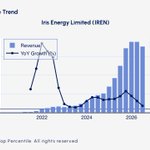
Trailing-12-month revenue has slipped from $757M to $707M. Behind that decline, AI Cloud revenue more than doubled QoQ to $70.5M, while Bitcoin mining continued to shrink.
WHAT HAPPENED AT LAST EARNINGS
◆ IREN reported $4B in contracted AI Cloud annualised run-rate revenue for 2026 capacity, but only $1B was operating. Microsoft accepted the first Horizon facility, with three more targeted for Q4.
WHAT HAPPENED LATELY
◆ New satellite analysis raised concerns about whether Horizon 4 will meet its year-end delivery target. A delay has not been confirmed.
WHAT MATTERS THIS EARNINGS
◆ Whether contracted AI Cloud capacity is becoming operational and translating into reported revenue.
◆ Progress on Microsoft’s remaining Horizon facilities, and the financing needed to sustain IREN’s expansion.

IREN $IREN reports earnings after markets close. AI Cloud contracts are growing fast, but reported revenue has been falling as it shifts away from Bitcoin mining.
Stock: down 43% YTD | down 48% over 1 month | down 10.4% at last earnings
Trailing-12-month revenue has slipped from $757M to $707M. Behind that decline, AI Cloud revenue more than doubled QoQ to $70.5M, while Bitcoin mining continued to shrink.
WHAT HAPPENED AT LAST EARNINGS
◆ IREN reported $4B in contracted AI Cloud annualised run-rate revenue for 2026 capacity, but only $1B was operating. Microsoft accepted the first Horizon facility, with three more targeted for Q4.
WHAT HAPPENED LATELY
◆ New satellite analysis raised concerns about whether Horizon 4 will meet its year-end delivery target. A delay has not been confirmed.
WHAT MATTERS THIS EARNINGS
◆ Whether contracted AI Cloud capacity is becoming operational and translating into reported revenue.
◆ Progress on Microsoft’s remaining Horizon facilities, and the financing needed to sustain IREN’s expansion.
“What we’re now starting to see is what was one great business is turning into two great businesses.”
René Haas, $ARM earnings call
KEY TAKEAWAYS FROM THE CALL
◆ AGI CPU orders strengthen. Multiple customers beyond Meta have placed orders, supporting up to $2B in revenue across FY27–28. Commercial shipments are expected in fiscal Q4.
◆ A very different margin profile. First-generation AGI CPU gross margins are expected around 30–40%, versus Arm’s current ~98% non-GAAP gross margin. Management targets 50%+ in later generations.
◆ Data-centre momentum continues. Royalties doubled YoY. Arm-based servers exceeded 50% share at leading hyperscalers in 2025; Arm expects over 60% by end-2026.
◆ Licensing strength needs context. Revenue rose 50%, helped by unexpectedly strong contract signings. Annualised contract value grew 12%; new designs should generate royalties over the next 12–24 months.
◆ Smartphones remain a drag. Physical AI royalties rose 50%, but memory-driven smartphone weakness limits total royalty growth to low single digits YoY in fiscal Q3.
WHAT ANALYSTS ASKED
Gary Mobley, StoneX
Q: How firm is the $2B AGI CPU outlook, and is Meta the only major buyer?
A: Meta is the lead customer, but multiple others have placed orders. Confidence in supply has improved across wafers, memory and packaging.
Sebastien Naji, William Blair
Q: Can Arm AGI CPU compete with AMD’s latest server chips?
A: The reported 2x rack-performance test compared Arm against the earlier EPYC 9755, not AMD’s new Venice. Haas emphasised efficiency and custom-design flexibility.
Krish Sankar, TD Cowen
Q: What drives AGI CPU growth beyond the first generation?
A: Higher core counts and some pricing uplift. Supermicro, Lenovo and ASRock Rack are building racks; Arm gave no specific enterprise forecast.
Mehdi Hosseini, Susquehanna
Q: When does AGI CPU revenue begin?
A: Mainly fiscal Q4 2027. Any contribution in Q3 should be small.
Simon Leopold, Raymond James
Q: How concentrated are data-centre royalties?
A: Amazon, Google, Microsoft and Nvidia account for the majority. No exact concentration figure was disclosed.
Harlan Sur, J.P. Morgan
Q: When is the next AGI CPU, and will Arm add networking and I/O?
A: Typical product cycles run 18–24 months. Arm is exploring broader system capabilities but announced no schedule or product.
Lee Simpson, Morgan Stanley
Q: Is $773M a sustainable quarterly licensing run rate?
A: Management would not commit to that. Large deals shift between quarters, although the licensing pipeline remains strong.
Vivek Arya, Bank of America
Q: Can Arm secure enough capacity against established rivals like AMD?
A: Supply is tight, but Arm has longstanding ties with TSMC and memory suppliers and is planning capacity over several years.
Joseph Quatrochi, Wells Fargo
Q: Can Arm protect AGI CPU margins against higher supply costs?
A: Management sees some pricing flexibility. First-generation margins should be 30–40%, with 50%+ targeted in future generations.
Other questions covered royalty rates, which depend heavily on chip mix; data centres, which are moving towards a third of royalties without a firm date; and smartphones, where Arm expects CSS adoption to lift royalties despite broadly flat handset shipments.
REMAINING QUESTION
◆ Can AGI CPU shipments deliver the promised growth without significantly diluting Arm’s exceptional margins?
Arm Holdings $ARM is down around 4% despite beating revenue and earnings expectations. Strong licensing revenue drove the beat, while royalties disappointed.
HEADLINE PRINT
🟢 Revenue: $1.44B vs $1.38B expected
🟢 Adj. EPS: $0.52 vs $0.47 expected
WHAT CHANGED
🔴 Royalty revenue: $670M vs $712M expected (+8% YoY)
🟢 License & other revenue: $773M vs $661M expected (+50% YoY)
🟡 Q3 revenue guidance: ~$1.54B vs $1.53B expected
WHY THIS EARNINGS MATTERS
◆ Licensing drove the revenue beat, but royalties grew just 8% despite data-centre royalties doubling. Smartphone weakness weighed on growth, while the timing of large licensing agreements helped the quarter.
Arm’s AGI CPU business is progressing, with purchase orders from multiple customers and first commercial deliveries expected in fiscal Q4 2027. Confidence in its potential $2B revenue opportunity across FY2027–28 has increased.
REMAINING QUESTION
◆ Can data-centre royalty growth offset smartphone weakness while AGI CPU orders translate into meaningful revenue?

Arm Holdings $ARM is down around 4% despite beating revenue and earnings expectations. Strong licensing revenue drove the beat, while royalties disappointed.
HEADLINE PRINT
🟢 Revenue: $1.44B vs $1.38B expected
🟢 Adj. EPS: $0.52 vs $0.47 expected
WHAT CHANGED
🔴 Royalty revenue: $670M vs $712M expected (+8% YoY)
🟢 License & other revenue: $773M vs $661M expected (+50% YoY)
🟡 Q3 revenue guidance: ~$1.54B vs $1.53B expected
WHY THIS EARNINGS MATTERS
◆ Licensing drove the revenue beat, but royalties grew just 8% despite data-centre royalties doubling. Smartphone weakness weighed on growth, while the timing of large licensing agreements helped the quarter.
Arm’s AGI CPU business is progressing, with purchase orders from multiple customers and first commercial deliveries expected in fiscal Q4 2027. Confidence in its potential $2B revenue opportunity across FY2027–28 has increased.
REMAINING QUESTION
◆ Can data-centre royalty growth offset smartphone weakness while AGI CPU orders translate into meaningful revenue?
Arm Holdings $ARM reports earnings tonight. For decades, it has made money licensing chip designs. Now it’s entering the market for finished AI data-centre CPUs.
Stock: up 85% YTD | down 34% over 1 month | down 1.3% at last earnings
Arm ranks in the top 1% for Business Excellence across the market. Its move into selling its own CPUs opens a major growth opportunity, but also brings new costs and execution risks.
WHAT HAPPENED AT LAST EARNINGS
◆ Data-centre royalties more than doubled YoY. AGI CPU customer demand exceeded $2B across FY2027–28, with capacity secured for the first $1B. Initial products have reached customers, but the $2B is not recognised revenue.
WHAT HAPPENED LATELY
◆ An October jury found Arm breached its Qualcomm licensing agreement, awarding just $2 in damages. A judge must still decide whether Qualcomm can suspend royalty payments.
WHAT MATTERS THIS EARNINGS
◆ Evidence that AGI CPU demand is moving towards volume shipments and meaningful revenue.
◆ Whether data-centre royalties can maintain their momentum, and how management addresses the Qualcomm risk.
