

Via Galactica
M31
Joined November 2023
- Tweets12.7K
- Following0
- Followers709
- Likes31.4K





Entropy harvested from microsecond hesitations, BIKE keys now grow only inside the exact processor that dreamed them. Processors generate cryptographic keys from their own fleeting metabolic pulse – CPU load spikes, thermal telemetry, and memory latency jitter - turning ordinary silicon into a software-only physical unclonable function that binds post-quantum BIKE seeds against prediction. Abd-Elkareem, Selim & Shalaby sample three runtime traits 416 times each • utilization percentages, Thermal Design Power estimates, and microsecond memory accesses • thresholded into binary plus a 32-bit CPUID XOR, yielding a 1,280-bit raw vector.
A block-wise BCH fuzzy extractor corrects thermal and workload noise into a stable 128-bit seed (via SHA-256 of a 256-bit root) that drives BIKE’s two sparse weight-142 polynomials over the 12,323-dimension ring. Randomness suites (NIST SP 800-22, DIEHARD, TestU01) pass with min-entropy ≥0.997; inter-device normalized Hamming distance averages 53.56%; TVLA side-channel t-statistics stay well below leakage thresholds. Entropy gathering consumes 99.67% of init latency; polynomial generation is nearly free.
A silicon organism whose heartbeat is the seed: every workload fluctuation becomes irreproducible entropy that never sits in memory as a static secret. As quantum computers threaten classical public-key schemes, BIKE (NIST Round 4 code-based candidate relying on quasi-cyclic moderate-density parity-check syndrome decoding) gains a commodity-hardware leash, no custom PUF circuits required.
The same processors once blamed for side-channel leakage now supply the defense, though the method resists only software-observable threats, not microprobing or full electromagnetic attacks (a concurrent piece already shows neural nets extracting BIKE secrets from power traces).
Post-quantum key generation may shift from “trust the RNG” to “trust the physics of this exact chip under this exact load,” complicating cloning while raising questions about portability and long-term reproducibility across firmware updates.

1
39
Enhancing BIKE with physical unclonable functions for post-quantum cryptography link.springer.com/article/10…

13
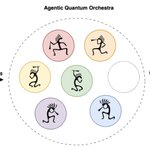
Qubits Learn the Blues, Agents Grow Musical Souls Without Ever Hearing a Record • Quantum Circuits Jam Their Way to Personality. Eduardo Reck Miranda and Moein Fahmideh Vatandoost at the University of Plymouth’s Interdisciplinary Centre for Computer Music Research have built an agentic orchestra: virtual musical partners implemented as parameterized quantum circuits and trained by quantum reinforcement learning. Qubits with attitude.
Instead of devouring vast corpora of existing music and regurgitating styles, each agent evolves its own mindset – a learned disposition toward particular behaviors such as rhythmic variety, melodic balance, or textural smoothness – through pure trial-and-error interaction with a musical environment. A dim stage where neon waveforms pulse like living score-lines, each agent a solitary qubit ensemble probing superposition: countless parallel musical futures collapsing on measurement into one decisive note or duration.
Two complementary architectures shape the outcome. Atomistic agents handle pitch and rhythm as separate streams (six qubits for a 64-element pitch alphabet, three for durations); holistic agents treat each note as a single pitch-plus-duration event. Musically interpretable rewards • diversity (unique elements over total), perfect balance (even temporal spacing), smoothness (reduced distributional jumps) • can be weighted and summed so different agents in the same ensemble develop distinct personalities.
Experiments confirm the approach works on today’s noisy intermediate-scale quantum hardware. On IBM devices the agents learn, generalize to unseen MIDI material, and operate in both interactive (real-time with humans) and batch modes. One control comparison showed a trained agent reaching a mean best-so-far composite reward of roughly 0.63 versus 0.41 for random actions and 0.38 for a frozen circuit. The researchers position this as the first application of quantum reinforcement learning to computer-aided music composition and performance; agents as adaptive instruments or collaborators rather than autonomous composers.


1
61
Beyond Corpus-Driven Imitation: Evolving Musical Mindsets in the Agentic Orchestra via Quantum Reinforcement Learning semanticscholar.org/paper/Be…
Machines famous for optimizing logistics now bumble their way toward aesthetic goals the way a novice drummer discovers groove by feeling the consequences of each hit. As quantum hardware scales, the same hybrid loop could let human ensembles jam live with cloud-based agents whose personalities continue evolving mid-performance, turning the orchestra pit into a shared Hilbert space.


1
32
Alien Calculus Cracks the Strong-Coupling Cipher :: One Fredholm Determinant Maps Two Universes. Tilted Realities Unite, The O(6) Mass Gap and the Cusp Anomaly Were Always the Same Equation. Physicists enacted an exact, all-orders bridge between two of AdS/CFT’s most stubborn strong-coupling observables: the dynamically generated mass gap of the O(6) sigma model and the cusp anomalous dimension of planar N=4 supersymmetric Yang-Mills. We didn’t solve the strong-coupling problem; we discovered it was already solved on the other side of the tilt.
At infinite coupling, power-series expansions fail and non-perturbative exponential corrections (trans-series) dominate. Boldis and le Plat introduce one-parameter tilted deformations, the tilted cusp and tilted mass gap, that separate these hidden scales. Both admit elegant representations as Fredholm determinants of matrix Bessel kernels. From this common skeleton they build an Alien calculus: a systematic operator generating every non-perturbative sector from perturbative data. The result is a closed all-orders identity mapping the entire strong-coupling trans-series of the O(6) mass gap onto that of the cusp anomalous dimension, proving and extending earlier resurgence conjectures.
A true all-orders relation across every non-perturbative sector, not a weak-coupling or leading-order result. The strong-coupling regime is a dense jungle of instanton and anti-instanton thickets that ordinary perturbation theory cannot penetrate. Tilted deformations act like seismic charges separating canopy layers; Alien calculus is the decoder ring reading the entire forest from the trunks alone. The most non-perturbative objects in the dual pair prove algebraically identical once the right deformation is dialed.
A universal strong-coupling dictionary may now be within reach for other AdS/CFT observables sharing Fredholm or determinant representations. From Bessel kernels to alien calculus: the strong-coupling veil lifts, one exact relation at a time.

1
1
59
From Fredholm determinants to AdS/CFT observables: a universal strong-coupling framework link.springer.com/article/10…

23
Voltage Rips the Arrow of Time, Magnets Stay Home. Temporary time-reversal, permanent insight. Extreme voltage alone can temporarily create a magnetic-style Hall effect in exotic quantum materials, no magnets required, by driving electrons into a fleeting nonequilibrium state that mimics broken time-reversal symmetry. In the classical Hall effect, a magnetic field breaks symmetry between past and future electron paths, deflecting current sideways. Quantum anomalous versions achieve the same via internal magnetism.
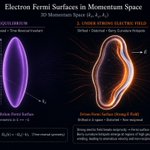
Rice theorists describe a fully nonequilibrium variant in a strongly correlated topological semimetal: weak voltage produces a nonlinear sideways response (current scales with voltage squared, symmetry intact); beyond a material-specific threshold, the current becomes linear – exactly as if time-reversal were broken – yet the effect vanishes the moment voltage drops. Electrons briefly acquire extra momentum; their Fermi surfaces (momentum-space contours of the most responsive states) stretch and distort under the strong electric field until equilibrium returns.
A river calm under gentle flow that, under a sudden flood, briefly carves magnetic-looking bends before snapping back to symmetric flow. Or electrons on a quantum trampoline: soft jumps preserve the arrow of time’s illusion; hard ones stage a reversible heist of that symmetry. The finding explains puzzling Hall data from Technical University of Vienna experiments on these materials and validates the correlated topological semimetal state itself.
It shows nonequilibrium driving can illuminate equilibrium topology; Berry curvature multipoles beyond the usual dipole contribute once the field pushes the electron distribution past curvature hotspots. A companion nonperturbative Green’s-function treatment further maps the strong-field crossover. Nonequilibrium becomes a reversible probe rather than a complication.


1
68
No magnets needed: Extreme voltage drives completely new kind of Hall effect news.rice.edu/news/2026/no-m…

1
1
32


Instantons Rewrite Expansion • Strong Force Topology Pushes Galaxies Without New Particles. The force binding the nucleus may unbind the cosmos. QCD vacuum topology may drive cosmic acceleration, no new particles required. The strong nuclear force binding quarks in protons and neutrons could generate the ~70% energy density expanding the universe via a global vacuum response to spacetime stretch. The model matches supernova, CMB, and DESI data at least as well as ΛCDM while yielding the observed dark-energy scale from known constants.
The quantum vacuum acts as topological foam of gluon fields and instantons; never empty, usually canceling to near-zero energy. In expanding space, tunneling between vacuum sectors creates residual energy density scaling with the Hubble rate, activating late and producing phantom-crossing behavior near redshift z ~ 0.67 without new scalar instabilities. Empty space breathes under stretch, yielding gentle repulsion from the physics holding nuclei together.
“The characteristic energy scale from the QCD vacuum and gravity matches the observed dark-energy scale today without an ad-hoc field or parameter,” notes UBC’s Ariel Zhitnitsky. Ludovic Van Waerbeke adds that it emerges from known constants alone. Lead author Dong Ha Lee (Sheffield) notes it reproduces DESI’s preferred late-time evolution while linking dark energy to the Standard Model’s strong force.
Timely amid DESI hints of evolving dark energy and Hubble tension. Bayesian evidence mildly favors the QCD model over ΛCDM, offering an economical origin without fine-tuning the cosmological constant. It resembles nuclear glue’s vacuum memory of topological sectors generating cosmic rubber-band tension dominant as expansion dilutes matter.
Next-generation telescopes can probe the expansion history and topological signatures; tabletop Casimir-like experiments might test related vacuum responses. Standard physics can explain acceleration, though QCD response refinement remains needed. Galaxies recede under the quiet topological exhalation of the gluon vacuum that formed the first protons.


1
1
48
Could standard physics explain the mysterious energy driving the Universe apart? news.ubc.ca/2026/11/could-st…


1
1
23


Tetrahedral Entanglement Weaves the Holographic Veil | LQG Spin Networks Birth Perfect Codes Beyond the Event Horizon. Quantum tetrahedra in Loop Quantum Gravity (LQG) weave into holographic tensor networks on hyperbolic tessellations, yielding perfect-tensor codes, a discrete Ryu-Takayanagi entropy, and a postselection model for black-hole Page curves. Preprint starts from four-valent intertwiners and SU(2)-holonomy-dressed Bell states gluing quantum tetrahedra.
For the {5,4} tessellation, six tetrahedra form one effective cell with five network legs plus a logical index. When the microscopic transfer map has full row rank, a right inverse plus kernel completion produces an isometric embedding proportional to a perfect tensor (Absolutely Maximally Entangled when local dimensions allow). The construction generalizes to the family (p=2^n-1).
On finite, radially oriented networks, a normalized bulk-to-boundary map is isometric. For cuts isometric on both sides, the boundary entropy splits as S(A)=∑_ℓ log(2j_ℓ+1)+S_bulk, a discrete quantum Ryu-Takayanagi formula whose link term tracks the LQG area spectrum. Black-hole interiors encode non-isometrically via postselection; under additional Haar statistics, overlaps preserve on average and competing entropy branches reproduce Page-curve behavior.
The link between LQG geometric degrees of freedom and holographic codes is constructive yet conditional: full-rank transfer maps, admissible radial orientation, and controlled spin sectors are required before the discrete area, the quantum extremal surface, and evaporation dynamics fully align. A fresh theoretical bridge, not a generic derivation of holography from arbitrary LQG states.


Holographic Tessellations Tensor Networks {p,q} from Entangled Quantum Tetrahedron in Loop Quantum Gravity scixplorer.org/abs/2026arXiv…


1
23
Local light-cone gravity cures Schrödinger-Newton’s relativistic sins. Gravity reads quantum states without collapsing them, cloning via curvature. Past cones source, future cones collapse: causality restored in semiclassical spacetime. Gravity bends to local quantum shadows, not global wavefunctions: a causal gravitisation arrives. Classical Einstein equations are sourced only by the local reduced density matrix, updated solely by collapses inside the past light cone, plus a singular null-shell source on the future light cone of each measurement.
The result is a relativistically causal, generally covariant nonlinear extension of quantum theory in 1+3 dimensions that recovers the Schrödinger-Newton equation in the nonrelativistic limit as its causal completion. Naive Møller-Rosenfeld semiclassical gravity (full global-state expectation value sourcing curvature) has long faced charges of superluminal signaling, inconsistency, and foliation dependence.
This version tames those pathologies by restricting the source to past-light-cone data and confining collapse updates to the future light cone. In the weak-field limit the metric is built from retarded Green functions, so gravitational backreaction stays causal. Discontinuities in the stress-energy expectation value across measurement events remain consistent with distributional solutions via Barrabès-Israel null shells; the metric stays continuous while curvature jumps.
Nonlinearities open an unusual door: effective readout devices can approximately extract a quantum state’s Born probabilities by measuring its classical gravitational field (Cavendish-style) without collapsing or disturbing the state. Approximate cloning becomes possible. The theory violates the quantum no-signaling principle yet still forbids superluminal signaling. The classical gravitational field is generally not Bell-local once spacelike-separated entangled measurements are allowed. Proper and improper mixtures source different geometries, violating the mixture equivalence principle.
Tabletop tests against low-energy quantum gravity are sketched: gravitational-information-entanglement setups (superposed mesoscopic masses), synchronized inertial labs hunting mixture-equivalence violations, and near-collapse probes of stress-energy jumps. Open questions remain on an action principle, black-hole information, and full quantum-field-theory extensions.
A theory that lets gravity quietly photocopy quantum information while forbidding faster-than-light telegrams. The geometry stays classical; quantum matter remains nonlinear and nonlocal in its gravitational imprint. Precise enough to be falsified by existing or near-term optomechanics and matter-wave experiments.


Kähler Density–Phase Manifold Recovers Schrödinger Without the Fairy Tales. Quantum mechanics drops its two infinite myths – point particles and instantaneous collapse – by using a density–phase picture with a hard information-capacity limit. It treats an objective density ρ and compact phase Φ as basic. Finite Fisher information blocks exact localization at finite energy; quantized vortices and nodal matching answer Wallstrom’s objection.
The closed system recovers Schrödinger dynamics, spectra, and uncertainty via a weak Kähler structure. Continuous monitoring stays well-posed under a Nyquist–Planck ceiling ΔE_int/ℏ (from Bohr bandwidth with sampling K ≤ 1/4), yielding Born weights, Lindblad evolution, and no-signaling. Circuit-QED diagnostics can falsify the capacity bound.

1
1
36
A Density–Phase Formulation of Quantum Mechanics with an Information-Capacity Hypothesis preprints.org/manuscript/202…

1
17
Galactic Bar’s Shockwave Nursery Rewrites the Milky Way Map. The Milky Way’s supposed Norma spiral arm may not be an arm at all. It is likely a luminous shock front of newborn stars formed by the Galaxy’s central bar – a long, slowly rotating stellar ellipsoid that rakes through gas clouds, compressing them into stellar nurseries. Study matches sophisticated N-body hydrodynamic simulations of galactic evolution to microwave masers, natural lasers marking birth sites of massive young stars.
Those masers, previously assigned to the Norma arm, track the predicted leading-edge dust lane and shock of a bar roughly 4.3 kpc (about 14,000 light-years) long, tilted near 20 degrees, and rotating at under ~40 km/s/kpc. In most nearby barred galaxies such shocks suppress star formation; here they ignite it. An arm named for a southern constellation may simply be the bar’s dusty, star-forming wake.
From an interdimensional overlook the bar turns like a luminous scythe, its gravitational plowshare cutting a glowing furrow across the inner disk. Gas piles and ignites along the blade rather than classic density-wave spiral arms, the cosmic equivalent of a traffic bottleneck spontaneously birthing an entire neighborhood instead of mere gridlock. The finding constrains a decades-long debate on bar length, angle, and speed while suggesting the Milky Way hosts fewer true major spiral arms than textbook maps show.
It is uncommon but not unique; a few other galaxies show similar bar-shock star birth. The discovery genuinely challenges inner structure and star-formation geography, grounded in simulation-observation match.


1
1
62
The nature of the Norma arm as a bar-driven star-forming shock front nature.com/articles/s41550-0…


1
27