
God first || All things Web, Certified Human Resources Personal
Joined November 2023
- Tweets13.3K
- Following372
- Followers483
- Likes10.1K




Pinned Tweet
DAC is built around the idea of creating a trusted digital ecosystem where assets, data, and business operations can work securely and transparently.
It represents more than technology
it represents a community working together to build better digital tools.
The blue DAC symbol represents trust, connectivity, innovation, and forward movement.
Dac emphasizes that technology is ultimately created for people and powered by people.
DAC is for the community.
DAC is for builders.
DAC is for the future.
Gdac always

The world of Phäros feels like a mysterious universe waiting to be explored.
A world filled with ancient civilizations, five unique tribes, hidden secrets, powerful stories, and unexplored territories.
What excites me most about Project Phäros is the chance to discover its history, understand the different tribes, meet interesting characters, and uncover the mysteries behind this fascinating world.
I hope to find unexpected adventures, deeper connections, forgotten stories, and surprises along the way.
There's still so much to discover, and I'm excited to see where this journey leads.
The adventure into Phäros begins!
@projpharos


Why does DAC use different sources of randomness?
Because strong transaction encryption depends on unpredictable data.
DAC combines multiple sources of physical randomness to generate high-quality entropy for transaction protection.
This helps reduce dependence on a single source and makes encryption material harder to predict.
By using physical randomness, DAC adds another layer of protection to transaction confidentiality, helping keep sensitive information secure.
It's not just about encrypting transactions; it's about strengthening how that encryption is generated.
Better randomness. Stronger protection. A more secure future.
@dac_chain

I’m Akronis — The Sentinels.
I discovered my tribe in Earth 1088. Which one are you?
@projpharos #ProjectPharos tribe.projectpharos.xyz/shar…

DAC’s Encryption Challenge: Securely Delivering Key Material to Validators
One of the important challenges in DAC’s architecture is figuring out how encryption material can be securely delivered to validators without compromising network privacy.
Validators play a major role in processing and verifying transactions.
However, they need access to the right information to perform these duties without exposing sensitive encryption material to unauthorized parties.
This creates several important questions:
- How can encryption material reach the right validators securely?
- How can DAC prevent unauthorized access or exposure during distribution?
- How can validators verify transactions without weakening user privacy?
- How can the system manage key updates, validator changes, and network growth?
These challenges go beyond simply creating strong encryption.
They involve secure distribution, access control, coordination, and reliable verification.
For DAC, building a quantum-resistant blockchain also means ensuring that every part of the security process works together.
Protecting the data is important. Protecting how the security material is delivered is equally important.
This is one of the critical design challenges worth exploring as DAC moves toward a more secure digital future.

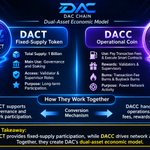
DACT vs DACC: Understanding DAC's Dual-Asset Model
1. DACT – Fixed-Supply Token
DACT has a fixed maximum supply of 1 billion tokens.
It focuses on long-term participation in the DAC ecosystem through governance, staking and validator or supervisor access.
Its fixed supply provides a predetermined token limit.
2. DACC – Operational Coin
DACC powers everyday activities on the DAC network.
It is used to pay transaction fees, execute smart contracts and reward validators and supervisors for maintaining the blockchain.
3. DACC Rewards and Burns
New DACC enters circulation through block rewards given to network participants.
Meanwhile, transaction-fee burns and periodic buyback-and-burn mechanisms remove DACC from circulation.
This creates a balance between new coin issuance and supply reduction.
4. How They Work Together
DACT supports governance and network participation, while DACC handles network operations and rewards.
DAC also provides a conversion mechanism connecting both assets.
DACT provides fixed-supply participation, while DACC drives network activity through fees, rewards and burns.
Together, they form DAC's dual-asset economic model.

One Transaction, One Fresh Address.
DAC’s Yellow Paper recommends using a fresh address for every transaction.
Why does this matter?
Reusing the same address can make it easier to connect different transactions and track activity over time.
By generating a new address for each transaction, DAC helps reduce address linkability and strengthen user privacy.
It’s another step toward making blockchain transactions more private and secure.
With DAC, privacy starts with the way transactions are designed.
@dac_chain $DACT

Joined

Before the first trade comes the first conversation.
Our Discord is now open: discord.gg/tickrofficial
Tick Zero is the highest role you can claim right now. Spots are limited.
Claim it, get your Tick Zero card, and share it on X.

10
What Happens When Quantum Computers Challenge Blockchain Security?
Today, blockchains rely on cryptographic systems like RSA and ECDSA to protect digital identities, wallets, and transactions.
Powerful, fault-tolerant quantum computers could use Shor’s algorithm to break these systems, putting traditional digital signatures at risk.
DAC approaches the problem differently.
Rather than relying only on replacing existing signature algorithms, DAC focuses on protecting transaction data before it travels across the network.
1. Physical Quantum Entropy
DAC uses physical randomness generated through the Barkhausen effect to produce entropy for its one-time-pad approach.
This helps conceal transaction information, including public keys, while transactions are in transit.
The idea is to reduce the information an attacker can observe and exploit, rather than relying solely on the mathematical difficulty of breaking a signature.
2. Proof of Quantum Work (PoQW)
DAC also introduces Proof of Quantum Work, a different approach to blockchain mining and block production designed as part of its broader quantum-security architecture.
🚀 Why This Matters
Quantum security is not just about protecting today's transactions. It is about preparing for a future where current cryptographic assumptions may no longer be safe.
DAC combines physical entropy, transaction confidentiality, and a different mining approach to build toward a more quantum-resilient blockchain.
The quantum threat is approaching. Building for it must start today.
🔗 dachain.tech
How DAC Is Preparing for the Quantum Era
Quantum computers could eventually weaken some of the cryptographic systems that protect today's blockchains.
DAC is developing a different approach to help address this future challenge.
The goal is to strengthen transaction protection, improve the use of randomness, and explore new ways to secure blockchain operations.
1. Lattice-Based Cryptography
Lattice-based cryptography relies on mathematical problems believed to be difficult for both traditional and quantum computers to solve. It is one of the leading approaches to post-quantum security.
However, DAC's published technical paper focuses on quantum entropy and transaction protection rather than presenting lattice-based signatures as its main security mechanism.
2. Quantum Entropy: Randomness from Nature
DAC's technical paper describes generating randomness using the Barkhausen effect, a physical phenomenon associated with changes in magnetic materials.
This approach aims to provide unpredictable values that can support cryptographic security.
By using physical randomness, DAC seeks to strengthen the protection of transaction information against potential future threats.
3. Entropy-Padded Transactions (EPT)
DAC proposes combining transaction data with physical randomness before broadcasting it across the network.
Think of it as adding a protective layer around information while it travels between computers.
The aim is to make transaction information harder for outside observers to analyse and reduce the exposure of sensitive cryptographic data.
Its effectiveness depends on secure implementation and proper management of the random values.
4. Proof of Quantum Work (PoQW)
DAC also proposes Proof of Quantum Work, a consensus approach designed around quantum annealing and optimisation problems.
Unlike traditional blockchain systems that rely on conventional hashing-based mining, this approach explores a different method of producing blocks.
While quantum entropy focuses on randomness and transaction protection, PoQW addresses how the network reaches consensus.
The Bigger Picture
DAC's quantum-security approach focuses on three main areas:
- Quantum Entropy: Using physical processes to generate unpredictable randomness.
- Entropy-Padded Transactions: Adding protection to transaction data during transmission.
- Proof of Quantum Work: Exploring an alternative approach to blockchain consensus.
Together, these mechanisms represent DAC's approach to preparing for the quantum era.
However, their real-world security depends on implementation, independent testing, and continued technical validation.
This is good news coming from the team
Summary of what was said
* The 24-month vesting schedule applies only to the Grant allocation, not the community airdrop.
* The community airdrop will be separate and will not be subject to the 24-month vesting.
* The team has not yet announced the official airdrop amounts or full distribution details.
* TGE (Token Generation Event) is coming soon.
* Ignore unofficial figures and check the project's official channels for accurate updates.
Main point: The community airdrop will not follow the 24-month vesting schedule, but the amount you will receive has not yet been confirmed.

Quantum Security Is a Challenge We Must Prepare for Today.
As Italy advances its quantum computing infrastructure with the launch of Volta B1, DAC is highlighting an important question: Are our blockchain networks ready for the future of quantum computing?
Quantum technology brings new opportunities, but it could also challenge the cryptographic systems protecting digital assets, transactions, and sensitive data.
Waiting until these threats become practical may be too late. Preparing today gives blockchain networks time to build stronger security for tomorrow.
DAC is developing a quantum-resistant Layer-1 blockchain using Proof of Quantum Work (PoQW) and quantum entropy, with the goal of making security a core part of its architecture.
The future of computing is advancing. Blockchain security must advance with it.
Build for today. Prepare for tomorrow. Build with DAC.
🔗 dachain.tech/

Bullish

The first-ever global digital cricket tournament is live.
Fans vs superstars.
Play the game, climb the leaderboard and earn your chance to challenge the legends.
Play now: powerplay.sixrcricket.com/ga…
20
Italy has taken another step into the quantum era with the launch of its first quantum supercomputer.
The Digital Innovation Forum in Cernobbio, Lake Como, marked the inauguration of the quantum supercomputer and Volta B1, an industrial quantum annealer developed under Q-Alliance's supervision.
The event also brought experts together to discuss quantum computing, HPC, supercomputers, and blockchain. DAC’s Head of Innovation, @davide___costa, joined the discussion, while the DAC team connected with industry leaders and technology experts.
DAC is building an EVM-compatible Layer-1 with quantum resistance at its core, using Proof of Quantum Work and quantum entropy to strengthen security and support predictable business costs.
As quantum technology advances, blockchain security must evolve too. Digital assets, transactions, and real-world applications need protection for the future.
DAC is building today for the security challenges of tomorrow.


Italy just switched on its first quantum supercomputer.
This week the Digital Innovation Forum in Cernobbio, on Lake Como, marked the inauguration of Italy's first Quantum Supercomputer and an industrial quantum annealer, Volta B1, built under the supervision of Q-Alliance.
Alongside it, a Forum panel covered quantum computing, HPC, supercomputers and blockchain. DAC's Head of Innovation, @davide___costa, joined speakers from academia, research and technology institutions, and the DAC team was on site speaking with industry leaders and experts.
DAC is an EVM-compatible Layer-1 built with quantum resistance as a core priority. It uses Proof of Quantum Work and quantum entropy, with a focus on long-term cryptographic resilience and predictable costs for businesses.
Every blockchain relies on cryptography to secure value, and quantum machines are moving from research labs into national infrastructure. The networks securing real assets need to prepare now.
That's the problem DAC is built to address.

Designing blockchain infrastructure for both current users and future digital systems is important because technology must solve today’s problems while remaining secure, reliable, and adaptable for tomorrow.
5 Key Reasons
1. Security for the future: Protects digital assets, identities, and transactions against evolving cyber threats.
2. Better user experience: Makes blockchain easier to use, with faster transactions, lower costs, and more reliable services.
3. Scalability: Ensures the network can support more users, businesses, and transactions as adoption grows.
4. Real-world adoption: Creates a foundation for applications such as digital identity, healthcare records, property ownership, and automated business processes.
5. Compatibility with future technology: Allows blockchain to connect with other networks, AI systems, and emerging digital tools.
Why does this matter for DAC Chain?
For DAC Chain, this approach means building infrastructure that serves people today while preparing for future challenges, including quantum computing and the growing demand for privacy and security.
The goal is not just to build a blockchain that works now, but one that can continue supporting real-world applications as technology evolves.

✅ Blockchain is evolving.
But is its security ready for the quantum era?
Quantum computing could eventually challenge some of the cryptographic methods that protect digital assets today.
For Web3, preparing for that possibility needs to start before it becomes an immediate threat.
Here are three areas that deserve attention:
1. The Future of Wallet Protection
Blockchain wallets depend on cryptographic signatures to authorize transactions.
A sufficiently powerful quantum computer could threaten certain signature schemes, making future-proof security an important priority.
2. Securing Real-World Blockchain Adoption
From digital identity to tokenized property and financial applications, real-world blockchain use requires infrastructure that can adapt as security standards evolve.
Long-term adoption depends on more than speed and scalability.
It also requires planning for emerging risks.
⏳ 3. Data Collected Today, Risks Faced Tomorrow
Some attackers may store encrypted information now in the hope of decrypting it with more advanced technology later.
This makes preparation for future cryptographic threats relevant even before quantum computers reach that level.
Quantum machines that can break widely used blockchain cryptography at scale are not available today. However, upgrading established systems takes planning, testing, and time.
That’s why DAC Chain’s approach is worth watching.
@dac_chain is bringing attention to Proof of Quantum Work (PoQW) as part of its broader focus on quantum-oriented blockchain infrastructure.
Rather than treating quantum computing as a distant problem, DAC puts the question of future security into the discussion today.
Its wider vision connects this focus with a blockchain ecosystem built around practical utility, verifiable transactions, and infrastructure designed to support real-world applications.
The challenge ahead is clear: blockchain cannot stand still while computing technology advances.
DAC Chain is working toward a future where blockchain innovation and quantum-era security are considered together not as separate conversations, but as part of the same long-term vision. 🚀
The next chapter of Web3 will reward those who prepare early, adapt intelligently, and build with the future in mind.
#DACChain #PoQW #QuantumComputing #BlockchainSecurity #Web3
WHEN TRUST IN DIGITAL SYSTEMS BREAKS, EVERYTHING IS AT RISK.
Assets become difficult to verify.
Contracts lose reliability.
Digital identities face growing threats.
Business operations become vulnerable.
DAC is building a stronger foundation.
🔹 Verifiable digital records
🔹 Tokenization of real-world assets
🔹 Protected digital identity
🔹 Automated business processes
🔹 Privacy-focused infrastructure
This is more than putting businesses on a blockchain.
It’s about creating infrastructure that helps enterprises manage valuable assets, protect critical information, and power real-world operations with greater confidence.
As digital adoption grows, trust must be built into the systems behind it.
DAC isn’t just building for today’s challenges. It’s preparing for tomorrow’s demands.
Security starts at the foundation.
That’s DAC.
#DAC #Blockchain #Cybersecurity #Web3
What happens when enterprises can’t fully trust the systems managing their most valuable assets?
Assets become harder to track.
Contracts become vulnerable.
Identity can be compromised.
Workflows become exposed.
DAC is built to change that.
Verifiable records.
Tokenized real-world assets.
Secure digital identity.
Automated workflows.
Privacy-focused infrastructure.
Not blockchain for the sake of blockchain.
Infrastructure designed for enterprises that need security, reliability, and real-world utility at scale.
Because when the stakes are high, security isn’t a feature.
It’s the foundation.
That’s DAC. #DAC
