

Free thinker. Open mind.
Africa
Joined December 2011
- Tweets43.4K
- Following1.4K
- Followers1.5K
- Likes80.4K




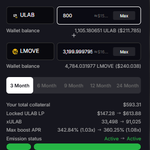
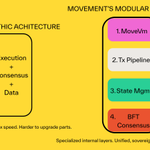


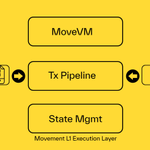
They say comparison is a thief of joy. If you compare yourself to others, you will never be happy.
If you aren’t satisfied, you can push yourself but you can’t do negative self-talk.
19
Is that @movement_xyz ? 👀

Fastest Block Time Leaders (Avg Block Time) ~ @tokenterminal
▫️ @Aptos — 58ms
▫️ @BNBCHAIN — 250ms
▫️ @arbitrum — 250ms
▫️ @movement_xyz — 296ms
▫️ @solana — 396ms
▫️ @SeiNetwork — 518ms
▫️ @NEARProtocol — 604ms
▫️ @injective — 620ms
▫️ @dYdX — 632ms
▫️ @flow_blockchain — 802ms

The real deal is that computers are becoming partners, not just tools. It is like moving from giving strict instructions to working with a smart teammate.
For students (and honestly, all of us), this changes what we need to learn. It is not just about coding anymore (though that is still important!). It is about learning how to guide, manage, and make ethical choices for these smart systems.
Problem-solving, logic and design skills are still key. But now, we will use them to build and work alongside AI. It is just like learning to collaborate with a super-fast, super-smart partner on projects.
The biggest challenge for our generation will be building tech right. How do we make sure it is safe, fair, and actually helps people? That is the real assignment for the next 10 years.
It is an exciting time to be learning.
1
4
156
Movement is sovereign. It's not an L1, It's an M1.
- speed: 10k+ TPS (high performance)
- secure by design
- dedicated validator set
- community first native $MOVE staking
- no staking of locked tokens
- move 2.0
- the people's chain


M1 is live! The future of The Movement begins now.
For the first time ever, a Move-based blockchain has migrated from an L2 to an L1.
The new Movement layer one, known as "M1", liberates the network from reliance on slow and centralized services from other chains and provides a sovereign stack with lightning-fast speed, decentralized validators, and big new Move features.
Key Upgrades:
- High performance: 500 L2 TPS ➡️ 10,000+ L1 TPS
- A dedicated validator set: true decentralized consensus
- Native $MOVE staking: earn yield while helping to secure the network
- Community-first staking: team and investors cannot stake locked tokens
- Move 2.0: major smart contract language update for next-gen apps
M1 is the dawning of a new era.
Join the People's Chain. Join The Movement.
2
7
252
Road to M1: Join the Meridian $MS TGE Quest on Movement's New L1
@meridian_money @movement_xyz @moveindustries $MS $MOVE #DeFi
Movement’s plan to transition to a sovereign L1 is no longer news. Meridian, one of the premier DEXs and Central Liquidity Hubs on Movement and a chartered member of the Move Alliance, is also preparing for its Meridian Strategies ($MS) Token Generation Event (TGE) to launch on this much-anticipated Movement sovereign L1.
This timed $MS TGE alongside Movement’s L1 transition is so significant that it has called for the inclusion of the Movement community and everyone through a series of activities and quests on the Movement Parthenon website.
Meridian currently offers the following DeFi services: swaps, liquidity pools (stable, weighted, etc.), and staking with high APR.
Concentrated liquidity pools, Meridian LST, and a new user interface (UI) are planned for its V2 launch, in tandem with the $MS TGE.
Road to M1 Mainnet
This campaign has just launched on the Movement Parthenon V2 platform:
parthenon.movementlabs.xyz/q…
This is the ultimate quest campaign leading up to the Movement L1 launch and $MS TGE.
It will position you comfortably for rewards from both Movement and Meridian. It is also a great opportunity to explore one of Movement’s leading DeFi infrastructure projects.
You can earn XP and Discord roles by simply onboarding, trading, and providing liquidity on Meridian. There are 13 quests in total, with 5000 XP available by hitting trading volume targets and liquidity milestones.
The more XP you earn, the greater your $MS allocation.
For all details about this campaign, check out this post👇🏿
nitter.gq/meridian_money/status/…
It’s getting worse by the day. What sovereign nation hands over its tax data to another? France, of all countries. This is draining. This is the lowest low. It’s embarrassing. I condemn this completely.

Nigeria-France Strengthen Tax Cooperation Through New MoU.
The Federal Inland Revenue Service (FIRS) and France’s Direction Générale des Finances Publiques (DGFIP) signed a landmark Memorandum of Understanding to strengthen bilateral cooperation and advance the digital transformation of Nigeria’s revenue administration. The partnership focuses on compliance management, taxpayer services, data-driven enforcement, and the exchange of innovative ideas to build resilient and forward-looking tax systems.
Both institutions also committed to workforce development, aiming to strengthen human capital, build professional standards, and develop globally competent teams for the future of public finance administration. The MoU further expands cooperation in international taxation, including information exchange, transfer pricing, and Base Erosion and Profit Shifting (BEPS), enhancing transparency and efficiency for both countries.
@asovilladigital

64
Minted!

The Movevent Diamond Heads NFT mint is now LIVE! 💎🔥
The wait is over, it’s time to mint!
Mint here 👇
🔗 asspad.gorilla-moverz.xyz/mi…
Secure your Diamond Head and be part of the Movevent journey. 🚀
Let’s see how fast they go.



Just finished testing the new @LayerBankFi $ULAB and xULAB mechanics on @moveindustries testnet.
Here’s my detailed review on the incentives, UX, and how this can supercharge Movement as a DeFi hub. #DeFi 🧵
- Protocol: LayerBank on Movement Testnet
- Focus: ULAB liquidity incentives & xULAB locking mechanics
- Overall Verdict: A powerful flywheel for deep liquidity. Core mechanics are solid.
- Key Achievement: Successfully tested the full lifecycle: supply → LP creation → lock (xULAB) → claim/vest → compound.
- Main Concern: The Borrow flow is a game-changer for capital efficiency but needs clearer guidance.
This quoted post is unavailable.
Step-by-Step Findings & Analysis
Step 1: Requesting Testnet Tokens
The "Request Coins" interface worked flawlessly. All three tokens (MOVE, LMOVE, ULAB) arrived instantly. No initial gas or token balance was required to claim test tokens - a great start for testers.
Step 2: Supplying Assets
Supplying LMOVE and ULAB was straightforward and intuitive. The market UI was clear.
Architecting Speed: A Deep Dive into the Imminent Movement L1 Execution Layer
@moveindustries $MOVE
For years, the blockchain world has been gripped by the Scalability Trilemma. This is the daunting challenge of achieving decentralization, security, and scalability simultaneously. Many networks compromise on one to excel at the others.
As the demand for faster, cheaper, and more complex applications grows, the focus has sharpened on a blockchain's core engine: the Execution Layer. This is where the battle for performance is truly won or lost.
The execution layer is the dynamic core of a blockchain. It's where smart contracts run, transactions are processed, and the network's global state is updated. Without it, a blockchain would be little more than a static ledger. Such a ledger might record ownership, but it could never power the programmable applications we rely on today, from DeFi to NFTs.

To understand how a modern chain tackles the trilemma, we can examine Movement L1. Its execution layer isn't a monolith; it's a finely tuned system of specialized components working in concert.
Think of a blockchain as a global computer. The execution layer is its processor, and Movement’s design is a masterclass in engineering a high-performance one.

Recap: The Movement Townhall with Layerbank-$ULAB TGE & Everything You Need to Know
TL;DR
$ULAB TGE details & tokenomics are coming very soon.
Testnet is LIVE: Try the staking flow now for future rewards & a special role.
99X Lpoint Boost for Movement users active on Layerbank mainnet-major airdrop weight.
Goal: Unify multichain liquidity, starting with Movement, focusing on RWA integration.
1. Introduction & Participants
Hosted by The Movement (@moveindustries), co-hosted by Merq (@mer_q_tio), with Sharon (@0xsharonny), Business Director & Core Member @LayerBankFi.
The focus was on Layerbank's upcoming $ULAB Token Generation Event (TGE) on the Movement Network, timed with Movement's imminent sovereign L1 launch and native $MOVE staking.
2. What is Layerbank?
Merq asked: "What is Layerbank? What makes it different?"
Sharon explained: "We are a multichain protocol... Our basic function allows you to deposit assets into our yield and then borrow assets to unlock liquidity...
We are currently live on 14 different chains across EVM, MOVE, and BTC ecosystems with access to 150 different markets...
Our goal overall is to make DeFi feel simple, safe, and profitable for users at any experience level."
3. Why Launch $ULAB on Movement?
Merq asked: "What attracted you to build your token launch on us?"
Sharon responded: "Movement already has a very strong DeFi foundation... We are excited about the focus on RWAs... We would like to collaborate with the team to onboard RWA assets and provide 1-click looping...
With our cross-chain liquidity infrastructure, our goal is to eventually connect Movement to deep liquidity pools across multiple chains."
4. The $ULAB Token & Its Flywheel
Sharon on $ULAB's utility: "$ULAB is the governance token... We are going to be enabling $ULAB/$MOVE pair staking... When you stake, you are compounding rewards... $XULAB (staked $ULAB) is designed to be flexible across multiple chains...
As the value of $ULAB grows, stakers earn higher APRs which creates a flywheel that naturally attracts more liquidity, increases TVL, activates buybacks, and increases the token's value."
What is the problem that existed that led to the creation of blockchain?
We have transacted with one another since the beginning of time. But as populations grew, transactions became complex, and we needed a trusted middleman or third party to govern and mediate for us. These are banks, lawyers, governments, etc.
Unfortunately, these middlemen often acted not necessarily in our interest. Yet, civilization has grown to the point that we cannot do without them.
What is the solution?
The solution comes with the invention of the blockchain, which takes out the middlemen.
We don't need to have a bank account; with a wallet, we can transact with our fellow man peer-to-peer.
We don't necessarily need a lawyer; we can have a smart contract coded into the blockchain that executes when certain actions take place, as agreed by the parties involved.
We can have decentralized autonomous organizations (DAOs) where anyone can take part in governance and decision-making processes.
But the technology has one problem: it cannot scale. How can we then have mass adoption?
This introduces the Blockchain Trilemma:
Decentralization.
Security.
Scalability.
We want a decentralized network governed by no one that needs no third party, but the problem is that it cannot scale.
If security is a constant, decentralization may be sacrificed for scalability, or scalability for decentralization.
How then have we tried to solve these problems? This leads us to the layers of blockchain. We have:
Layer 0: This is the foundational infrastructure. Think of the optical fiber cables, the hardware, and the internet itself. The ingenuity of humankind is the major contributor to this layer.
Layer 1: This is the underlying main blockchain architecture. It's the primary network that validates and finalizes transactions without needing to rely on another chain. It has its own native cryptocurrency and provides its own security.
Layer 2: A Layer 2 blockchain depends on a Layer 1 to solve part of the trilemma, while it focuses on solving the remaining part (typically scalability).
Layer 3: This is the layer that allows users to interact with the blockchain using dApps built on the underlying layers.
Every L1 battles to balance Security, Decentralization, and Scalability.
Pushing the limits on performance, which is the 'Scalability' part of the trilemma, often comes down to radical innovation at two key layers: The Execution Layer and the Consensus Layer.
The big question:
What really makes an L1 a performance chain?
Join me and @bamidelewa_ on Friday, 28th November at 5 PM WAT here on X Space for a chat. Link below 👇🏿

The Space is now scheduled.
We’re breaking down what really makes an L1 a performance chain — from execution to consensus.
🗓️ Fri, Nov 28
⏰ 5 PM
Set a reminder and pull up.
👇🏾
nitter.gq/i/spaces/1OyKAjddEQqGb
The ability to offer a superior developer experience with safety guarantees, like Move does, will become a more significant performance metric than just transactions per second.
Movement's bet on the MoveVM is about providing a safer, more secure developer environment without sacrificing performance, which is critical for its focus on Real-World Assets (RWA) and financial applications.
The M1 Hackathon is almost here!
Build on a high performance chain. Build on Movement. @moveindustries
#L1 #M1 #MOVE $MOVE #Movement #RWA #DEFİ #Hackathon #Security #Blockchain
