Eric Fine retweeted
During his visit to Australia, New York based VanEck Portfolio Manager, @EricFine123, joined Ed Boyd of @News24Aust to talk about the key takeaways from the IMF annual meetings, US midterm elections and more. Listen to the full interview here: open.spotify.com/podcast-cha…
Back from the IMF Annual Meetings in Bangkok. One takeaway, four asset price implications, seven market denials. Thread.
Mexico's central bank had already loosened its habit of following the Fed before this hiking cycle. A rising US policy rate will be the real test of that. It may mean a willingness to let the peso weaken.
We wrote after the April 2025 meetings that the CNY and CGBs would appreciate. We still think so, and political pressure on China is just a tailwind. Our conclusion is gradually stronger CNY and CGB prices. The external surpluses will continue indefinitely.
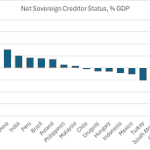
EM is not a monolith. Winners: Brazil, Colombia, Malaysia, Thailand (a surprise to us), China, Pakistan, Peru. Losers: Indonesia, India, Philippines, Turkey, Mexico. Our conclusion: overweight the winners, underweight the losers.
I left Bangkok in 1979, at 13. Today there are no strays and no soldiers behind sandbags at intersections. Rabies deaths fell from 370 in 1980 to 7 in 2025. Life expectancy rose from 61.7 to 77.1 years. Progress is real.
AI isn't only about capex and productivity anymore. AI debt issuance globally in 2026 transcends sovereign issuance. The IMF counted 14 circular-financing deals since 2023: about $300bn of equity and $650bn of debt against roughly $1.4tn of revenue commitments.
Markets were right to ignore geopolitics for years: the oil always got out. Not now. The Gulf closure was a first in its history. And most participants forget there's always a "grown up" table, and that part of every side's agenda is propaganda.
For the first time, some participants in Europe are wondering whether they have vassal status. That's hard for them to accept, given their information diet.
The denials
At the meetings, the US offered generous advice to China: revalue, then stimulate consumption. Amazing that low inflation is now a bad thing. We think the CNY appreciates anyway, and external surpluses continue indefinitely.
Many EMs won't hike with the Fed. The reason is anchored inflation, not fragile financial systems. Asian inflation has been below US inflation for years, and China's USD bonds trade through Treasuries.
EM bond volatility has been lower than DM bond volatility for several years. The old prior, that EMs are just riskier and pay a higher premium, is out of date.
EM exceptionalism isn't a hot take. It's low government debt, less levered financial institutions, independent central banks and often commodity revenues. The only heterodox part is that it's about EM.
Europe has no fiscal union and no financial union. That invites attack on individual sovereign bond markets. France will have to fix France, not the EU and not the EZ.
Simple heuristic: if your bonds and your currency are both falling, your credibility is being questioned. The US isn't in that box. Europe, Japan and the UK have deeper problems.
The IMF's advice: rebuild fiscal space, keep support temporary and targeted, keep monetary policy data-dependent. That's fiscal dominance, minus the phrase. The advice focused on the “advanced economies”.
G-10 economists live in a world where FX = 1. EM economists know FX ≠ 1. That's why DM models struggled with fiscal dominance: its output is higher yields and a weaker currency, even for a reserve currency.