

Speaker on AI transformation & leadership coherence · Author, The Center of the Compass · Founder, Aretos Advisory · 30 yrs exec leadership
Twin Cities, MN
Joined September 2025
- Tweets72
- Following15
- Followers1
- Likes2






Pinned Tweet
The Center of the Compass arrived at the office this week. Thank you to @naren_amplify at Amplify Publishing, and to early endorsers @CoachGoldsmith, @DavidHorsager and @barbbetts_.
If you lead a team, an organization, or a family, this book is for you. Out in December.

I once hosted a client event in Tucson while news of a divestiture was spreading. Clients were wondering what would happen next, and my team was watching me for cues.
I opened with a joke about the rumor: “By Sunday, half of you might be spun off too!” The room laughed. Then I told them what was true: we were stable, focused, and committed.
If everyone in the room is thinking about the rumor, name it. Then say what is true.
1
1
3
Aretos Advisory works with boards and executive teams on integrations and leadership transitions. aretosadvisory.com

2
Most merger models carry a synergy number, and it is often set before anyone who has to deliver it has seen how the two companies actually run.
The integration team inherits it. Then the work shows where the savings depend on incompatible systems, customers who may leave, and roles that overlap on paper but not in what the people know.
Revisit the number early with the operating leaders in the room. Sort it into savings within reach, savings that depend on a decision, and savings resting on an untested assumption.
1
2
After watching a few longtime leaders retire, one thing always surprises me: how quickly the dust settles. There’s the farewell party, a few nice speeches, and by Monday morning the business has to keep moving.
That’s usually when you find out what kind of leader they were.
The best transitions I’ve seen happen when a leader spent years quietly handing over the reins: explaining why decisions were made, letting others take the heat in tough meetings, and stepping back before they had to.
If your team only succeeds when you’re in the room to steer them, what you have built is a dependency.
1
3
People can handle a heavy stretch when the goal makes sense, the expectations are clear, and they feel seen for the effort. What wears them down is moving goalposts, calls that feel unfair, and workloads nobody could realistically finish.
Energy and morale often get treated as perks. Really, they reflect how the place is run.
The work doesn't have to be easy. It has to be worth it.
This week, ask someone on your team one simple question: “What part of your week gives you energy, and what part drains it?”
3
Aretos Advisory works with boards and executive teams. aretosadvisory.com
2
One of the hardest parts of any restructuring is the stretch between the decision and the announcement. A small group knows what’s coming, and everyone else senses that something is off.
Meetings get moved around, certain people disappear behind closed doors, and routine budget questions go unanswered. People notice all of that.
Leadership can’t share a decision before it is final, but it can reduce the uncertainty by settling three things early: when people will hear and from whom, what managers can say in the meantime, and who takes questions on day one.
The announcement takes a day. The weeks before it are what people remember.
1
3
The framework in my book, The Center of the Compass, gives leaders the high-level questions. At Aretos Advisory, we apply them in detail to the specific problem in front of a company: strategy, transformation, M&A integration, restructuring, leadership strength, AI governance.
Dr. Marshall Goldsmith put his name behind it. Out December 1.

3
This comes from the trust chapter of The Center of the Compass. Trust is the east point of the compass, and the question I come back to is “Have I done what I said I would do?”

2
A leader I advised once told me, “I can talk to you about things I cannot say in my own boardroom.” I have thought about that sentence often.
This leader wanted a place to talk things through and know the conversation would not leave the room. That took two things: I kept what I heard to myself, and I talked a lot less than people expect an outside advisor to.
When executives realized they weren’t going to be interrupted, corrected, or steered toward an answer, they started telling me things they hadn’t said out loud before.
Silence does more work than certainty.
At some point a leader has to talk and give direction, but I also have come to believe trust often runs opposite to how much a leader talks.
People trust the person who lets them finish.
Pay attention this week to how often you finish, or want to finish, someone else’s sentence.
1
4
Aretos Advisory works with executive teams and boards. aretosadvisory.com
A leadership team can leave a room in full agreement and be working on different priorities by Friday.
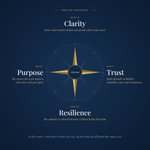
Have everyone write down which of these is weakest right now: clarity, resilience, trust, or purpose. Then compare answers. If everyone names something different, the team isn’t seeing the same problem. If most name the same one, that’s where to start.

1
2
This is from The Center of the Compass, out December 1. Pre-order: ericmahler.com/book
When did being straight with a team about a hard situation make the job easier to carry?

1
Earlier in my career, I was offered the top job in the Kansas City office. It was the lowest-performing unit in the company. It would be a turnaround challenge. The mandate was clear: improve results or the office could be shut down. I said yes without much hesitation.
Morale was low, sales were flat, skepticism was high, and trust was thin. Before I changed anything, I listened. People wanted to be heard. I wanted to understand what the team had been through, so I spent a lot of time with the consultants one-on-one, in small groups, and in branch-wide meetings. I laid out the facts, the wins, the problems, and where we actually stood.
Many of the early questions were hard, negative, and aimed directly at me. I didn’t respond with promises. I told the team what I had heard, what I knew, and what I didn’t. I tried not to commit to anything I wasn’t sure I could deliver. People were already talking about why the office was in trouble, and I wanted them to hear the real version from me.
None of that was comfortable, and I didn’t have all the answers. I found that saying so helped.
The hard questions faded over time and the team got closer. Being open also made the job easier to carry. Once people understand the real situation, they can take on part of it. I brought in leaders to run resource management, delivery, and operations, people who could handle the pressure in their areas and share responsibility for the results. I didn’t have to hold all of it myself.
Within two years, the team had taken Kansas City from the lowest-performing unit in the company to the fastest-growing one. The first signs of improvement weren’t financial. The consultants noticed first. An office that had started with low morale and a lot of skepticism began to feel predictable again. There were fewer surprises, it was clear who owned a problem when something went wrong, and decisions came faster, with the reason explained.
Trust came back before the numbers did.
1
1
Aretos Advisory works with boards and executive teams on AI governance. aretosadvisory.com
The compass gives every leader the same starting questions. Then the situation takes over.
A board overseeing AI asks what decision AI is shaping, who owns it, and how it would know it was wrong.
A new CFO asks who needs to see them do what they said they would, and by when.
After a merger, whose purpose and values does the combined company serve?
In a restructuring, what do leaders absorb, what do managers carry, and what does everyone release?

1
1
From The Center of the Compass. Out Dec 1. Pre-order: ericmahler.com/book
1
Early in my career I handed my manager a report I was proud of. She read it, handed it back and said: “You’re close. But close doesn’t count. Walk me through what you didn’t check.”
No edge, no embarrassment. Just a clear standard.
Credibility comes from consistency. Say what you know, admit what you don’t, then do the work to close the gap.
Next time someone hands you something that looks finished, including an AI-generated summary, ask what they didn’t check.
1
1